 Indietro
Cellular Respiration and Fermentation: Energy Pathways in Biology
Guida di studio - Note intelligenti
 Appunti personalizzati basati sui tuoi materiali, ampliati con definizioni chiave, esempi e contesto.
Energy and Life
Cellular Respiration: The Process of Harvesting Energy
Cellular respiration is a fundamental metabolic pathway that enables cells to extract energy from glucose and other food molecules. This process is essential for life, as it produces ATP, the energy currency of the cell, through a series of complex biochemical reactions.
Definition: Cellular respiration is the process by which cells convert glucose and oxygen into ATP, carbon dioxide, and water.
General Equation:
Stages: Cellular respiration occurs in three main stages:
Glycolysis: Occurs in the cytoplasm; breaks down glucose into two molecules of pyruvic acid, producing a small amount of ATP and NADH.
Citric Acid Cycle (Krebs Cycle): Takes place in the mitochondria; further breaks down pyruvic acid, releasing CO2, producing ATP, NADH, and FADH2.
Electron Transport Chain: Located in the inner mitochondrial membrane; uses NADH and FADH2 to generate a large amount of ATP, with water as a byproduct.
Opposite of Photosynthesis: While photosynthesis stores energy in glucose, cellular respiration releases it for cellular use.
Glycolysis
Glycolysis is the first step in cellular respiration, breaking down glucose into pyruvic acid and generating ATP and NADH.
Location: Cytoplasm
Input: Glucose
Output: Pyruvic acid, ATP, NADH
Key Point: Glycolysis does not require oxygen and is the starting point for both aerobic and anaerobic pathways.
Example: During intense exercise, glycolysis provides quick energy to muscle cells.
Citric Acid Cycle (Krebs Cycle)
The citric acid cycle completes the breakdown of pyruvic acid, releasing carbon dioxide and transferring energy to carrier molecules.
Location: Mitochondrial matrix
Input: Pyruvic acid
Output: CO2, ATP, NADH, FADH2
Key Point: Most energy is transferred to NADH and FADH2 for use in the electron transport chain.
Example: The citric acid cycle is central to metabolism, connecting to the breakdown of fats and proteins.
Electron Transport Chain
The electron transport chain is the final stage, producing the majority of ATP by transferring electrons to oxygen.
Location: Inner mitochondrial membrane
Input: NADH, FADH2, O2
Output: ATP, H2O
Key Point: Oxygen is essential as the final electron acceptor; without it, the chain cannot function.
Example: The electron transport chain powers most cellular activities by producing ATP.
Fermentation: Anaerobic Energy Harvesting
Fermentation is an alternative pathway for energy production when oxygen is unavailable. It allows cells to continue producing ATP, though much less efficiently than cellular respiration.
Definition: Fermentation is the anaerobic breakdown of glucose, resulting in limited ATP production and various byproducts.
Key Point: Fermentation regenerates NAD+ so glycolysis can continue.
Types of Fermentation:
Lactic Acid Fermentation: Occurs in muscle cells and bacteria; produces lactic acid. Example: Yogurt and cheese production by bacteria.
Alcohol Fermentation: Occurs in yeast; produces ethanol and CO2. Example: Bread rising and alcoholic beverages.
Comparison Table:
Process | Oxygen Required? | ATP Yield | Byproducts |
|---|---|---|---|
Cellular Respiration | Yes | High | CO2, H2O |
Fermentation | No | Low | Lactic acid or ethanol, CO2 |
Cellular Respiration: The Metabolic Hub
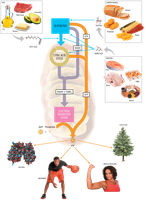
Cellular respiration is central to metabolism, integrating the breakdown of carbohydrates, fats, and proteins to produce ATP. This energy is used for all cellular activities and life processes.
Metabolism: The sum of all chemical reactions in the body; cellular respiration is a key component.
ATP: The universal energy currency; all food energy is converted to ATP.
Food Molecules: Carbohydrates, fats, and proteins enter cellular respiration at different points, contributing to ATP production.
Example: Energy from a meal is used for movement, growth, and maintenance in all organisms.
Additional info: The diagram included visually summarizes how various food sources (carbohydrates, fats, proteins) are funneled into cellular respiration, highlighting the interconnectedness of metabolic pathways and the central role of ATP in powering life processes.
