 Indietro
Cellular Respiration and Fermentation: Energy Production in Cells
Guida di studio - Note intelligenti
 Appunti personalizzati basati sui tuoi materiali, ampliati con definizioni chiave, esempi e contesto.
Cellular Respiration and Fermentation
Overview of Cellular Respiration
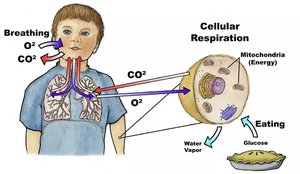
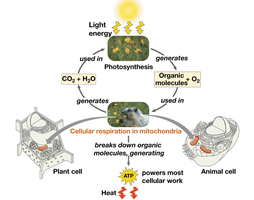
Cellular respiration is a fundamental process by which cells extract energy from organic molecules, primarily glucose, to produce ATP, the energy currency of the cell. This process involves a series of metabolic pathways that occur in different regions of the cell and is essential for both plant and animal life.
Cellular respiration occurs in the mitochondria of eukaryotic cells.
It transforms chemical energy stored in food into ATP, releasing some energy as heat.
Oxygen is required for aerobic respiration, and carbon dioxide is released as a waste product.
Glucose is the primary fuel, but other molecules like fats and proteins can also be used.
ATP produced drives most cellular work.
Fermentation is an alternative pathway that occurs without oxygen.
Redox Reactions in Cellular Respiration
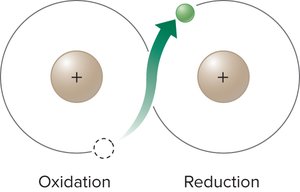
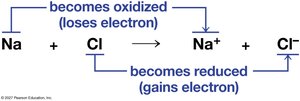
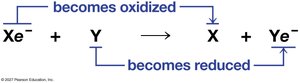
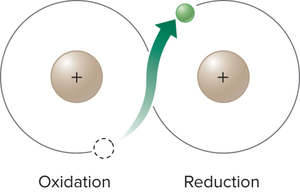
Cellular respiration relies on redox (reduction-oxidation) reactions, which involve the transfer of electrons between molecules. These reactions are central to the release of energy from organic fuels.
Oxidation: Loss of electrons from a molecule.
Reduction: Gain of electrons by a molecule.
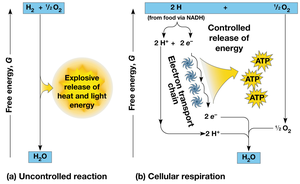
Energy is released as electrons move from high-energy states (in glucose) to lower-energy states (in oxygen).
Dehydrogenation: Loss of hydrogen atoms (electrons and protons) from a molecule.
Decarboxylation: Removal of carbon, releasing CO2.
Electron Carriers and the Electron Transport Chain
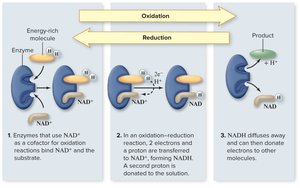
Electron carriers such as NAD+ play a crucial role in cellular respiration by shuttling electrons to the electron transport chain, where most ATP is produced.
NAD+ is a coenzyme that acts as an electron acceptor, becoming NADH when reduced.
Enzymes called dehydrogenases facilitate the transfer of electrons and protons to NAD+.
NADH stores energy and donates electrons to the electron transport chain.
The electron transport chain is located in the inner mitochondrial membrane and consists of a series of protein complexes.
Stages of Cellular Respiration
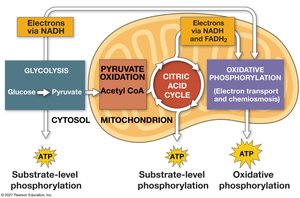
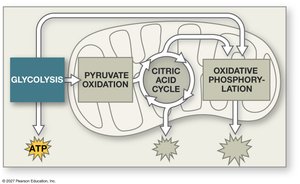
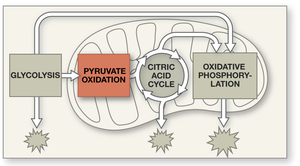
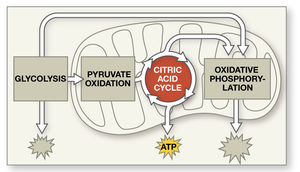
Cellular respiration consists of three main stages: glycolysis, pyruvate oxidation and the citric acid cycle, and oxidative phosphorylation. Each stage occurs in a specific region of the cell and contributes to ATP production.
Glycolysis: Occurs in the cytosol; breaks down glucose into two pyruvate molecules.
Pyruvate Oxidation and Citric Acid Cycle: Occurs in the mitochondria; completes the breakdown of glucose and produces NADH and FADH2.
Oxidative Phosphorylation: Occurs in the mitochondria; uses the electron transport chain and chemiosmosis to produce most ATP.
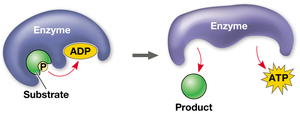
ATP is produced by substrate-level phosphorylation in glycolysis and the citric acid cycle, and by oxidative phosphorylation in the electron transport chain.
Glycolysis: Harvesting Energy from Glucose
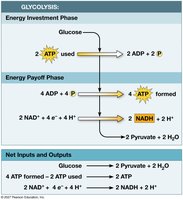
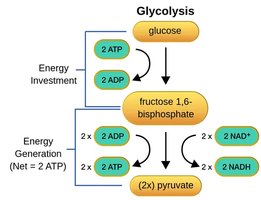
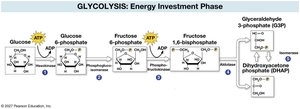
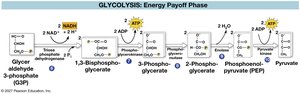
Glycolysis is the first stage of cellular respiration, occurring in the cytoplasm. It consists of two phases: the energy investment phase and the energy payoff phase.
Energy investment phase: 2 ATP are used to split glucose into two three-carbon molecules.
Energy payoff phase: 4 ATP are produced, 2 NAD+ are reduced to NADH, and 2 pyruvate molecules are formed.
Net gain: 2 ATP and 2 NADH per glucose molecule.
Glycolysis does not require oxygen and occurs in all living cells.
Phase | ATP Used | ATP Produced | NADH Produced | Pyruvate Produced |
|---|---|---|---|---|
Energy Investment | 2 | 0 | 0 | 0 |
Energy Payoff | 0 | 4 | 2 | 2 |
Net | -2 | +2 | +2 | +2 |
Pyruvate Oxidation and the Citric Acid Cycle
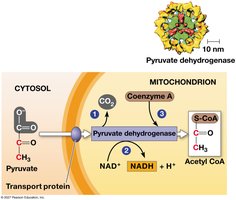
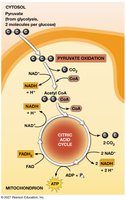
After glycolysis, pyruvate is transported into the mitochondria and converted to acetyl CoA, which enters the citric acid cycle. This cycle completes the oxidation of glucose and produces electron carriers for the electron transport chain.
Pyruvate is oxidized, releasing CO2 and producing NADH and acetyl CoA.
The citric acid cycle (Krebs cycle) generates 1 ATP, 3 NADH, and 1 FADH2 per turn.
Each glucose molecule results in two turns of the cycle.
CO2 is released as a waste product.
NADH and FADH2 carry electrons to the electron transport chain.
Oxidative Phosphorylation and Chemiosmosis
Oxidative phosphorylation is the final stage of cellular respiration, where the electron transport chain and chemiosmosis produce the majority of ATP. Electrons from NADH and FADH2 are transferred through protein complexes, creating a proton gradient that drives ATP synthesis.
Electron transport chain is embedded in the inner mitochondrial membrane.
Electrons are passed through a series of carriers, releasing energy.
Energy is used to pump protons (H+) across the membrane, creating a gradient.
ATP synthase uses the proton gradient to synthesize ATP from ADP and phosphate.
This process is called chemiosmosis.
Up to 32 ATP can be produced per glucose molecule.
Equation for Cellular Respiration:
Summary Equation for Glucose Degradation:
Fermentation and Anaerobic Respiration
When oxygen is unavailable, cells can produce ATP through fermentation or anaerobic respiration. These processes allow glycolysis to continue by regenerating NAD+.
Fermentation: Extension of glycolysis; produces ATP without oxygen.
Alcohol fermentation: Pyruvate is converted to ethanol, releasing CO2.
Lactic acid fermentation: Pyruvate is reduced to lactate; no CO2 released.
Anaerobic respiration: Uses an electron transport chain with a final electron acceptor other than oxygen (e.g., sulfate).
Fermentation produces only 2 ATP per glucose, much less than aerobic respiration.
Catabolic Pathways and Regulation
Cellular respiration is versatile, allowing cells to use carbohydrates, fats, and proteins as fuel. The process is tightly regulated by feedback mechanisms to ensure efficient energy production.
Other food molecules can enter the pathway at different points.
Feedback inhibition regulates key enzymes, such as phosphofructokinase, to control ATP production.
Catabolic pathways funnel electrons from various molecules into cellular respiration.
Key Terms and Concepts
ATP (Adenosine Triphosphate): Main energy carrier in cells.
NAD+ (Nicotinamide Adenine Dinucleotide): Electron carrier, reduced to NADH.
FAD (Flavin Adenine Dinucleotide): Electron carrier, reduced to FADH2.
Substrate-level phosphorylation: Direct transfer of phosphate to ADP by an enzyme.
Oxidative phosphorylation: ATP synthesis powered by the electron transport chain and chemiosmosis.
Glycolysis: Breakdown of glucose to pyruvate.
Citric Acid Cycle (Krebs Cycle): Completes oxidation of glucose, produces electron carriers.
Electron Transport Chain: Series of proteins that transfer electrons and create a proton gradient.
Chemiosmosis: Movement of protons across a membrane to drive ATP synthesis.
Fermentation: Anaerobic process to regenerate NAD+ and produce ATP.
