 Indietro
Chapter 9: Cellular Respiration and Fermentation
Guida di studio - Note intelligenti
 Appunti personalizzati basati sui tuoi materiali, ampliati con definizioni chiave, esempi e contesto.
Introduction to Cellular Energy Production
The process of cellular respiration allows cells to efficiently convert glucose into ATP, while fermentation provides an alternative pathway when oxygen is absent.
Cellular respiration is a multi-step process that consists of four main stages:
Glycolysis: Glucose is broken down into two pyruvate molecules in the cytosol.
Pyruvate Processing: Pyruvate is converted to acetyl-CoA in the mitochondrial matrix (eukaryotes) or cytosol (prokaryotes).
Citric Acid Cycle: Acetyl CoA is oxidized to CO2, and high-energy electron carriers (NADH, FADH2) are produced.
Electron Transport and Oxidative Phosphorylation: Electrons are transferred through the electron transport chain, creating a proton gradient used to synthesize ATP.
Glucose: The Hub of Energy Processing
Glucose is central to cellular metabolism. Plants produce glucose via photosynthesis, while other organisms obtain it from food. Glucose can be stored as glycogen (animals) or starch (plants) and is used as a substrate for ATP production.
Metabolic pathways are classified as:
Catabolic pathways: Break down molecules to harvest energy (e.g., cellular respiration).
Anabolic pathways: Synthesize larger molecules from smaller components, often using ATP.
Cellular respiration interacts with other metabolic pathways, allowing cells to use carbohydrates, fats, and proteins as substrates for energy production.
Metabolism consists of thousands of chemical reactions organized into pathways. Regulation of these pathways maintains homeostasis, ensuring a stable internal environment despite changing conditions.
Discovery and Process of Glycolysis
Glycolysis is a sequence of 10 enzyme-catalyzed reactions occurring in the cytosol. It begins with an energy investment phase, using ATP, and ends with an energy payoff phase, producing ATP and NADH. Glycolysis is regulated by feedback inhibition, primarily at the enzyme phosphofructokinase. High ATP levels inhibit the enzyme, slowing glycolysis when energy is abundant.
Net yield: 2 ATP, 2 NADH, and 2 pyruvate per glucose molecule.
Substrate-level phosphorylation: ATP is produced directly by transferring a phosphate group from a substrate to ADP.
Step 3: Phosphofructokinase: phosphorylates fructose-6-phosphate using ATP
Processing Pyruvate to Acetyl CoA
Mitochondrial Structure and Pyruvate Processing
In eukaryotes, pyruvate enters the mitochondrion, which has inner and outer membranes and a matrix. Pyruvate is processed by pyruvate dehydrogenase to produce acetyl CoA, CO2, and NADH.
Regulation of Pyruvate Processing
Pyruvate dehydrogenase is regulated by phosphorylation. High levels of NADH, acetyl CoA, or ATP increase phosphorylation and inhibit the enzyme, while high levels of ADP, pyruvate, CoA, or NAD+ activate it.
The Citric Acid Cycle: Oxidizing Acetyl CoA to CO2
Citric Acid Cycle Process
The citric acid cycle (Krebs cycle) oxidizes acetyl CoA to CO2 in a cyclic series of reactions. It produces NADH, FADH2, and ATP (or GTP). The cycle turns twice for each glucose molecule. Its regulated by feedback inhibition. High levels of ATP and NADH inhibit the cycle, while low levels stimulate it.
Step | Enzyme | Reaction |
|---|---|---|
1 | Citrate synthase | Transfers acetyl group to oxaloacetate, forming citrate. |
2 | Aconitase | Converts citrate to isocitrate. |
3 | Isocitrate dehydrogenase | Oxidizes isocitrate, produces NADH and CO2. |
4 | α-Ketoglutarate dehydrogenase | Oxidizes α-ketoglutarate, produces NADH and CO2. |
5 | Succinyl-CoA synthetase | Converts succinyl CoA to succinate, produces ATP or GTP. |
6 | Succinate dehydrogenase | Oxidizes succinate, produces FADH2. |
7 | Fumarase | Converts fumarate to malate. |
8 | Malate dehydrogenase | Oxidizes malate, produces NADH. |
Electron Transport and Chemiosmosis
Electron Transport Chain (ETC)
The ETC consists of four protein complexes and two mobile carriers (ubiquinone/Q and cytochrome c). Electrons from NADH and FADH2 are transferred through the chain, releasing energy used to pump protons across the membrane, creating a proton gradient.
Component | Name | Reaction |
|---|---|---|
Complex I | NADH dehydrogenase | Oxidizes NADH, reduces Q, pumps 4 H+. |
Complex II | Succinate dehydrogenase | Oxidizes FADH2, reduces Q. |
Q | Ubiquinone | Transfers electrons between complexes. |
Complex III | Cytochrome c reductase | Oxidizes Q, reduces cytochrome c, pumps 4 H+. |
Cytochrome c | Cytochrome c | Transfers electrons to complex IV. |
Complex IV | Cytochrome c oxidase | Oxidizes cytochrome c, reduces O2 to H2O, pumps 2 H+. |
ATP Synthase and Chemiosmosis
ATP synthase is a protein complex that synthesizes ATP from ADP and inorganic phosphate (Pi) using the energy from the proton gradient. The process is called chemiosmosis, and the energy source is the proton-motive force.
ATP Yield from Cellular Respiration
Cellular respiration produces about 29 ATP per glucose molecule, with most ATP generated by oxidative phosphorylation.
Fermentation Process
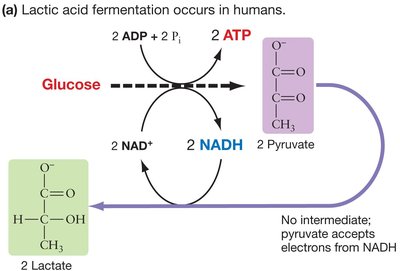
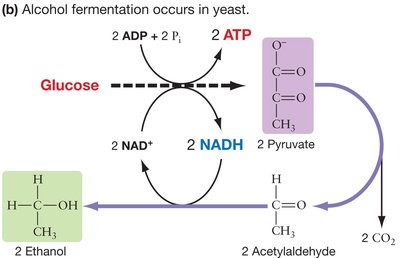
When oxygen is absent, cells use fermentation to regenerate NAD+ from NADH, allowing glycolysis to continue. Fermentation is less efficient than cellular respiration, producing only 2 ATP per glucose.
Lactic acid fermentation: Occurs in muscle cells; pyruvate accepts electrons from NADH, forming lactate and NAD+.
Alcohol fermentation: Occurs in yeast; pyruvate is converted to acetaldehyde and CO2, then acetaldehyde accepts electrons from NADH, forming ethanol and NAD+.
Efficiency and Facultative Anaerobes
Fermentation is much less efficient than cellular respiration. Some organisms, called facultative anaerobes, can switch between fermentation and aerobic respiration depending on oxygen availability.
Summary Table: Comparison of Cellular Respiration and Fermentation
Process | Final Electron Acceptor | ATP Yield (per glucose) | End Products |
|---|---|---|---|
Cellular Respiration (Aerobic) | Oxygen | ~29 | CO2, H2O |
Fermentation (Lactic Acid) | Pyruvate | 2 | Lactate |
Fermentation (Alcohol) | Acetaldehyde | 2 | Ethanol, CO2 |
Additional info: These notes expand on the original content by providing definitions, context, and examples for each process, as well as summarizing key regulatory mechanisms and efficiency comparisons.
