 Indietro
Cellular Respiration and Fermentation: Energy Production in Cells
Guida di studio - Note intelligenti
 Appunti personalizzati basati sui tuoi materiali, ampliati con definizioni chiave, esempi e contesto.
Cellular Respiration and Fermentation
Introduction to Cellular Energy Production
Cells require energy to perform essential functions, and this energy is primarily supplied by ATP (adenosine triphosphate). Metabolic pathways harvest energy from high-energy molecules, such as glucose, to produce ATP. The process of cellular respiration is central to energy production in most organisms, and it involves a series of interconnected biochemical reactions.
ATP fuels cellular work such as movement, synthesis, and transport.
Cells obtain glucose from photosynthesis (plants) or food (other organisms).
Glucose is stored as glycogen (animals) or starch (plants).
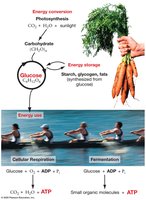
Overview of Cellular Respiration
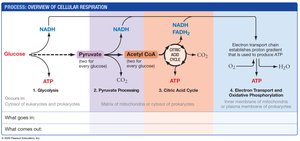
Cellular respiration is a set of four processes that oxidize glucose to produce ATP. It is a fundamental pathway for energy production in both eukaryotic and prokaryotic cells.
Glycolysis: Glucose is broken down into two pyruvate molecules.
Pyruvate Processing: Pyruvate is oxidized to form acetyl CoA.
Citric Acid Cycle: Acetyl CoA is oxidized to CO2.
Electron Transport and Oxidative Phosphorylation: Electrons move through a transport chain, creating a proton gradient used to make ATP.
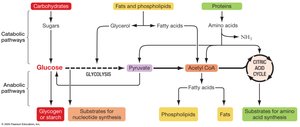
Metabolic Pathways: Catabolic and Anabolic Interactions
Cellular respiration interacts with other metabolic pathways, allowing cells to break down various molecules and synthesize macromolecules.
Catabolic pathways: Breakdown of molecules to harvest energy (e.g., carbohydrates, fats, proteins).
Anabolic pathways: Synthesis of larger molecules using energy from ATP.
Fats are broken down into glycerol (enters glycolysis) and fatty acids (converted to acetyl CoA).
Proteins are broken down into amino acids, which are processed and enter glycolysis or the citric acid cycle.
Intermediates from cellular respiration are used to synthesize nucleotides, fatty acids, amino acids, and glucose.
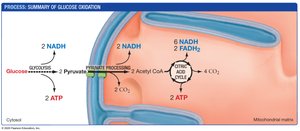
Four Steps of Cellular Respiration
Glycolysis
Glycolysis is a sequence of 10 reactions occurring in the cytosol, where glucose is oxidized to pyruvate. It consists of two phases: energy investment and energy payoff.
Energy investment phase: Uses 2 ATP (reactions 1–5).
Energy payoff phase: Produces 2 NADH, 2 ATP (by substrate-level phosphorylation), and 2 pyruvate (reactions 6–10).
Net yield: 2 NADH, 2 ATP, 2 pyruvate per glucose.
Processing Pyruvate to Acetyl CoA
Pyruvate produced by glycolysis is transported into mitochondria (eukaryotes) or remains in the cytosol (prokaryotes). It is processed by pyruvate dehydrogenase to produce acetyl CoA, CO2, and NADH.
Occurs in the mitochondrial matrix (eukaryotes).
One carbon is oxidized to CO2, NADH is produced, and the remaining two-carbon unit is attached to coenzyme A.
The Citric Acid Cycle
The citric acid cycle (Krebs cycle) oxidizes acetyl CoA to CO2 in a series of eight enzymatic rea1ctions. It occurs in the mitochondrial matrix (eukaryotes) or cytosol (prokaryotes).
Each acetyl CoA is oxidized to two CO2.
Reduces three NAD+ to NADH, one FAD to FADH2, and phosphorylates ADP (or GDP) to ATP (or GTP).
The cycle turns twice for each glucose molecule.
Electron Transport Chain and Oxidative Phosphorylation
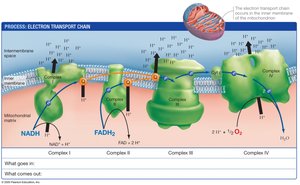
The electron transport chain (ETC) is a series of protein complexes and molecules embedded in the inner mitochondrial membrane. It oxidizes NADH and FADH2, transferring electrons to oxygen and pumping protons to create a proton gradient.
Electrons are transferred through complexes I-IV, with ubiquinone (Q) and cytochrome c as carriers.
Low-energy electrons are passed to oxygen, forming water.
The energy released is used to pump protons into the intermembrane space.
ATP Synthase and Proton-Motive Force
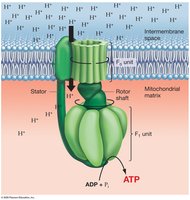
ATP synthase is a complex enzyme that synthesizes ATP using the energy from the proton gradient created by the ETC. It consists of two main units: F1 (ATPase knob) and F0 (membrane-bound base).
Protons flow through F0, causing it to rotate.
The rotation changes the conformation of F1, enabling phosphorylation of ADP to ATP.
This process is called oxidative phosphorylation.
ATP Yield from Cellular Respiration
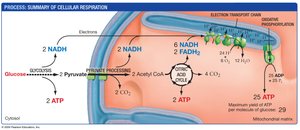
Most ATP is produced during oxidative phosphorylation, with a maximum yield of about 29 ATP per glucose molecule. Substrate-level phosphorylation during glycolysis and the citric acid cycle produces a smaller amount of ATP.
Glycolysis: 2 ATP
Citric Acid Cycle: 2 ATP
Oxidative Phosphorylation: ~25 ATP
Total: ~29 ATP per glucose
Summary Table: Steps of Cellular Respiration
Step | Main Inputs | Main Outputs | Location |
|---|---|---|---|
Glycolysis | Glucose, 2 ATP | 2 Pyruvate, 2 NADH, 2 ATP | Cytosol |
Pyruvate Processing | 2 Pyruvate | 2 Acetyl CoA, 2 NADH, 2 CO2 | Mitochondrial matrix |
Citric Acid Cycle | 2 Acetyl CoA | 6 NADH, 2 FADH2, 2 ATP, 4 CO2 | Mitochondrial matrix |
Electron Transport Chain & Oxidative Phosphorylation | 10 NADH, 2 FADH2, O2 | ~25 ATP, H2O | Inner mitochondrial membrane |
Key Terms and Concepts
ATP (Adenosine Triphosphate): The primary energy currency of the cell.
Glycolysis: The breakdown of glucose to pyruvate in the cytosol.
Pyruvate Processing: Conversion of pyruvate to acetyl CoA.
Citric Acid Cycle: Oxidation of acetyl CoA to CO2 and reduction of electron carriers.
Electron Transport Chain: Series of protein complexes that transfer electrons and pump protons.
Oxidative Phosphorylation: ATP synthesis driven by the proton gradient.
Substrate-Level Phosphorylation: Direct transfer of a phosphate group to ADP to form ATP.
Proton-Motive Force: The electrochemical gradient of protons across the mitochondrial membrane.
Homeostasis: Regulation of internal conditions to maintain stability.
Important Equations
The overall equation for cellular respiration is:
ATP synthesis by oxidative phosphorylation:
Additional info:
These notes expand on the brief points in the original materials, providing context and definitions for key terms, and organizing the content into a logical structure suitable for exam preparation in a General Biology course.
