 Indietro
Cellular Respiration and Fermentation: Energy Transformation in Biological Systems
Guida di studio - Note intelligenti
 Appunti personalizzati basati sui tuoi materiali, ampliati con definizioni chiave, esempi e contesto.
Cellular Respiration and Fermentation
Energy Transformation in Cells
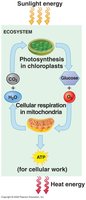
Cellular respiration and fermentation are fundamental processes by which cells extract energy from food molecules. These processes are central to metabolism and are tightly linked to photosynthesis in the energy flow of ecosystems.
Photosynthesis converts sunlight into chemical energy stored in glucose.
Cellular respiration transfers chemical energy in glucose to ATP, releasing heat.
Fermentation allows ATP production in the absence of oxygen by regenerating NAD+.
Macromolecules and Energy
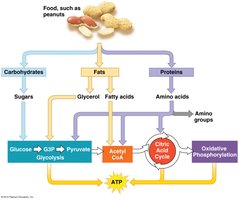
Food contains macromolecules (carbohydrates, fats, proteins) that are broken down into subunits, which are used to build new molecules and release energy for cellular work.
Carbohydrates are broken down into sugars.
Fats are broken into glycerol and fatty acids.
Proteins are deaminated to amino acids.
All subunits can enter cellular respiration pathways to produce ATP.
Breathing and Cellular Respiration
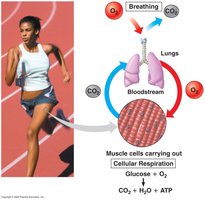
Breathing supplies oxygen for cellular respiration and removes carbon dioxide, linking the respiratory system to cellular energy production.
O2 is required for aerobic respiration.
CO2 is a waste product of cellular respiration.
Glucose is the primary fuel, but other molecules can also be used.
Overview of Cellular Respiration
Summary Equation and Redox Reactions
Cellular respiration is a series of redox reactions that transfer electrons and release energy from glucose, which is used to synthesize ATP.
Summary equation:
Oxidation: loss of electrons; Reduction: gain of electrons.
Electron transfer releases energy for ATP synthesis.

Redox Reactions and ATP Generation
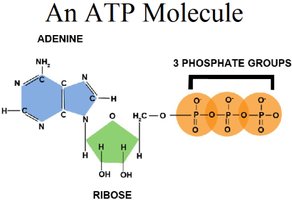
Redox reactions involve the transfer of electrons between molecules, driving the formation of ATP. ATP is the cell's energy currency, storing energy in high-energy phosphate bonds.
Oxidation: loss of electrons (and often hydrogen).
Reduction: gain of electrons (and often hydrogen).
ATP consists of adenine, ribose, and three phosphate groups.
Energetic Coupling
Energetic coupling links exergonic (energy-releasing) and endergonic (energy-requiring) reactions. Redox reactions are key examples, commonly seen in cellular respiration and metabolism.
Tracking Redox in Biological Systems
Electrons are often accompanied by protons (hydrogen atoms) in biological redox reactions. The movement of hydrogen atoms helps track where oxidation and reduction occur.
Reducing agent: electron donor, becomes oxidized.
Oxidizing agent: electron acceptor, becomes reduced.
Redox and Electron Sharing
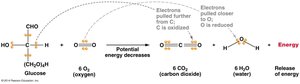
Some redox reactions involve shifts in electron sharing within covalent bonds. Oxygen, being highly electronegative, pulls electrons closer, releasing energy.
Example: NAD+ to NADH
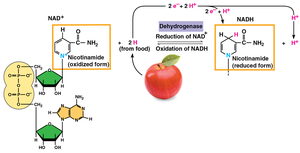
NAD+ is reduced to NADH, which acts as an electron carrier and provides reducing power for cellular reactions.
NADH donates electrons to other molecules.
Derived from vitamin B3 (niacin).
Glucose Oxidation
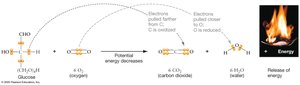
During cellular respiration, carbon in glucose is oxidized to CO2, and oxygen is reduced to H2O. Energy released drives ATP synthesis.
ADP + Pi → ATP
Controlled redox reactions ensure efficient energy capture.
Steps of Cellular Respiration
Three Main Steps
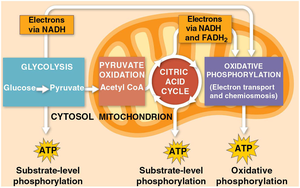
Cellular respiration occurs in three main stages, each contributing to ATP production.
Glycolysis: Glucose → pyruvate, some ATP produced.
Pyruvate oxidation & Citric acid cycle: Pyruvate → acetyl-CoA → CO2, some ATP produced.
Electron transport & chemiosmosis: Reduced compounds are oxidized, producing most ATP.
Glycolysis Overview
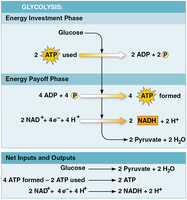
Glycolysis occurs in the cytoplasm and consists of two phases: energy investment and energy payoff. It results in a net gain of 2 ATP via substrate-level phosphorylation.
Energy investment: 2 ATP used to split glucose.
Energy payoff: 4 ATP made, 2 NAD+ reduced to NADH, 2 pyruvate + 2 H2O formed.
Energy Investment Phase
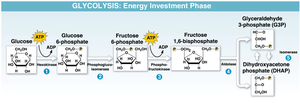
During the energy investment phase, glucose is phosphorylated twice, producing fructose-1,6-bisphosphate.
2 ATP are used.
Glucose is converted to fructose-1,6-bisphosphate.
Energy Payoff Phase
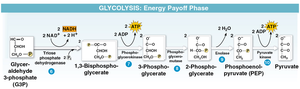
The energy payoff phase produces 2 pyruvate molecules, 2 NADH, and 4 ATP (net gain: 2 ATP).
2 NAD+ are reduced to 2 NADH.
4 ATP produced by substrate-level phosphorylation.
Substrate-Level Phosphorylation
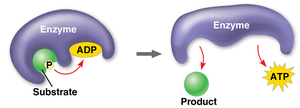
Substrate-level phosphorylation occurs in glycolysis and the citric acid cycle, where an enzyme transfers a phosphate group directly from a substrate to ADP, forming ATP.
Differs from oxidative phosphorylation, which uses the electron transport chain.
Pyruvate Processing and Citric Acid Cycle
Pyruvate Processing
Pyruvate from glycolysis is transported into the mitochondrial matrix and converted to acetyl-CoA by pyruvate dehydrogenase.
1 CO2 released per pyruvate.
1 NADH produced per pyruvate.
Regulation: inhibited by high ATP, stimulated by high CoA or NAD+, or low ATP.
Citric Acid Cycle
The citric acid cycle completes glucose oxidation, producing CO2, NADH, FADH2, and ATP (via GTP intermediate). It is regulated by feedback inhibition and requires O2 indirectly.
Cycle runs twice per glucose.
Outputs: CO2, NADH, FADH2, ATP.
Electron Transport Chain and Chemiosmosis
Electron Transport Chain (ETC)
The ETC is located in the inner mitochondrial membrane and consists of four large protein complexes and mobile electron carriers. NADH and FADH2 donate electrons, which move downhill in energy, ending with O2 as the final electron acceptor.
Proton Gradient and Proton-Motive Force
Energy released by electron transfer is used to pump protons across the membrane, creating an electrochemical gradient (proton-motive force).
Chemiosmosis and Oxidative Phosphorylation
Protons flow down their gradient through ATP synthase, driving ATP production from ADP + Pi. This process is called oxidative phosphorylation.
ATP Yield and Metabolic Control
ATP Yield from Glucose Oxidation
Most ATP (26–28 of 30–32 total) comes from oxidative phosphorylation. The efficiency of ATP production depends on the entry point of electrons from NADH or FADH2.
Catabolic Pathways and Metabolic Control
Glycolysis accepts many carbohydrates, proteins are deaminated, and fats are broken into components that enter respiration. Feedback inhibition regulates enzyme activity and prevents wasteful production.
Low ATP stimulates respiration.
High ATP inhibits respiration.
ATP Production Without Oxygen: Fermentation
Fermentation Pathways
Cells lacking oxygen produce less ATP. Glycolysis can continue without oxygen if NAD+ is regenerated by fermentation.
Alcohol fermentation: Pyruvate is converted to acetaldehyde and CO2, then to ethanol and NAD+.
Lactic acid fermentation: Pyruvate is reduced directly to lactate.
Evolutionary Significance of Glycolysis
Ancient Metabolic Pathway
Glycolysis is the most widespread metabolic pathway on Earth, likely used by early prokaryotes before oxygen was present. It serves as a central hub connecting catabolic and anabolic pathways.
