Indietro
Cellular Respiration and Fermentation: Mechanisms of ATP Production
Guida di studio - Note intelligenti
 Appunti personalizzati basati sui tuoi materiali, ampliati con definizioni chiave, esempi e contesto.
Cellular Respiration and Fermentation
Overview of Cellular Respiration
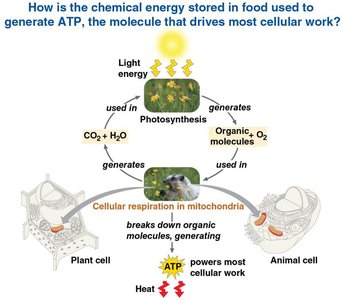
Cellular respiration is the process by which cells extract energy from organic molecules and use it to generate ATP, the main energy currency of the cell. This process occurs in both plant and animal cells and involves a series of metabolic pathways that break down glucose and other fuels in the presence or absence of oxygen.
ATP (Adenosine Triphosphate): The molecule that powers most cellular work.
Cellular Respiration: Occurs mainly in mitochondria, transforming chemical energy in food into ATP, with some energy lost as heat.
Photosynthesis and Respiration: Photosynthesis stores energy in organic molecules, while cellular respiration releases that energy for cellular work.
Catabolic Pathways and ATP Production
Catabolic pathways break down complex molecules into simpler ones, releasing stored energy. This energy is harnessed to produce ATP through various mechanisms.
Fermentation: Partial degradation of sugars without oxygen.
Aerobic Respiration: Consumes organic molecules and oxygen, yielding ATP.
Anaerobic Respiration: Similar to aerobic but uses electron acceptors other than oxygen.
General Equation for Glucose Catabolism:

The Principle of Redox
Redox Reactions in Cellular Respiration
Redox (oxidation-reduction) reactions are central to energy transfer in cells. These reactions involve the transfer of electrons from one molecule to another, releasing energy that can be used to synthesize ATP.
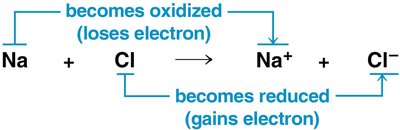
Oxidation: Loss of electrons from a substance.
Reduction: Gain of electrons by a substance.
Redox Reaction Example: Sodium (Na) is oxidized, and chlorine (Cl) is reduced in the formation of NaCl.
Generalized Redox Reaction:
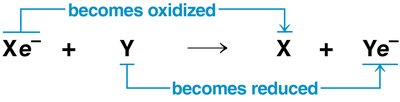
In biological systems, redox reactions often involve changes in electron sharing in covalent bonds, especially with oxygen due to its high electronegativity.
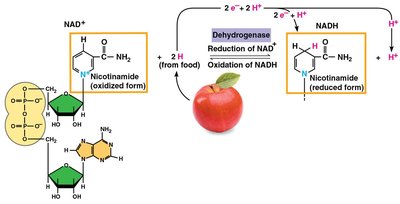
Electron Carriers: NAD+ and FAD
During cellular respiration, electrons from organic molecules are usually transferred to electron carriers such as NAD+ (nicotinamide adenine dinucleotide) and FAD (flavin adenine dinucleotide).
NAD+: Functions as an oxidizing agent, accepting electrons and becoming NADH.
NADH: Represents stored energy used to generate ATP.
Stages of Cellular Respiration
Three Main Stages
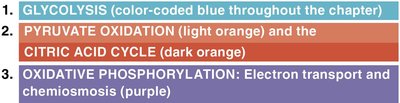
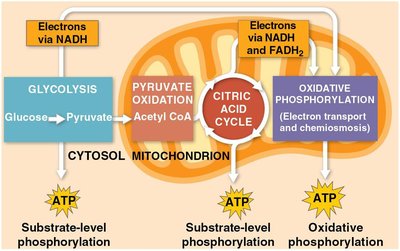
Cellular respiration consists of three main stages, each with distinct roles in energy extraction from glucose:
Glycolysis: Breaks down glucose into two molecules of pyruvate in the cytoplasm.
Pyruvate Oxidation and Citric Acid Cycle: Completes the breakdown of glucose to CO2 in the mitochondrial matrix.
Oxidative Phosphorylation: Electron transport chain and chemiosmosis generate most of the cell’s ATP.
ATP Synthesis Mechanisms
Oxidative Phosphorylation: Powered by redox reactions in the electron transport chain, produces most ATP.
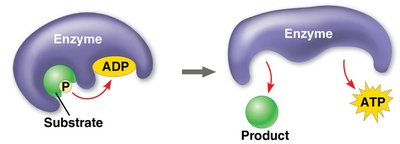
Substrate-Level Phosphorylation: Enzyme transfers a phosphate group directly from a substrate to ADP, forming ATP.
Glycolysis
Process and Phases
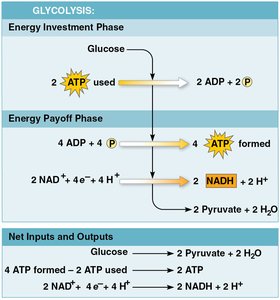
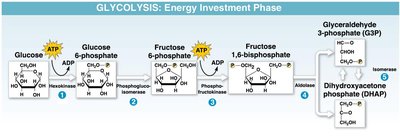
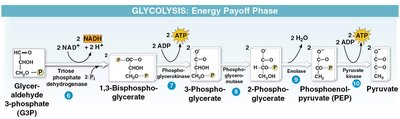
Glycolysis is the first step in cellular respiration, occurring in the cytoplasm. It splits glucose into two pyruvate molecules through two phases:
Energy Investment Phase: 2 ATP are used to phosphorylate glucose and its intermediates.
Energy Payoff Phase: 4 ATP are produced (net gain of 2 ATP), 2 NAD+ are reduced to NADH, and 2 pyruvate are formed.
Pyruvate Oxidation
Conversion to Acetyl CoA
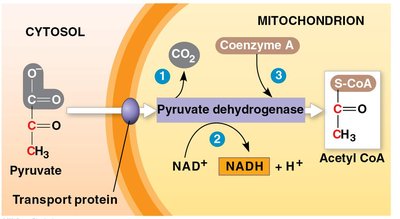
Before entering the citric acid cycle, pyruvate is transported into the mitochondrion and converted to acetyl coenzyme A (acetyl CoA) by the pyruvate dehydrogenase complex.
Carboxyl group is removed as CO2.
NAD+ is reduced to NADH.
Remaining two-carbon fragment is attached to coenzyme A, forming acetyl CoA.
The Citric Acid Cycle (Krebs Cycle)
Cycle Steps and Outputs
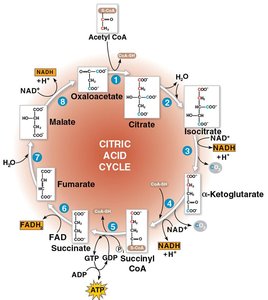
The citric acid cycle completes the breakdown of glucose by oxidizing acetyl CoA to CO2. It occurs in the mitochondrial matrix and consists of eight enzyme-catalyzed steps.
Acetyl group combines with oxaloacetate to form citrate.
Citrate is progressively oxidized, regenerating oxaloacetate.
Produces NADH and FADH2 (electron carriers), ATP (by substrate-level phosphorylation), and CO2.
Oxidative Phosphorylation
Electron Transport Chain (ETC)
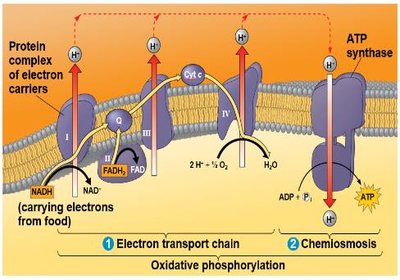
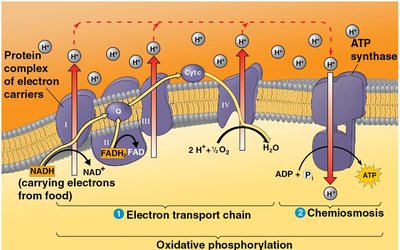
The electron transport chain is a series of protein complexes embedded in the inner mitochondrial membrane. NADH and FADH2 donate electrons, which are passed through the chain to oxygen, the final electron acceptor, forming water.
Electrons move through carrier proteins, including cytochromes.
Energy released is used to pump H+ ions across the membrane, creating a proton gradient.
Chemiosmosis and ATP Synthase
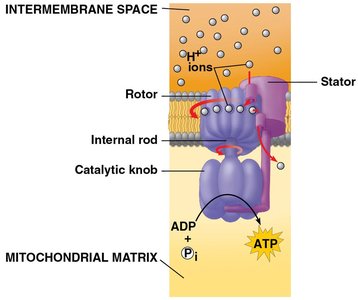
Chemiosmosis is the process by which the energy stored in the proton gradient is used to drive ATP synthesis. H+ ions flow back into the mitochondrial matrix through ATP synthase, a molecular machine that catalyzes the phosphorylation of ADP to ATP.
Proton-Motive Force: The H+ gradient across the membrane, which drives ATP synthesis.
ATP Yield from Cellular Respiration
ATP Accounting
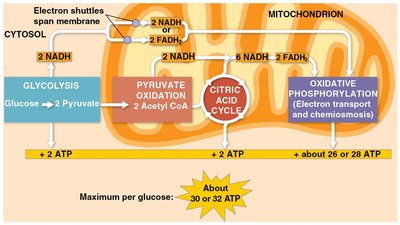
Most ATP is produced during oxidative phosphorylation. The theoretical maximum yield from one molecule of glucose is about 30–32 ATP, though actual yield may vary.
Glycolysis: 2 ATP (net), 2 NADH
Citric Acid Cycle: 2 ATP, 6 NADH, 2 FADH2
Oxidative Phosphorylation: About 26–28 ATP
Versatility of Catabolism
Other Fuels in Cellular Respiration
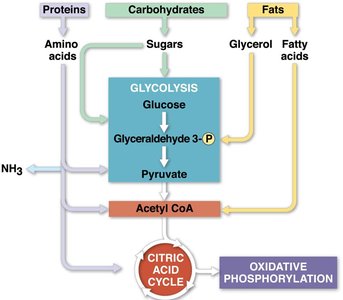
Cells can use proteins, fats, and carbohydrates as fuel for cellular respiration. These molecules enter the pathway at various points after being converted to intermediates.
Proteins: Digested to amino acids, deaminated, and fed into glycolysis or the citric acid cycle.
Fats: Broken down to glycerol (enters glycolysis) and fatty acids (converted to acetyl CoA by beta oxidation).
Fats yield more than twice as much ATP per gram as carbohydrates.
Regulation of Cellular Respiration
Feedback Mechanisms
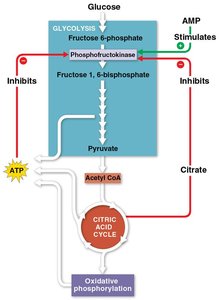
Cellular respiration is tightly regulated by feedback inhibition to maintain energy balance. Key enzymes are regulated by the levels of ATP and other metabolites.
High ATP: Inhibits key enzymes, slowing respiration.
Low ATP: Stimulates respiration to produce more ATP.
Phosphofructokinase: A major regulatory enzyme in glycolysis, inhibited by ATP and citrate, stimulated by AMP.