 Indietro
Cellular Respiration and Fermentation: Mechanisms of Energy Production in Cells
Guida di studio - Note intelligenti
 Appunti personalizzati basati sui tuoi materiali, ampliati con definizioni chiave, esempi e contesto.
Cellular Respiration and Fermentation
Overview of Energy Flow in Ecosystems
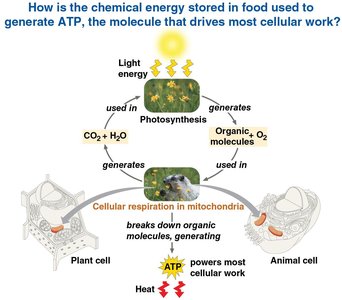
Energy enters ecosystems as light and is transformed by photosynthesis and cellular respiration. Photosynthesis converts carbon dioxide and water into organic molecules and oxygen, while cellular respiration breaks down these molecules to generate ATP, the energy currency of cells.
Photosynthesis: Uses CO2 and H2O to produce organic molecules and O2.
Cellular Respiration: Uses O2 and organic molecules to produce ATP, CO2, and H2O.
ATP: Powers most cellular work; energy exits as heat.
Catabolic Pathways and ATP Production
Catabolic pathways release stored energy by breaking down complex molecules. Cellular respiration is a catabolic pathway that produces ATP through oxidation of organic fuels.
Fermentation: Partial degradation of sugars without oxygen.
Aerobic Respiration: Consumes organic molecules and oxygen, yielding ATP.
Anaerobic Respiration: Uses electron acceptors other than oxygen.
General Equation:

Redox Reactions in Cellular Respiration
Oxidation and Reduction
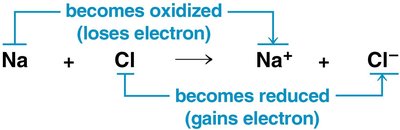
Redox reactions involve the transfer of electrons between reactants. Oxidation is the loss of electrons, while reduction is the gain of electrons. These reactions are central to energy release in cellular respiration.
Oxidation: Loss of electrons from a substance.
Reduction: Gain of electrons to a substance.
Redox Example: Sodium becomes oxidized, chlorine becomes reduced.
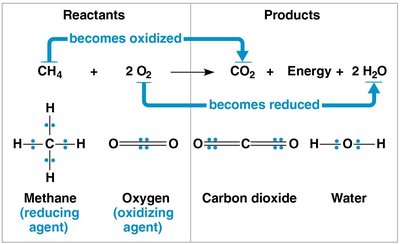
Some redox reactions involve changes in electron sharing in covalent bonds, such as in methane oxidation.
Energy Release in Redox Reactions
Electrons moving toward more electronegative atoms (like oxygen) release energy, which is harnessed to produce ATP.
Cellular Respiration: Fuel molecules are oxidized, O2 is reduced.
Organic Molecules: Abundant hydrogen makes them excellent sources of high-energy electrons.
Electron Carriers and Stepwise Energy Harvest
NAD+ and NADH
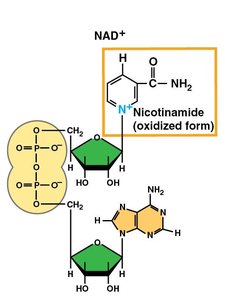
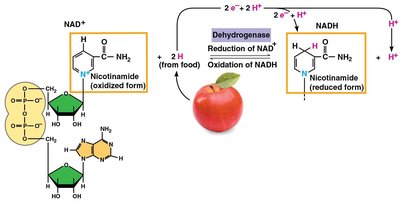
Nicotinamide adenine dinucleotide (NAD+) is a coenzyme that acts as an electron carrier. It accepts electrons during oxidation reactions, becoming NADH, which stores energy for ATP synthesis.
NAD+: Oxidizing agent; accepts electrons.
NADH: Reduced form; stores energy.
Electron Transport Chain (ETC)
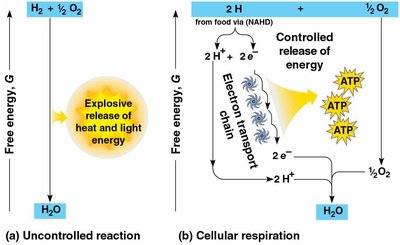
Electrons are transferred stepwise through the ETC, preventing explosive energy release and allowing controlled ATP production.
ETC: Series of protein complexes in the inner mitochondrial membrane.
Energy Release: Used to pump H+ ions and create a gradient.
Stages of Cellular Respiration
Glycolysis
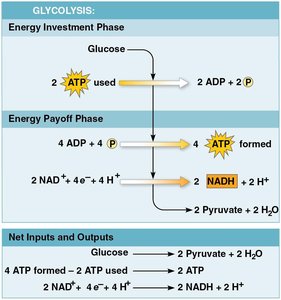
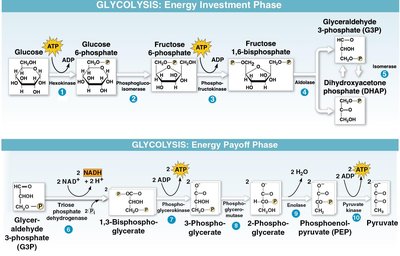
Glycolysis occurs in the cytoplasm and splits glucose into two pyruvate molecules, generating a net yield of 2 ATP and 2 NADH per glucose.
Location: Cytoplasm
Products: 2 ATP, 2 NADH, 2 pyruvate
Phases: Energy investment and energy payoff
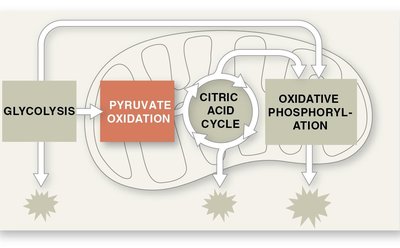
Pyruvate Oxidation
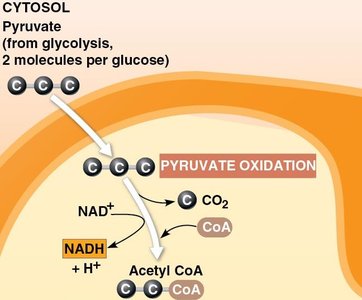
Pyruvate is transported into the mitochondrion and converted to acetyl CoA, producing NADH and CO2.
Enzyme: Pyruvate dehydrogenase
Steps: Removal of CO2, oxidation to acetate, combination with CoA
Citric Acid Cycle (Krebs Cycle)
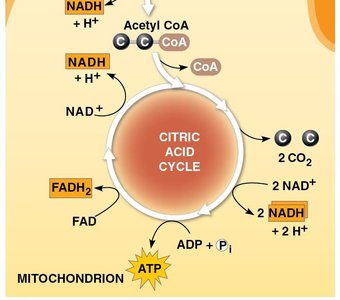
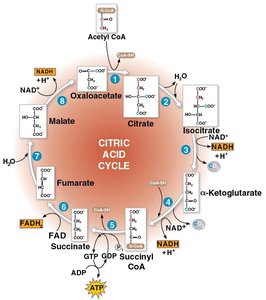
The citric acid cycle completes the oxidation of acetyl CoA, generating ATP, NADH, FADH2, and CO2 as waste.
Location: Mitochondrial matrix
Products per glucose: 2 ATP, 6 NADH, 2 FADH2, 4 CO2
Cycle: Acetyl group combines with oxaloacetate to form citrate; citrate is decomposed back to oxaloacetate.
Oxidative Phosphorylation
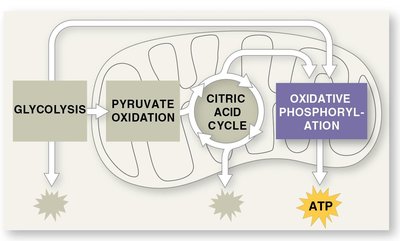
Oxidative phosphorylation includes the electron transport chain and chemiosmosis, producing most of the cell's ATP.
Location: Inner mitochondrial membrane
Process: NADH and FADH2 donate electrons to the ETC; energy is used to pump H+ and drive ATP synthesis via ATP synthase.
Fermentation and Anaerobic Respiration
Fermentation
Fermentation allows ATP production without oxygen by regenerating NAD+ through substrate-level phosphorylation.
Alcohol Fermentation: Pyruvate is converted to ethanol; CO2 is released.
Lactic Acid Fermentation: Pyruvate is reduced to lactate; no CO2 released.
ATP Yield: 2 ATP per glucose
Regulation and Evolutionary Significance
Regulation of Cellular Respiration
Cellular respiration is regulated by feedback inhibition, ensuring efficient energy production and preventing waste.
Feedback Inhibition: High ATP slows respiration; low ATP speeds it up.
Enzyme Regulation: Key enzymes are regulated at strategic points.
Evolutionary Significance of Glycolysis
Glycolysis is an ancient metabolic pathway, used by early prokaryotes before oxygen was present in the atmosphere. It remains central to both fermentation and cellular respiration.
Universality: Most widespread metabolic pathway on Earth.
Metabolic Heirloom: Continues to function in modern cells.
Summary Table: Comparison of ATP Production Pathways
Pathway | Glycolysis Used? | Oxidizing Agent | Final Electron Acceptor | ATP Yield |
|---|---|---|---|---|
Aerobic Respiration | Yes | NAD+ | Oxygen | 30–32 ATP |
Anaerobic Respiration | Yes | NAD+ | Inorganic molecule other than oxygen | 30–32 ATP |
Fermentation | Yes | NAD+ | Organic molecule (pyruvate or acetaldehyde) | 2 ATP |
Additional info: These notes expand on the original content by providing definitions, context, and examples for each process, ensuring a comprehensive and self-contained study guide for exam preparation.
