 Indietro
Lecture 13:Cellular Respiration and Fermentation: Mechanisms, Pathways, and Clinical Relevance
Guida di studio - Note intelligenti
 Appunti personalizzati basati sui tuoi materiali, ampliati con definizioni chiave, esempi e contesto.
Cellular Respiration and Fermentation
Overview of Cellular Respiration
Cellular respiration is a fundamental metabolic pathway that enables cells to extract energy from glucose and other organic molecules. It consists of several stages, each contributing to the efficient production of ATP, the cell's energy currency. - Key Point 1: Cellular respiration includes glycolysis, pyruvate oxidation, the citric acid cycle, and oxidative phosphorylation. - Key Point 2: Oxygen is essential for the completion of aerobic respiration, serving as the final electron acceptor in the electron transport chain (ETC). - Example: Glucose breakdown yields up to ~32 ATP molecules per molecule of glucose under aerobic conditions.
Glycolysis
Glycolysis is the first step in cellular respiration, occurring in the cytoplasm. It breaks down glucose into pyruvate, generating ATP and NADH. - Key Point 1: Glycolysis converts one molecule of glucose into two molecules of pyruvate. - Key Point 2: Net production: 2 ATP and 2 NADH per glucose. - Equation:
Pyruvate Oxidation
Pyruvate produced in glycolysis is transported into the mitochondria and oxidized to acetyl CoA, releasing CO2 and generating NADH. - Key Point 1: Each pyruvate yields one acetyl CoA, one NADH, and one CO2. - Equation:
The Citric Acid Cycle (Krebs Cycle)
The citric acid cycle completes the oxidation of glucose derivatives, producing NADH, FADH2, ATP, and CO2. - Key Point 1: Each acetyl CoA enters the cycle, generating 3 NADH, 1 FADH2, 1 ATP, and 2 CO2. - Equation:
Oxidative Phosphorylation and Electron Transport Chain (ETC)
Oxidative phosphorylation is the final stage, where most ATP is produced. The ETC is located in the inner mitochondrial membrane and transfers electrons from NADH and FADH2 to oxygen. - Key Point 1: Electrons are passed through protein complexes (I-IV), ultimately reducing O2 to H2O. - Key Point 2: The ETC does not directly generate ATP; instead, it creates a proton gradient. - Example: Cytochromes, containing iron, are key electron carriers. 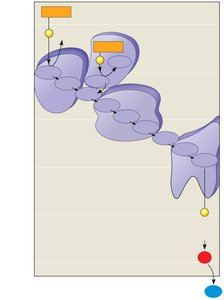
Chemiosmosis and ATP Synthase
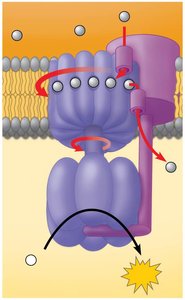
Chemiosmosis is the process by which the energy stored in the proton gradient is used to synthesize ATP. - Key Point 1: The ETC pumps H+ ions into the intermembrane space, creating a proton-motive force. - Key Point 2: ATP synthase allows H+ to flow back into the matrix, driving ATP production. - Equation: 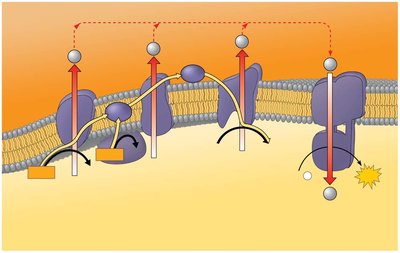
Summary of Cellular Respiration Equations
The overall process of cellular respiration can be summarized by the following equation: - Equation:
Reducing Efficiency and Uncoupling
Uncoupling proteins can dissipate the proton gradient, reducing ATP production and generating heat. - Key Point 1: Uncoupling can be adaptive (e.g., in hibernating animals) or pathological. 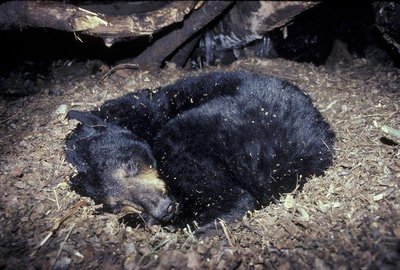
Anaerobic Respiration and Fermentation
When oxygen is unavailable, cells can produce ATP via anaerobic respiration or fermentation. - Key Point 1: Anaerobic respiration uses an alternative electron acceptor (e.g., sulfate). - Key Point 2: Fermentation regenerates NAD+ via substrate-level phosphorylation, allowing glycolysis to continue.
Lactic Acid Fermentation
Lactic acid fermentation occurs in some bacteria, fungi, and human muscle cells. - Key Point 1: Pyruvate is reduced to lactate by NADH, with no CO2 released. - Example: Cheese and yogurt production, and muscle ATP generation during intense exercise. 
Alcohol Fermentation
Alcohol fermentation is performed by yeast and some bacteria. - Key Point 1: Pyruvate is converted to ethanol and CO2 in two steps. - Example: Brewing, winemaking, and baking. 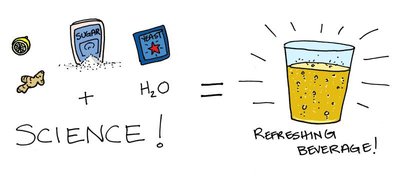
Comparison of Fermentation, Anaerobic, and Aerobic Respiration
All three pathways use glycolysis, but differ in their electron acceptors and ATP yield.
Pathway | Final Electron Acceptor | ATP Yield | Key Features |
|---|---|---|---|
Aerobic Respiration | O2 | ~32 ATP | Complete oxidation, ETC, high efficiency |
Anaerobic Respiration | Other (e.g., sulfate) | Variable | ETC present, less efficient |
Fermentation | Organic molecule (e.g., pyruvate) | 2 ATP | No ETC, substrate-level phosphorylation |
Clinical Case: Mitochondrial Disease
Impairment of the electron transport chain can lead to severe symptoms, including fatigue, lactic acidosis, and ATP deficiency. - Key Point 1: MELAS (Mitochondrial Encephalomyopathy, Lactic Acidosis, and Stroke-like episodes) is a disorder caused by defective ETC complexes. - Key Point 2: NADH accumulates, NAD+ becomes limiting, glycolysis slows, and cells rely on lactic acid fermentation.
ETC Poisons and Their Effects
Certain chemicals can inhibit specific complexes of the ETC, leading to metabolic consequences.
Poison | Target Complex | Predicted Consequences |
|---|---|---|
Cyanide | Complex IV | All ETC carriers remain reduced; NAD+ not regenerated; glycolysis slows; ATP collapse; lactic acidosis |
Rotenone | Complex I | NADH oxidation halted; NAD+ depleted; FADH2 pathway partly compensates; moderate ATP drop |
Antimycin A | Complex III | QH2 accumulates; upstream carriers reduced; partial NAD+ regeneration; ROS buildup; ATP falls |
Oligomycin | ATP Synthase | Proton gradient not relieved; ETC backs up; redox slows; heat generation increases; ATP decreases |
Summary
Cellular respiration is a complex, multi-step process that efficiently converts glucose into ATP. When oxygen is unavailable, cells adapt by using fermentation or anaerobic respiration, though these pathways are less efficient. Clinical cases and poisons highlight the importance of each step in maintaining cellular energy balance. Additional info: The notes expand on brief points with academic context, definitions, and examples to ensure completeness and clarity for exam preparation.
