 Indietro
Cellular Respiration and Fermentation: Pathways of Energy Harvest Part 1
Guida di studio - Note intelligenti
 Appunti personalizzati basati sui tuoi materiali, ampliati con definizioni chiave, esempi e contesto.
Chapter 9: Cellular Respiration and Fermentation
Overview of Cellular Respiration
Cellular respiration is a series of metabolic pathways that extract energy from organic molecules, primarily glucose, to produce ATP, the main energy currency of the cell. This process involves the oxidation of organic fuels and the transfer of electrons, ultimately yielding energy for cellular work.
Photosynthesis uses CO2 and H2O to make organic molecules and O2.
Cellular respiration uses O2 and organic molecules to make ATP, producing CO2 and H2O as waste.
The chemical elements essential to life are recycled between these processes.
Catabolic Pathways and Energy Yield
Catabolic pathways are metabolic processes that release stored energy by breaking down complex molecules such as carbohydrates, fats, and proteins. Cellular respiration is a key catabolic pathway that provides energy for cellular work.
Fermentation: Partial breakdown of sugars without oxygen; yields less ATP.
Aerobic respiration: Complete breakdown of organic molecules using oxygen; yields high ATP.
Anaerobic respiration: Uses electron acceptors other than oxygen (e.g., nitrate, sulfate); performed by some prokaryotes.
General equation for aerobic respiration:
ΔG = −686 kcal/mol: The breakdown of glucose is highly exergonic.
ATP Production and Usage
The main purpose of catabolism is to produce ATP, which powers cellular work such as movement, synthesis, and transport. Cells regenerate ATP from ADP and inorganic phosphate (Pi) in a cyclical process essential for life.
Fuel sources: Carbohydrates, fats, and proteins can all be used, but glucose is the primary model for study.
Stages of Cellular Respiration
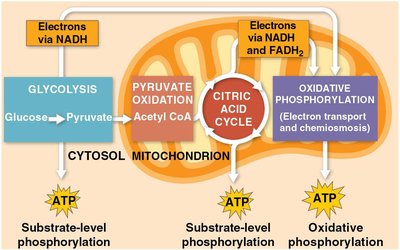
Cellular respiration consists of three main stages:
Glycolysis: Breaks down glucose into two molecules of pyruvate in the cytosol.
Pyruvate oxidation and the citric acid cycle: Completes the breakdown of glucose to CO2 in the mitochondrial matrix (eukaryotes).
Oxidative phosphorylation: Electron transport chain and chemiosmosis synthesize most of the cell’s ATP.
ATP Synthesis Mechanisms
Oxidative phosphorylation: Accounts for ~90% of ATP generated during cellular respiration; occurs in the electron transport chain and chemiosmosis.
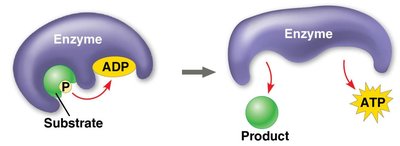
Substrate-level phosphorylation: An enzyme transfers a phosphate group directly from a substrate to ADP, forming ATP; occurs in glycolysis and the citric acid cycle.
Total ATP Yield from One Glucose Molecule
Up to 32 ATP molecules can be produced per glucose, depending on cell type and efficiency.
Most ATP is produced by oxidative phosphorylation; a smaller amount by substrate-level phosphorylation.
Glycolysis
Pathway and Phases
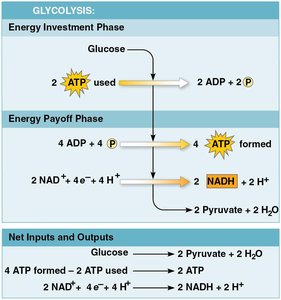
Glycolysis is the first stage of cellular respiration and occurs in the cytoplasm. It splits one glucose molecule (6 carbons) into two pyruvate molecules (3 carbons each) through a series of enzyme-catalyzed reactions. Glycolysis consists of two phases:
Energy investment phase: 2 ATP are used to phosphorylate glucose and its intermediates.
Energy payoff phase: 4 ATP are produced (net gain of 2 ATP), 2 NAD+ are reduced to NADH, and 2 pyruvate and 2 H2O are formed.
Summary of Glycolysis
Net inputs: 1 glucose, 2 ATP, 2 NAD+, 4 ADP + 4 Pi
Net outputs: 2 pyruvate, 2 H2O, 2 ATP (net), 2 NADH + 2 H+
Key Enzymes and Steps
Hexokinase: Converts glucose to glucose-6-phosphate.
Phosphofructokinase: Converts fructose-6-phosphate to fructose-1,6-bisphosphate.
Aldolase: Splits fructose-1,6-bisphosphate into glyceraldehyde-3-phosphate (G3P) and dihydroxyacetone phosphate (DHAP).
x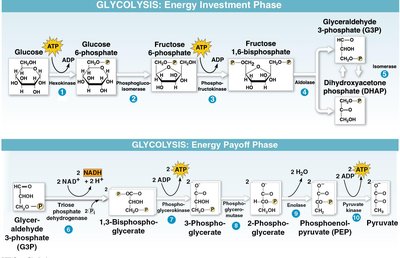
Pyruvate Oxidation and the Citric Acid Cycle
Oxidation of Pyruvate to Acetyl CoA
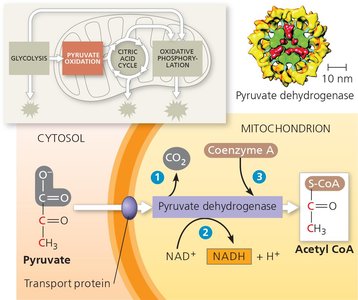
After glycolysis, pyruvate is transported into the mitochondrial matrix (in eukaryotes) and converted to acetyl coenzyme A (acetyl CoA) by the enzyme pyruvate dehydrogenase. This process involves:
Oxidation of pyruvate’s carboxyl group, releasing CO2.
Reduction of NAD+ to NADH.
Attachment of the remaining two-carbon fragment to coenzyme A, forming acetyl CoA.
The Citric Acid Cycle (Krebs Cycle)
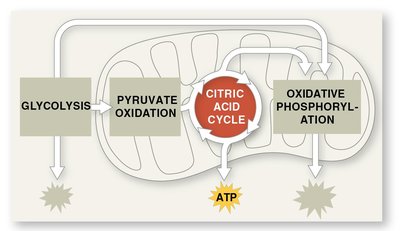
The citric acid cycle completes the oxidation of organic molecules, generating ATP, NADH, and FADH2. It occurs in the mitochondrial matrix and consists of eight enzyme-catalyzed steps. For each acetyl CoA entering the cycle:
1 ATP (or GTP) is produced by substrate-level phosphorylation.
3 NADH and 1 FADH2 are generated as electron carriers.
2 CO2 are released as waste.
Since each glucose yields 2 acetyl CoA, the cycle turns twice per glucose molecule.
Summary Table: Products of Glycolysis and the Citric Acid Cycle (per glucose)
Stage | ATP | NADH | FADH2 | CO2 |
|---|---|---|---|---|
Glycolysis | 2 | 2 | 0 | 0 |
Pyruvate Oxidation | 0 | 2 | 0 | 2 |
Citric Acid Cycle | 2 | 6 | 2 | 4 |
Electron Carriers and the Electron Transport Chain
NADH and FADH2 produced in glycolysis, pyruvate oxidation, and the citric acid cycle carry high-energy electrons to the electron transport chain, where oxidative phosphorylation occurs to generate the majority of ATP.
Electron carriers: NADH and FADH2
Key Concepts and Exam Preparation
Know the main stages of cellular respiration and where they occur in the cell.
Understand the difference between substrate-level and oxidative phosphorylation.
Be able to trace the fate of glucose carbons and electrons through glycolysis, pyruvate oxidation, and the citric acid cycle.
Memorize the net ATP, NADH, and FADH2 yields for each stage.
Recognize the enzymes responsible for key steps in glycolysis and the citric acid cycle.
