 Indietro
Cellular Respiration and Fermentation: Pathways of Energy Harvest
Guida di studio - Note intelligenti
 Appunti personalizzati basati sui tuoi materiali, ampliati con definizioni chiave, esempi e contesto.
Cellular Respiration and Fermentation
Overview of Cellular Respiration
Cellular respiration is a series of metabolic processes that convert the chemical energy in food molecules into ATP, the main energy currency of the cell. This process is essential for both plants and animals and involves the breakdown of glucose and other organic fuels in the presence of oxygen (aerobic respiration) or in its absence (anaerobic respiration and fermentation).
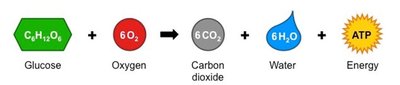
Aerobic respiration uses oxygen to completely oxidize glucose, producing carbon dioxide, water, and ATP.
Fermentation and anaerobic respiration allow ATP production when oxygen is not available, but yield less ATP.
Key Concepts in Cellular Respiration
Redox reactions (reduction-oxidation) are central to energy transfer. Oxidation is the loss of electrons, while reduction is the gain of electrons.
Cells use electron carriers such as NAD+ and FAD to safely transfer high-energy electrons.
Energy is harvested in small, controlled steps to maximize ATP production and minimize energy loss as heat.
Stages of Cellular Respiration
1. Glycolysis
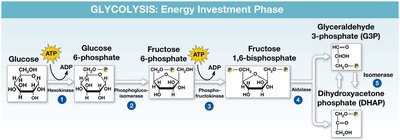
Glycolysis is the first stage of cellular respiration and occurs in the cytosol of all cells. It splits one glucose molecule (6 carbons) into two pyruvate molecules (3 carbons each) through a series of enzyme-catalyzed reactions.
Energy investment phase: 2 ATP are used to phosphorylate glucose, making it more reactive.
Energy payoff phase: 4 ATP and 2 NADH are produced, along with 2 pyruvate and 2 H2O.
Net yield per glucose: 2 ATP, 2 NADH, 2 pyruvate, 2 H2O.
2. Pyruvate Oxidation
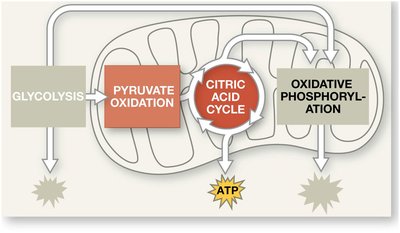
After glycolysis, pyruvate is transported into the mitochondrial matrix (in eukaryotes) where it is converted into acetyl CoA. This step links glycolysis to the citric acid cycle.
Each pyruvate (3C) loses one carbon as CO2 and is oxidized, reducing NAD+ to NADH.
The remaining 2-carbon fragment attaches to coenzyme A, forming acetyl CoA.
Per glucose: 2 NADH and 2 CO2 are produced.
3. Citric Acid Cycle (Krebs Cycle)
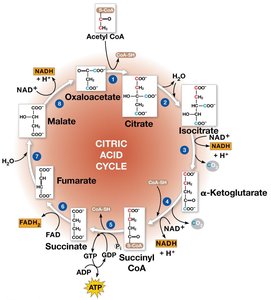
The citric acid cycle completes the breakdown of acetyl CoA into CO2 and transfers high-energy electrons to NAD+ and FAD, forming NADH and FADH2.
Each turn of the cycle (per acetyl CoA) produces: 3 NADH, 1 FADH2, 1 ATP (or GTP), and 2 CO2.
Since each glucose yields 2 acetyl CoA, the cycle runs twice per glucose.
4. Oxidative Phosphorylation
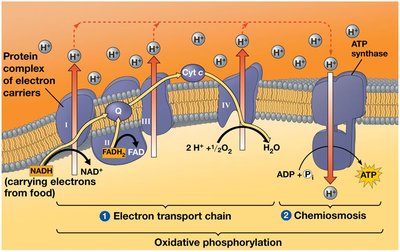
Oxidative phosphorylation is the final stage of cellular respiration and includes the electron transport chain (ETC) and chemiosmosis. It occurs in the inner mitochondrial membrane and produces the majority of ATP.
Electron Transport Chain (ETC): Electrons from NADH and FADH2 are passed through a series of protein complexes, releasing energy used to pump H+ ions across the membrane.
Proton-motive force: The resulting H+ gradient stores potential energy.
ATP synthase: H+ flows back into the matrix through ATP synthase, driving the phosphorylation of ADP to ATP (chemiosmosis).
Oxygen is the final electron acceptor, forming water.
ATP Yield from Cellular Respiration
Complete oxidation of one glucose molecule typically yields about 30–32 ATP in eukaryotic cells.
Most ATP is produced by oxidative phosphorylation; only a small amount is made by substrate-level phosphorylation during glycolysis and the citric acid cycle.
ATP Production without Oxygen
Anaerobic Respiration and Fermentation
When oxygen is not available, cells can still produce ATP through anaerobic pathways:
Anaerobic respiration: Uses an electron transport chain with a final electron acceptor other than oxygen (e.g., sulfate).
Fermentation: Does not use an electron transport chain; ATP is produced only by substrate-level phosphorylation during glycolysis.
Types of Fermentation
Alcohol fermentation: Pyruvate is converted to ethanol and CO2; NADH is oxidized to NAD+ so glycolysis can continue. Used by yeast in brewing and baking.
Lactic acid fermentation: Pyruvate is reduced directly by NADH to form lactate; no CO2 is released. Occurs in muscle cells during intense exercise and in some bacteria.
Comparison of Fermentation, Anaerobic, and Aerobic Respiration
Feature | Fermentation | Anaerobic Respiration | Aerobic Respiration |
|---|---|---|---|
Electron transport chain | No | Yes | Yes |
Final electron acceptor | Organic molecule | Non-oxygen acceptor | Oxygen |
ATP production | Substrate-level phosphorylation | Mostly oxidative phosphorylation | Mostly oxidative phosphorylation |
Relative ATP yield | Lowest | Variable | Usually highest |
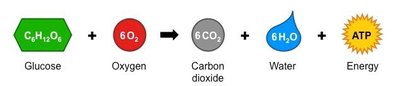
Summary Equation for Aerobic Cellular Respiration
The overall chemical equation for aerobic respiration is:
Key Terms
ATP (Adenosine Triphosphate): The main energy carrier in cells.
NAD+ / NADH: Electron carrier; NAD+ is reduced to NADH during glycolysis and the citric acid cycle.
FAD / FADH2: Electron carrier; FAD is reduced to FADH2 in the citric acid cycle.
Substrate-level phosphorylation: Direct transfer of a phosphate group to ADP to form ATP.
Oxidative phosphorylation: ATP production powered by the transfer of electrons through the ETC and chemiosmosis.
Fermentation: Anaerobic process that regenerates NAD+ for glycolysis by reducing pyruvate.
