 Indietro
Cellular Respiration and Fermentation: Pathways of Energy Transformation
Guida di studio - Note intelligenti
 Appunti personalizzati basati sui tuoi materiali, ampliati con definizioni chiave, esempi e contesto.
Cellular Respiration and Fermentation
Overview of Cellular Respiration
Cellular respiration is the process by which cells convert the chemical energy stored in food molecules into ATP, the energy currency of the cell. This process occurs in both plant and animal cells, primarily within mitochondria, and involves a series of metabolic pathways that break down organic molecules, releasing energy for cellular work. - Key Point 1: Cellular respiration transforms food energy into ATP, with some energy lost as heat. - Key Point 2: The products of photosynthesis (organic molecules and O2) are used in cellular respiration, and vice versa, demonstrating the cyclical nature of matter and energy in biological systems. 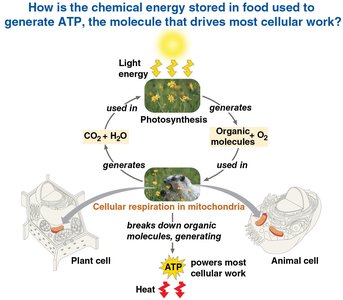
Catabolic Pathways: Types and Overall Reaction
Catabolic pathways break down organic fuels to release energy. There are three main types:
Fermentation: Partial degradation of sugars without oxygen.
Aerobic respiration: Complete breakdown of organic molecules using O2, yielding ATP.
Anaerobic respiration: Similar to aerobic, but uses a final electron acceptor other than O2.
The overall reaction for aerobic cellular respiration is:
Energy Flow: Photosynthesis vs. Cellular Respiration
Photosynthesis: Converts light energy to chemical energy in glucose (endergonic, ΔG > 0). Cellular Respiration: Converts chemical energy in glucose to ATP and heat (exergonic, ΔG < 0).
Process | Summary Reaction | Location | Energy Transformation | Redox |
|---|---|---|---|---|
Photosynthesis | 6 CO2 + 6 H2O + light → C6H12O6 + 6 O2 | Chloroplasts | Light → chemical energy | H2O oxidized, CO2 reduced |
Cellular Respiration | C6H12O6 + 6 O2 → 6 CO2 + 6 H2O + energy | Cytosol & mitochondria | Chemical energy → ATP + heat | Glucose oxidized, O2 reduced |
Redox Reactions in Cellular Respiration
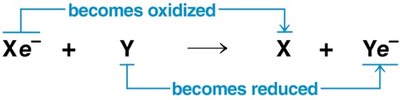
Redox reactions are central to energy transfer in cellular respiration. - Oxidation: Loss of electrons from a substance. - Reduction: Gain of electrons (positive charge is reduced). - Reducing agent: Electron donor; Oxidizing agent: Electron acceptor. 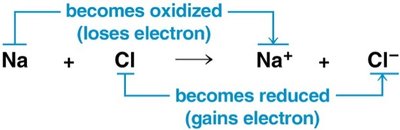

NAD+ and the Electron Transport Chain
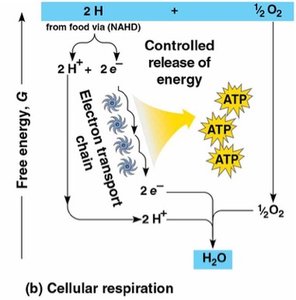
NAD+ is a key electron carrier in cellular respiration. - Key Point: Glucose is oxidized in steps, with electrons transferred to NAD+, forming NADH. - NADH: Stores energy and later donates electrons to the electron transport chain (ETC). 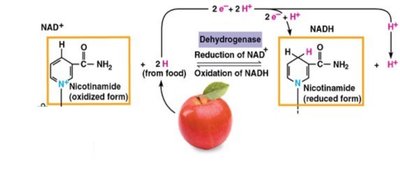
Electron Transport Chain (ETC)
The ETC is a series of molecules in the inner mitochondrial membrane that pass electrons in a stepwise manner, releasing energy gradually. - Key Point: O2 is the final electron acceptor, forming H2O. - Energy released: Used to regenerate ATP. 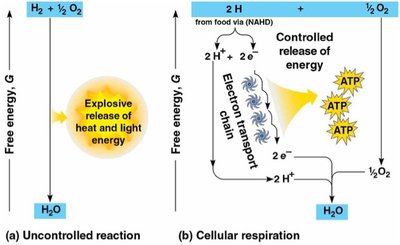
Stages of Cellular Respiration
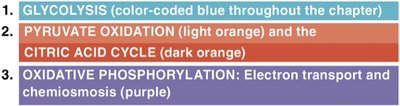
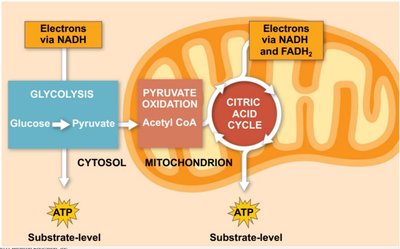
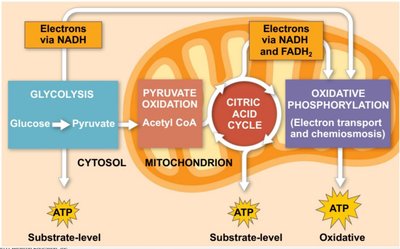
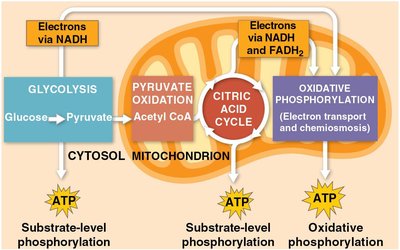
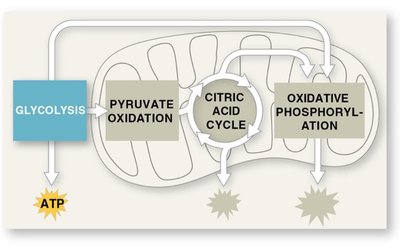
Cellular respiration consists of three main stages:
Glycolysis: Glucose → 2 pyruvate (cytosol)
Pyruvate oxidation & Citric Acid Cycle: Pyruvate → CO2 (mitochondrial matrix)
Oxidative phosphorylation: ETC & chemiosmosis (inner mitochondrial membrane)
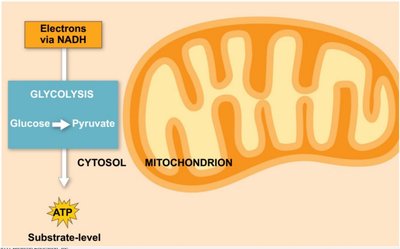
ATP Production: Substrate-Level vs. Oxidative Phosphorylation
- Substrate-level phosphorylation: Enzyme transfers phosphate directly from substrate to ADP (glycolysis, citric acid cycle). - Oxidative phosphorylation: Powered by redox reactions in the ETC, produces most ATP. 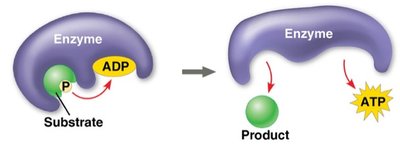
Glycolysis
Location and Phases of Glycolysis
Glycolysis occurs in the cytoplasm and does not require oxygen. It consists of two phases:
Energy investment phase: 2 ATP are used to split glucose.
Energy payoff phase: 4 ATP are produced, 2 NAD+ are reduced to NADH, and 2 pyruvate + 2 H2O are formed.
Net yield: 2 ATP (substrate-level phosphorylation). 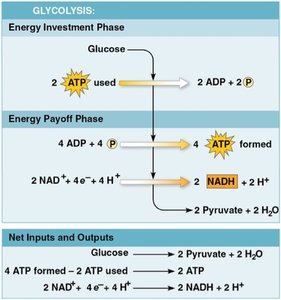
Energy Investment Phase (Steps 1–5)
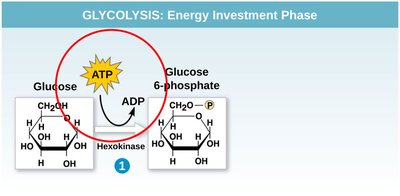
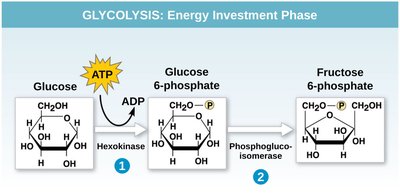
- Step 1: Hexokinase uses ATP to phosphorylate glucose. 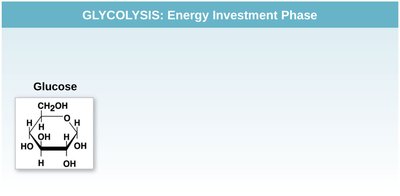
 - Step 2: Glucose 6-phosphate is rearranged to fructose 6-phosphate.
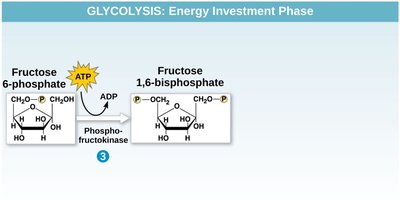
 - Step 3: Phosphofructokinase spends a second ATP.
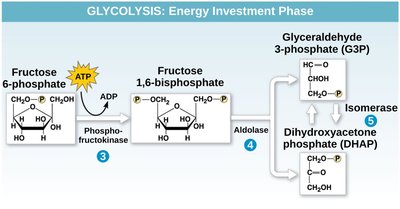
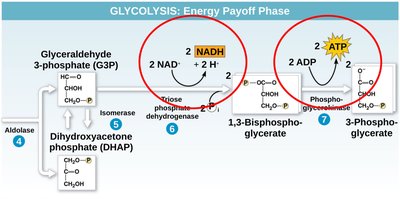
 - Steps 4–5: Aldolase splits the sugar into G3P and DHAP; isomerase converts DHAP to G3P.
Energy Payoff Phase (Steps 6–10)
- Step 6: G3P is oxidized, reducing 2 NAD+ to 2 NADH. 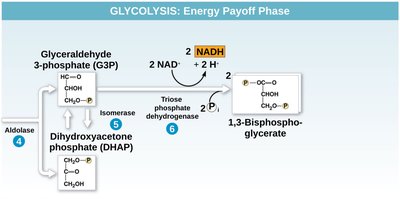 - Step 7: First 2 ATP of the payoff phase are produced.
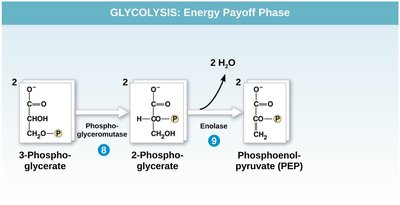
 - Steps 8–9: Rearrangement and loss of water form PEP.
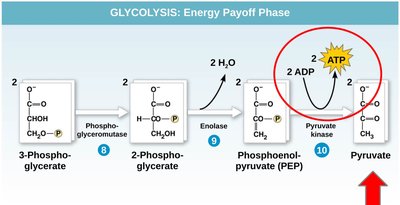
 - Step 10: Pyruvate kinase makes 2 more ATP and pyruvate.
Net Reaction of Glycolysis
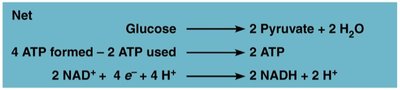
Glucose → 2 pyruvate + 2 H2O
4 ATP formed − 2 ATP used = 2 ATP net
2 NAD+ → 2 NADH
Most energy remains in pyruvate
Pyruvate Oxidation and Citric Acid Cycle
Pyruvate Oxidation
Pyruvate enters the mitochondrion (in eukaryotes) if O2 is present, where it is converted to acetyl CoA, linking glycolysis to the citric acid cycle. - Key Steps: 1. Carboxyl group is oxidized, releasing CO2. 2. NAD+ is reduced to NADH. 3. 2-carbon fragment joins coenzyme A. 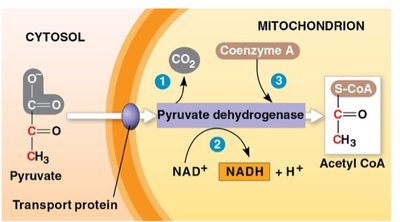
Citric Acid Cycle (Krebs Cycle)
The citric acid cycle completes the oxidation of pyruvate to CO2 in the mitochondrial matrix. - Per turn: 1 ATP, 3 NADH, 1 FADH2, 2 CO2 released. - Two turns per glucose: One per pyruvate. 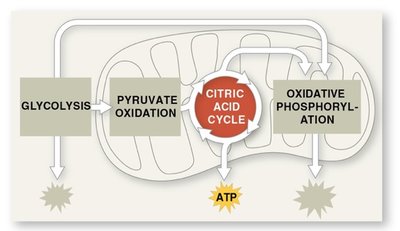
Citric Acid Cycle Steps
- Step 1: Acetyl group of acetyl CoA combines with oxaloacetate, forming citrate. - Steps 2–8: Citrate is decomposed back to oxaloacetate, completing the cycle. - Oxidation steps: Isocitrate → α-ketoglutarate → succinyl CoA, releasing CO2 and reducing NAD+ to NADH.
- ATP and FADH2: Substrate-level phosphorylation makes GTP (then ATP); FAD is reduced to FADH2.
- Regeneration: Steps 7–8 regenerate oxaloacetate and produce another NADH.
Oxidative Phosphorylation
Electron Transport Chain and Chemiosmosis
- NADH and FADH2: Donate electrons to the ETC, which powers ATP synthesis via oxidative phosphorylation. - Location: ETC molecules are embedded in the inner mitochondrial membrane. - Electron flow: Electrons step down in free energy to O2, passing through carrier molecules.
Chemiosmosis and ATP Synthase
- Key Point: Electron transport pumps H+ into the intermembrane space; H+ flows back through ATP synthase, driving ATP synthesis. - Proton-motive force: The H+ gradient couples ETC redox reactions to ATP synthesis.
ATP Yield
- Energy flow: Glucose → NADH → ETC → proton-motive force → ATP. - Yield: About 32 ATP per glucose; 34% of glucose’s energy is transferred to ATP, rest lost as heat.
Fermentation and Anaerobic Respiration
ATP Production Without Oxygen
- Anaerobic respiration: Uses an ETC with a final electron acceptor other than O2 (e.g., sulfate). - Fermentation: Regenerates NAD+ by passing electrons to pyruvate or its derivatives; yields only 2 ATP from glycolysis.
Connections and Regulation
Catabolic Pathways and Regulation
- Key Point: Many fuels (proteins, fats, carbohydrates) feed into respiration at various points. - Regulation: Feedback inhibition controls catabolism, keeping ATP production in step with demand.
The Big Picture
Cellular respiration is a highly regulated, multi-step process that efficiently converts the energy stored in food into ATP, supporting all cellular activities. Summary equation: Example: Fatty acids are broken down to acetyl CoA, which enters the citric acid cycle for further oxidation and ATP production. Additional info: Enzymes lower activation energy at each step, and ATP is used wherever cellular work is required.
