 Indietro
Cellular Respiration and Fermentation: Pathways of Energy Production
Guida di studio - Note intelligenti
 Appunti personalizzati basati sui tuoi materiali, ampliati con definizioni chiave, esempi e contesto.
Cellular Respiration
Overview of Cellular Respiration
Cellular respiration is the process by which cells extract energy from carbohydrates, primarily glucose, to produce ATP, the cell's energy currency. This process involves a series of metabolic pathways that occur in different parts of the cell and can be aerobic (requiring oxygen) or anaerobic (not requiring oxygen).
Glucose is the most commonly used carbohydrate for energy production.
Cellular respiration completely breaks down glucose, whereas fermentation only partially breaks it down.
Energy is transferred to ATP by breaking the bonds of carbohydrates.
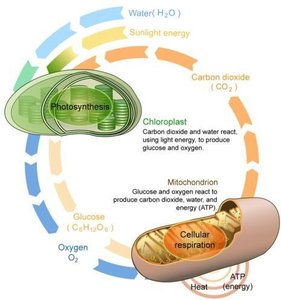
Aerobic Respiration
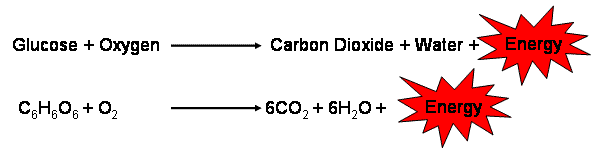
Aerobic respiration is a multi-step pathway that requires oxygen and produces carbon dioxide and water. It is the most efficient way for cells to generate ATP from glucose.
Occurs in three main stages: Glycolysis, Krebs Cycle (Citric Acid Cycle), and Electron Transport Chain.
Oxygen is the final electron acceptor, forming water.
Produces up to 32 ATP molecules per glucose molecule.
Glycolysis
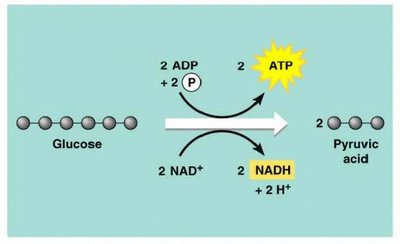
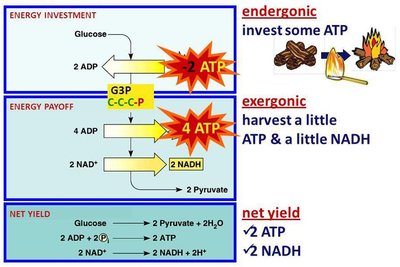
Glycolysis is the first step in both aerobic respiration and fermentation. It occurs in the cytoplasm and breaks down one glucose molecule into two molecules of pyruvate.
Requires investment of 2 ATP to start the process.
Produces 4 ATP (net gain of 2 ATP) and 2 NADH.
Pyruvate and NADH are key products for subsequent steps.
Acetyl-CoA Formation
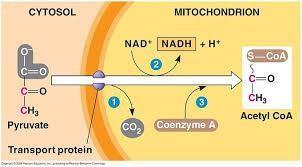
Pyruvate produced in glycolysis is transported into the mitochondrion, where it is converted into acetyl-CoA, releasing CO2 and generating NADH.
One carbon from pyruvate is oxidized to CO2.
Acetyl-CoA enters the Krebs cycle.
Krebs Cycle (Citric Acid Cycle)
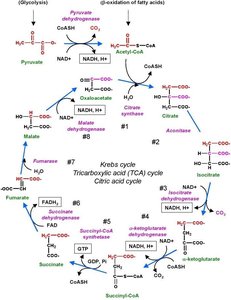
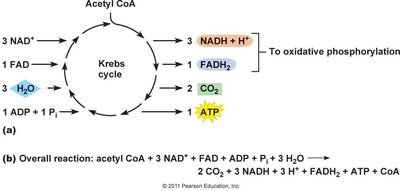
The Krebs cycle occurs in the mitochondrial matrix and further breaks down acetyl-CoA, producing CO2, NADH, FADH2, and ATP.
Each acetyl-CoA yields: 3 NADH, 1 FADH2, 1 ATP, and 2 CO2.
NADH and FADH2 carry electrons to the electron transport chain.
Electron Transport Chain (ETC) and Oxidative Phosphorylation
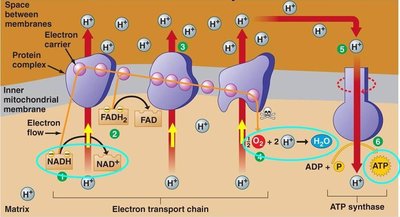
The ETC is located in the inner mitochondrial membrane. NADH and FADH2 deliver electrons, which flow through protein complexes, creating a proton gradient that powers ATP synthesis.
Oxygen is the final electron acceptor, forming water.
ATP synthase uses the proton gradient to generate ATP from ADP and Pi.
About 32 ATP are produced in this stage.
Summary Table: ATP Yield from Aerobic Respiration
Stage | ATP Produced | NADH Produced | FADH2 Produced |
|---|---|---|---|
Glycolysis | 2 | 2 | 0 |
Krebs Cycle | 2 | 8 | 2 |
Electron Transport Chain | ~28 | - | - |
Total | ~32 | - | - |
Fermentation
Overview of Fermentation
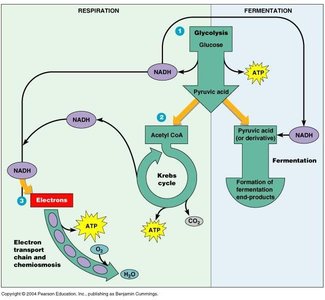
Fermentation is an anaerobic pathway that allows cells to produce ATP without oxygen. It begins with glycolysis, but pyruvate is not fully broken down; instead, it is converted to other molecules, regenerating NAD+ so glycolysis can continue.
Net ATP yield is only 2 ATP per glucose (from glycolysis).
Two main types: Alcoholic fermentation and Lactate fermentation.
Alcoholic Fermentation
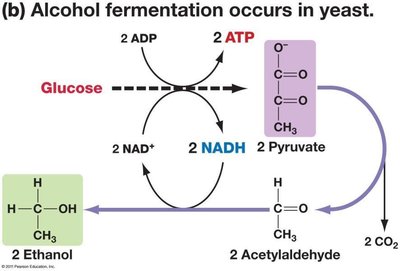
Alcoholic fermentation occurs in yeast and some bacteria. Pyruvate is converted to ethanol and CO2, regenerating NAD+.
Used in bread and wine production.
Key organism: Saccharomyces (yeast).
Lactate Fermentation
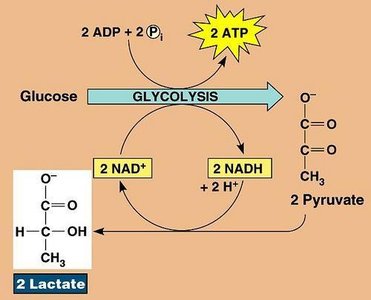
Lactate fermentation occurs in some bacteria and animal cells (e.g., muscle cells). Pyruvate is converted directly to lactate, regenerating NAD+.
Used in dairy product production and food preservation.
Occurs during intense exercise in animals.
Comparison of Respiration and Fermentation
Both pathways begin with glycolysis, but differ in their end products, ATP yield, and oxygen requirements.
Feature | Respiration | Fermentation |
|---|---|---|
Oxygen Required? | Yes | No |
ATP Yield | ~32 ATP | 2 ATP |
End Products | CO2, H2O | Ethanol or Lactate |
Alternative Energy Sources in the Body
Metabolism of Macromolecules
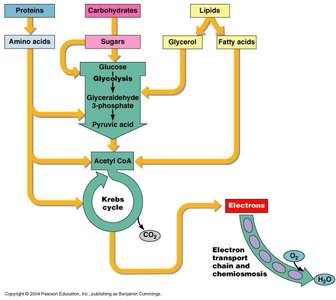
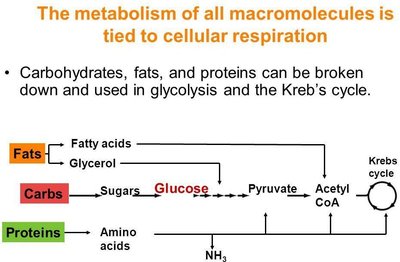
Carbohydrates, fats, and proteins can all be broken down and used in glycolysis and the Krebs cycle to produce ATP. These macromolecules enter the pathways at different points, depending on their structure.
Fats are broken down into fatty acids and glycerol.
Proteins are broken down into amino acids, which can enter the cycle after deamination.
Carbohydrates are broken down into sugars, which enter glycolysis.
Summary
Cellular respiration is a fundamental process for energy production in cells, involving glycolysis, the Krebs cycle, and the electron transport chain. Fermentation provides an alternative pathway when oxygen is unavailable, but yields much less ATP. All macromolecules can be metabolized to produce energy, highlighting the central role of cellular respiration in metabolism.
Key Equations
Overall equation for aerobic respiration:
ATP yield from NADH and FADH2:
Summary of glycolysis:
Summary of Krebs cycle:
Summary of alcoholic fermentation:
Summary of lactate fermentation:
