 Indietro
Cellular Respiration and Fermentation: Pathways of Energy Harvesting
Guida di studio - Note intelligenti
 Appunti personalizzati basati sui tuoi materiali, ampliati con definizioni chiave, esempi e contesto.
Cellular Respiration and Fermentation
Overview of Cellular Respiration
Cellular respiration is a series of catabolic pathways that break down organic molecules, primarily glucose, to release energy for cellular work. This process involves multiple stages, each contributing to the efficient extraction and storage of energy in the form of ATP.
Catabolism: The breakdown of complex molecules into simpler ones, releasing energy.
Anabolism: The synthesis of complex molecules from simpler ones, requiring energy input.
Metabolism: The sum of all catabolic and anabolic reactions in a cell.
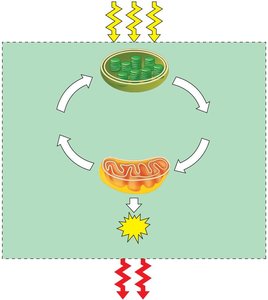
Key Point: Energy flows into ecosystems as light (photosynthesis) and exits as heat, while nutrients cycle between organisms and the environment.
Redox Reactions in Cellular Respiration
Redox (reduction-oxidation) reactions are central to energy transfer in biological systems. In these reactions, electrons are transferred from one molecule (the reducing agent) to another (the oxidizing agent).
Oxidation: Loss of electrons from a substance.
Reduction: Gain of electrons by a substance.
Electron carriers: Molecules like NAD+ and FAD that shuttle electrons during cellular respiration.

Example: In cellular respiration, glucose is oxidized and oxygen is reduced:

NAD+ and NADH: Electron Carriers
Nicotinamide adenine dinucleotide (NAD+) is a key electron carrier in cellular respiration. It cycles between oxidized (NAD+) and reduced (NADH) states, facilitating the transfer of high-energy electrons.
NAD+: Accepts electrons and becomes reduced to NADH.
NADH: Donates electrons to the electron transport chain, becoming oxidized back to NAD+.
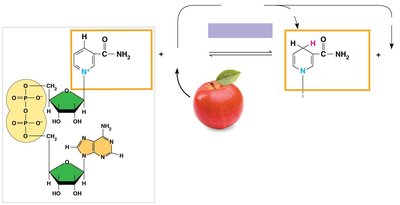
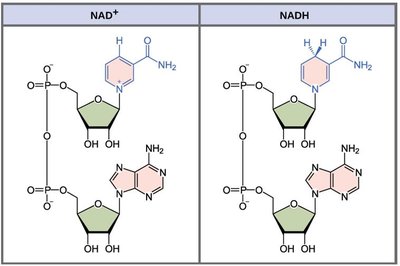
Key Point: NADH stores energy that can be used to make ATP during oxidative phosphorylation.
Stages of Cellular Respiration
1. Glycolysis
Glycolysis is the first stage of cellular respiration, occurring in the cytosol. It involves the breakdown of one glucose molecule (6 carbons) into two molecules of pyruvate (3 carbons each), producing a small amount of ATP and NADH.
Location: Cytosol
Main Steps: Energy investment phase and energy payoff phase
Net Products: 2 pyruvate, 2 ATP (net), 2 NADH
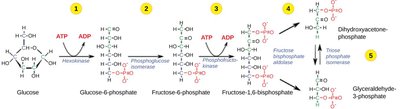
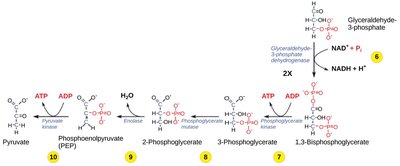
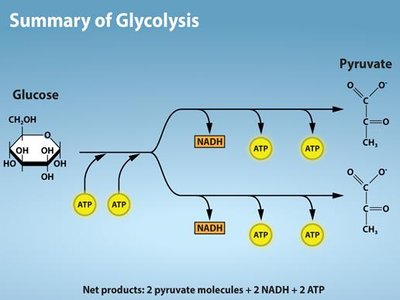
Key Enzymes: Hexokinase, phosphofructokinase, pyruvate kinase
Example: Glycolysis is an example of substrate-level phosphorylation, where ATP is produced directly by transferring a phosphate group to ADP from a phosphorylated intermediate.
2. Pyruvate Oxidation and Citric Acid Cycle (Krebs Cycle)
After glycolysis, pyruvate is transported into the mitochondrion, where it is converted to acetyl-CoA. Acetyl-CoA enters the citric acid cycle, a series of eight enzyme-catalyzed reactions that complete the oxidation of glucose derivatives.
Location: Mitochondrial matrix
Main Products per glucose: 6 NADH, 2 FADH2, 2 ATP (GTP), 4 CO2
Key Intermediates: Citrate, α-ketoglutarate, succinate, malate, oxaloacetate
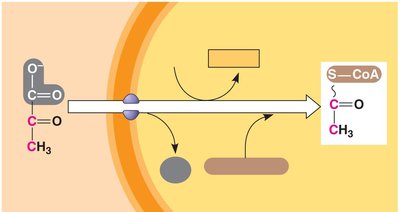
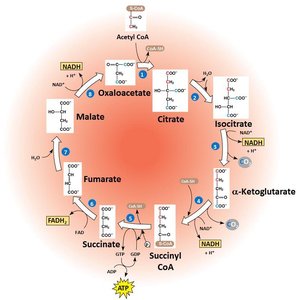
Function: Extracts high-energy electrons for use in the electron transport chain.
3. Oxidative Phosphorylation (Electron Transport Chain and Chemiosmosis)
Oxidative phosphorylation is the final stage of cellular respiration, occurring in the inner mitochondrial membrane. Electrons from NADH and FADH2 are transferred through a series of protein complexes (the electron transport chain), ultimately reducing oxygen to water. The energy released pumps protons across the membrane, creating a proton gradient (proton motive force) that drives ATP synthesis via ATP synthase.
Location: Inner mitochondrial membrane
Main Products: About 26-28 ATP per glucose
Key Process: Chemiosmosis
Equation:
Fermentation and Anaerobic Respiration
Fermentation
Fermentation is an anaerobic process that allows glycolysis to continue by recycling NADH back to NAD+ in the absence of oxygen. There are two main types:
Lactic Acid Fermentation: Pyruvate is reduced to lactate. Occurs in muscle cells and some bacteria.
Alcohol Fermentation: Pyruvate is converted to ethanol and CO2. Occurs in yeast and some bacteria.
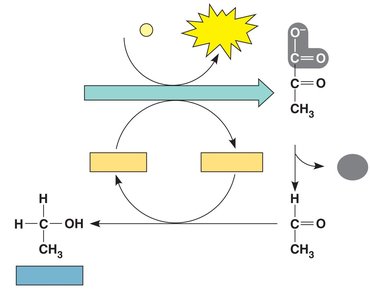
Key Point: Fermentation yields much less ATP than cellular respiration (2 ATP per glucose).
Comparison: Fermentation vs. Cellular Respiration
Process | Final Electron Acceptor | ATP Yield (per glucose) |
|---|---|---|
Cellular Respiration | O2 (aerobic) or other (anaerobic) | ~30-32 |
Fermentation | Organic molecule (e.g., pyruvate, acetaldehyde) | 2 |
Integration and Regulation of Metabolic Pathways
Metabolic Flexibility
Cells can catabolize a variety of organic molecules, including carbohydrates, fats, and proteins, feeding their breakdown products into glycolysis or the citric acid cycle. This flexibility allows cells to adapt to different nutrient availabilities.
Beta-oxidation: Fatty acids are broken down to acetyl-CoA, which enters the citric acid cycle.
Deamination: Amino acids are deaminated and their carbon skeletons enter glycolysis or the citric acid cycle.
Regulation of Cellular Respiration
Cellular respiration is tightly regulated by feedback mechanisms, primarily at the level of glycolysis. The enzyme phosphofructokinase is a key regulatory point, inhibited by high levels of ATP and stimulated by AMP.
Feedback inhibition: End products inhibit enzymes early in the pathway to prevent overproduction.
Summary Table: Major Stages of Cellular Respiration
Stage | Location | Inputs | Outputs | ATP Produced |
|---|---|---|---|---|
Glycolysis | Cytosol | Glucose, 2 NAD+, 2 ADP | 2 Pyruvate, 2 NADH, 2 ATP (net) | 2 |
Pyruvate Oxidation | Mitochondrial matrix | 2 Pyruvate, 2 NAD+, 2 CoA | 2 Acetyl-CoA, 2 NADH, 2 CO2 | 0 |
Citric Acid Cycle | Mitochondrial matrix | 2 Acetyl-CoA, 6 NAD+, 2 FAD, 2 ADP | 4 CO2, 6 NADH, 2 FADH2, 2 ATP | 2 |
Oxidative Phosphorylation | Inner mitochondrial membrane | 10 NADH, 2 FADH2, O2 | H2O, ~26-28 ATP | 26-28 |
