 Indietro
AP Biology Chapter 9 : Cellular Respiration
Guida di studio - Note intelligenti
 Appunti personalizzati basati sui tuoi materiali, ampliati con definizioni chiave, esempi e contesto.
Cellular Respiration & Fermentation
Principles of Energy Harvest
Cellular respiration and fermentation are catabolic pathways that allow cells to harvest energy from organic molecules. Energy enters ecosystems as sunlight and leaves as heat, with ATP serving as the usable energy currency for cells.
Catabolic Pathways: Break down molecules to release energy.
Fermentation: Anaerobic process producing ATP without oxygen.
Cellular Respiration: Aerobic process yielding more ATP.
Overall Equation:
Redox Reactions in Cellular Respiration
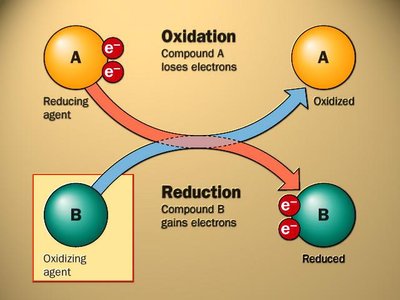
Redox reactions (oxidation-reduction) are central to energy transfer in biological systems. Electrons are transferred from one molecule to another, facilitating ATP production.
Oxidation: Loss of electrons (OIL: Oxidation Is Loss).
Reduction: Gain of electrons (RIG: Reduction Is Gain).
Reducing Agent: Electron donor.
Oxidizing Agent: Electron acceptor.
Electron Carriers: NAD+ and FAD
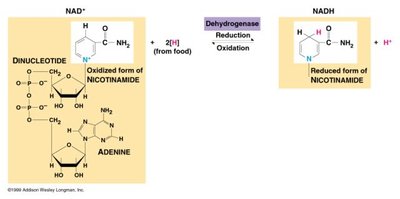
NAD+ (nicotinamide adenine dinucleotide) and FAD (flavin adenine dinucleotide) are key electron carriers in cellular respiration. They accept electrons during food oxidation and become reduced to NADH and FADH2.
NAD+: Removes electrons from food via dehydrogenase enzymes.
NADH: Reduced form, carries electrons to the electron transport chain.
Oxygen: Final electron acceptor in aerobic respiration.
Stages of Cellular Respiration
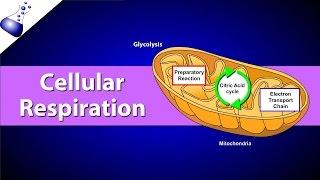
Cellular respiration consists of three main stages: glycolysis, the citric acid (Krebs) cycle, and the electron transport chain. Each stage occurs in specific cellular locations and contributes to ATP production.
Glycolysis: Cytosol; glucose is split into pyruvate.
Krebs Cycle: Mitochondrial matrix; pyruvate is oxidized to CO2.
Electron Transport Chain: Inner mitochondrial membrane; electrons are transferred to oxygen.
Glycolysis
Glycolysis is a ten-step pathway that converts glucose (C6H12O6) into two pyruvate molecules (C3H6O3). It occurs in the cytosol and can function with or without oxygen.
Energy Investment Phase: 2 ATP used to phosphorylate glucose.
Energy Payoff Phase: 4 ATP produced (net gain: 2 ATP), 2 NADH generated.
No CO2 released.
Occurs aerobically or anaerobically.
Mitochondria Structure
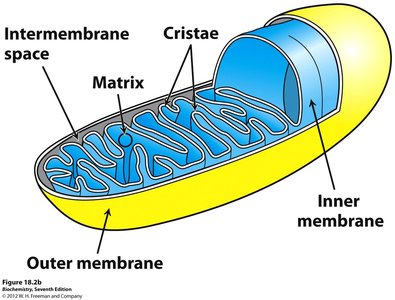
The mitochondrion is the site of the citric acid cycle and electron transport chain. Its structure includes the matrix, cristae, inner and outer membranes, and intermembrane space.
Matrix: Location of Krebs cycle.
Cristae: Folds of the inner membrane, increasing surface area for electron transport.
Intermembrane Space: Site of proton gradient formation.
Intermediate Step: Pyruvate Oxidation
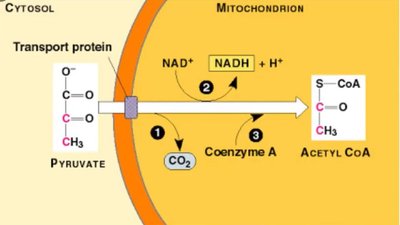
Before entering the Krebs cycle, pyruvate is converted to acetyl CoA in the mitochondrial matrix. This step links glycolysis to the citric acid cycle.
CO2 released.
NAD+ reduced to NADH.
Coenzyme A added, forming acetyl CoA.
Krebs Cycle (Citric Acid Cycle)
The Krebs cycle completes the oxidation of glucose, producing NADH, FADH2, ATP, and CO2. Each turn of the cycle processes one acetyl CoA.
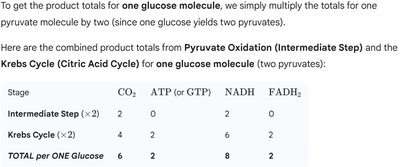
Per Pyruvate: 4 NADH, 1 FADH2, 1 ATP, 3 CO2 (including intermediate step).
Per Glucose: 8 NADH, 2 FADH2, 2 ATP, 6 CO2.
Oxaloacetate: Regenerated each cycle.
Stage | CO2 | ATP | NADH | FADH2 |
|---|---|---|---|---|
Intermediate Step (x2) | 2 | 0 | 2 | 0 |
Krebs Cycle (x2) | 4 | 2 | 6 | 2 |
Total per Glucose | 6 | 2 | 8 | 2 |
Electron Transport Chain & Chemiosmosis
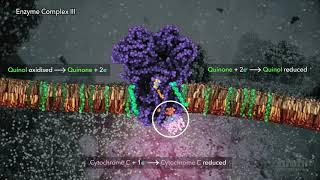
The electron transport chain (ETC) is a series of membrane proteins that transfer electrons from NADH and FADH2 to oxygen, creating a proton gradient across the inner mitochondrial membrane. Chemiosmosis uses this gradient to drive ATP synthesis via ATP synthase.
Electron Route: Food → NADH/FADH2 → ETC → Oxygen.
ATP Synthase: Enzyme that uses proton-motive force to phosphorylate ADP to ATP.
Oxidative Phosphorylation: ATP production coupled to electron transport and proton gradient.
ATP Yield from Cellular Respiration
Summary Table of ATP Production
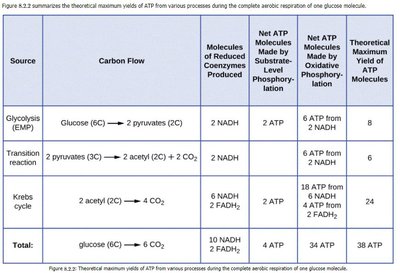
Theoretical ATP yield from complete aerobic respiration of one glucose molecule:
Source | Carbon Flow | Reduced Coenzymes | ATP (Substrate-Level) | ATP (Oxidative Phosphorylation) | Theoretical ATP Yield |
|---|---|---|---|---|---|
Glycolysis | Glucose → 2 pyruvates | 2 NADH | 2 | 6 | 8 |
Transition Reaction | 2 pyruvates → 2 acetyl CoA + 2 CO2 | 2 NADH | 0 | 6 | 6 |
Krebs Cycle | 2 acetyl (2C) → 4 CO2 | 6 NADH, 2 FADH2 | 2 | 22 | 24 |
Total | Glucose → 6 CO2 | 10 NADH, 2 FADH2 | 4 | 34 | 38 |
Fermentation and Anaerobic Metabolism
Fermentation Pathways
Fermentation allows cells to produce ATP in the absence of oxygen by regenerating NAD+ for glycolysis. Two main types are alcohol fermentation and lactic acid fermentation.
Alcohol Fermentation: Pyruvate converted to ethanol (yeast).
Lactic Acid Fermentation: Pyruvate converted to lactate (muscle cells, bacteria).
Facultative Anaerobes: Organisms that can switch between aerobic and anaerobic metabolism.
Connections to Other Metabolic Pathways
Catabolism of Fats and Proteins
Fats and proteins can be broken down and their products fed into cellular respiration. Fats undergo beta-oxidation to form acetyl CoA, while proteins are deaminated and their carbon skeletons enter various points in the pathway.
Beta-oxidation: Lipid catabolism to acetyl CoA.
Deamination: Protein catabolism.
Energy Content: Fats ~ 9 Kcal/gram; Carbs ~ 4 Kcal/gram; Proteins ~ 4 Kcal/gram.
Summary and Review
Cellular respiration: Efficient process for extracting energy from glucose.
ATP yield: 36-38 ATP per glucose (theoretical maximum).
40% of glucose energy stored in ATP; remainder lost as heat.
Fermentation: Provides ATP when oxygen is unavailable.
