 Indietro
Cellular Respiration and Fermentation: Step-by-Step Study Guidance
Guida di studio - Note intelligenti
 Appunti personalizzati basati sui tuoi materiali, ampliati con definizioni chiave, esempi e contesto.
Q29. Labeling and Understanding the Electron Transport Chain
Background
Topic: Electron Transport Chain (ETC) in Cellular Respiration
This question focuses on the structure and function of the electron transport chain, a series of protein complexes in the inner mitochondrial membrane that transfer electrons and help generate ATP.
Key Terms and Concepts:
Electron Transport Chain (ETC): A sequence of protein complexes that transfer electrons from electron donors (NADH, FADH2) to oxygen, coupled with the movement of protons across the membrane.
Free Energy: Each step in the chain releases energy, which is used to pump protons and create a gradient.
Final Electron Acceptor: Oxygen is the last molecule to accept electrons, forming water.
Step-by-Step Guidance
Examine the diagram of the electron transport chain. Notice the sequence of protein complexes (labeled I, II, III, IV) embedded in the inner mitochondrial membrane.
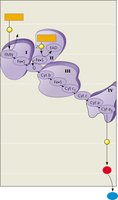
Recall that electrons enter the chain from NADH and FADH2. NADH donates electrons to Complex I, while FADH2 donates to Complex II.
As electrons move through the chain, each complex is at a lower free energy level than the previous one. This energy difference is used to pump protons (H+) across the membrane.
The molecule at zero free energy (the lowest point on the diagram) is oxygen (O2), which is highly electronegative and acts as the final electron acceptor.
Label the missing parts by identifying where NADH and FADH2 enter, the direction of electron flow, and where oxygen accepts electrons at the end of the chain.
Try solving on your own before revealing the answer!
Final Answer:
a) Each member of the electron transport chain is lower in free energy than the preceding member.
b) The molecule at zero free energy is oxygen (O2), which is the final electron acceptor and has the highest electronegativity.
c) The missing parts to label are:
NADH donates electrons to Complex I
FADH2 donates electrons to Complex II
Electrons flow through Complexes I, III, and IV
Oxygen accepts electrons at the end, forming water
This process is essential for creating the proton gradient used to generate ATP.
Q33. Labeling and Explaining ATP Synthase Function
Background
Topic: ATP Synthase and Chemiosmosis
This question addresses the structure and function of ATP synthase, the enzyme responsible for synthesizing ATP using the proton gradient established by the electron transport chain.
Key Terms and Concepts:
ATP Synthase: A large protein complex that uses the flow of protons (H+) down their gradient to catalyze the formation of ATP from ADP and inorganic phosphate.
Chemiosmosis: The process by which energy stored in a proton gradient is used to drive cellular work, such as ATP synthesis.
Step-by-Step Guidance
Study the diagram of ATP synthase. Identify the intermembrane space (where H+ ions are concentrated) and the mitochondrial matrix (where ATP is produced).
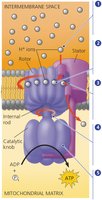
Follow the five steps of ATP production:
H+ ions flow down their gradient through a channel in the stator.
H+ ions bind to sites on the rotor, causing it to spin.
Each H+ ion completes a turn and exits into the matrix.
The spinning rotor turns an internal rod, which extends into the catalytic knob.
The turning of the rod activates catalytic sites in the knob, synthesizing ATP from ADP and phosphate.
Label each part of the diagram with its function and the direction of proton flow.
Try solving on your own before revealing the answer!
Final Answer:
The five steps to ATP production by ATP synthase are:
H+ ions flow down their gradient through the stator channel.
H+ ions bind to the rotor, causing it to spin.
Each H+ ion completes a turn and exits into the mitochondrial matrix.
The spinning rotor turns the internal rod, which extends into the catalytic knob.
The turning rod activates catalytic sites in the knob, producing ATP from ADP and inorganic phosphate.
This process is called chemiosmosis and is essential for ATP synthesis during oxidative phosphorylation.
Q36. Labeling the Electron Transport Chain and Describing Proton/Electron Pathways
Background
Topic: Electron Transport Chain and Chemiosmosis
This question asks you to label a diagram of the electron transport chain, showing the movement of electrons and protons, and to describe the process in words.
Key Terms and Concepts:
Electron Transport Chain (ETC): Series of protein complexes that transfer electrons and pump protons to create a gradient.
Proton Gradient: The difference in proton concentration across the inner mitochondrial membrane, which drives ATP synthesis.
ATP Synthase: The enzyme that uses the proton gradient to synthesize ATP.
Step-by-Step Guidance
Examine the diagram showing the inner mitochondrial membrane, protein complexes, and the movement of electrons (yellow arrows) and protons (red arrows).
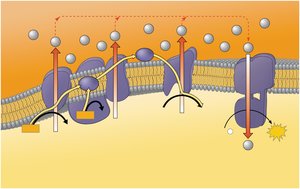
Label the protein complexes (I, II, III, IV) and ATP synthase. Identify where electrons enter the chain (from NADH and FADH2).
Trace the pathway of electrons as they move through the complexes, releasing energy at each step.
Show how protons are pumped from the matrix to the intermembrane space, creating a gradient.
Describe how protons flow back through ATP synthase, driving the production of ATP.
Try solving on your own before revealing the answer!
Final Answer:
The electron transport chain consists of four main protein complexes (I-IV) and ATP synthase. Electrons from NADH and FADH2 enter the chain and move through the complexes, releasing energy used to pump protons into the intermembrane space. The resulting proton gradient drives protons back through ATP synthase, producing ATP. The pathway of electrons is lateral through the complexes, while protons are pumped upward and then flow back down through ATP synthase.
Q38. Labeling the Processes of Cellular Respiration and ATP Production
Background
Topic: Overview of Cellular Respiration
This question involves labeling a summary diagram of cellular respiration, showing the flow of molecules, production of NADH and FADH2, and sites of ATP formation by substrate-level and oxidative phosphorylation.
Key Terms and Concepts:
Glycolysis: The breakdown of glucose to pyruvate, producing ATP and NADH.
Citric Acid Cycle: Completes the oxidation of glucose, producing NADH, FADH2, and ATP.
Oxidative Phosphorylation: Uses NADH and FADH2 to generate ATP via the electron transport chain and chemiosmosis.
Substrate-Level Phosphorylation: Direct formation of ATP in glycolysis and the citric acid cycle.
Step-by-Step Guidance
Study the diagram showing the stages of cellular respiration: glycolysis (blue box), pyruvate oxidation, citric acid cycle (red circle), and oxidative phosphorylation (purple box).
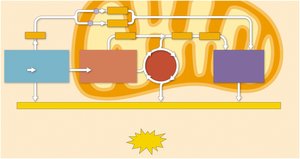
Label where NADH and FADH2 are produced (mainly in glycolysis and the citric acid cycle).
Identify where ATP is formed by substrate-level phosphorylation (glycolysis and citric acid cycle) and by oxidative phosphorylation (electron transport chain).
Show the flow of electrons from NADH and FADH2 to the electron transport chain, leading to ATP production.
Try solving on your own before revealing the answer!
Final Answer:
The diagram should be labeled as follows:
Glycolysis (blue box): produces ATP (substrate-level) and NADH
Pyruvate oxidation and Citric Acid Cycle (red circle): produce NADH, FADH2, and ATP (substrate-level)
Oxidative phosphorylation (purple box): uses NADH and FADH2 to produce ATP (oxidative phosphorylation)
Arrows show the flow of electrons and the production of ATP at each stage
This overview helps you see how energy is harvested and transferred throughout cellular respiration.
Q44. Labeling the Metabolic Juncture of Pyruvate
Background
Topic: Pyruvate as a Key Juncture in Metabolism
This question asks you to label a diagram showing the central role of pyruvate in cellular metabolism and to explain why it is a key metabolic branch point.
Key Terms and Concepts:
Pyruvate: The end product of glycolysis, which can enter different metabolic pathways depending on cellular conditions.
Aerobic Respiration: Pyruvate enters the mitochondrion and is converted to acetyl CoA for the citric acid cycle.
Fermentation: In the absence of oxygen, pyruvate is converted to lactate or ethanol.
Step-by-Step Guidance
Examine the diagram showing pyruvate at a branching point, with arrows leading to different metabolic fates.
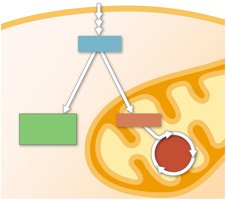
Label the blue box as pyruvate, the green box as fermentation (lactate or ethanol), and the orange/red boxes as entry into the mitochondrion and the citric acid cycle.
Explain that pyruvate is a key juncture because it can be used for aerobic respiration (when oxygen is present) or for fermentation (when oxygen is absent).
Try solving on your own before revealing the answer!
Final Answer:
The diagram should be labeled:
Blue box: Pyruvate
Green box: Fermentation (lactate or ethanol)
Orange box: Entry into mitochondrion
Red circle: Citric acid cycle
Pyruvate is a key metabolic juncture because it can be directed toward aerobic respiration or fermentation, depending on the presence of oxygen. This flexibility allows cells to adapt to different energy needs and environmental conditions.
Q39. Why is the total ATP yield from glucose not a specific number?
Background
Topic: ATP Yield Variability in Cellular Respiration
This question explores why the total number of ATP molecules produced from one glucose molecule is not always the same.
Key Terms and Concepts:
ATP Yield: The total number of ATP molecules generated from one glucose molecule during cellular respiration.
Variability: Factors such as shuttle mechanisms, proton leak, and cell type can affect the final ATP count.
Step-by-Step Guidance
Recall that the theoretical maximum ATP yield is about 30-32 ATP per glucose, but the actual number can vary.
Consider factors that influence ATP yield, such as the efficiency of electron shuttles (NADH from glycolysis may enter the mitochondria as FADH2), and the use of the proton gradient for other cellular processes.
Think about how some protons may leak across the membrane or be used for other work, reducing the number available for ATP synthesis.
Try solving on your own before revealing the answer!
Final Answer:
The total ATP yield from glucose is about 30 or 32 ATP molecules, rather than a specific number, because of variability in shuttle mechanisms, proton leak, and differences in cell types. Not all NADH produced in glycolysis results in the same number of ATP, and some energy from the proton gradient may be used for other cellular processes.
