 Indietro
Cellular Respiration and Fermentation: Structured Study Notes
Guida di studio - Note intelligenti
 Appunti personalizzati basati sui tuoi materiali, ampliati con definizioni chiave, esempi e contesto.
Cellular Respiration and Fermentation
Redox Reactions in Cellular Respiration
Redox reactions are fundamental to cellular respiration, involving the transfer of electrons between molecules. These reactions are essential for energy production in cells.
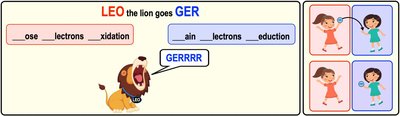
Oxidation: The process of losing electrons.
Reduction: The process of gaining electrons (overall charge is reduced).
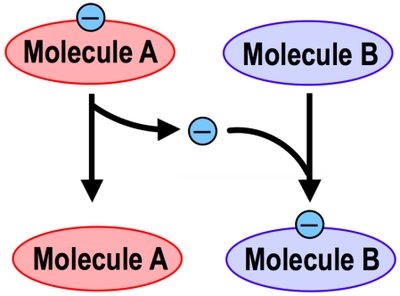
Oxidation and reduction always occur together in a redox reaction.
Mnemonic: LEO the Lion goes GER (Lose Electrons = Oxidation; Gain Electrons = Reduction).
Example: If Molecule A loses electrons and Molecule B gains them, Molecule A is oxidized and Molecule B is reduced.
Electron Carriers: NADH & FADH2
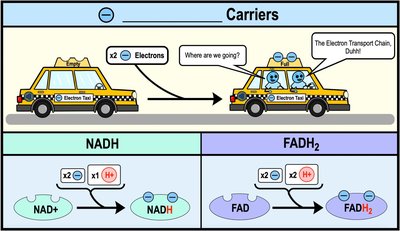
Electron carriers are molecules that transport electrons during cellular respiration, facilitating energy transfer.
NADH and FADH2 are reduced forms that carry electrons to the electron transport chain.
NAD+ and FAD are oxidized forms, ready to accept electrons.
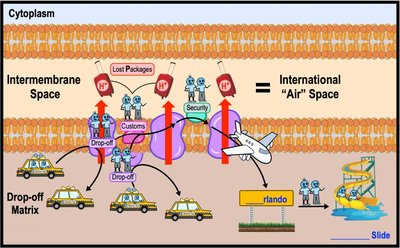
These carriers act like "electron taxis," shuttling electrons to different locations within the cell.
Overview of Aerobic Cellular Respiration
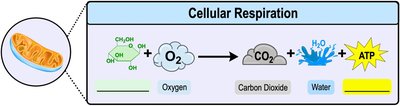
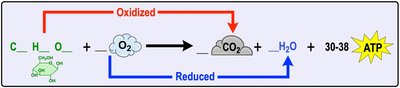
Aerobic cellular respiration is the process of breaking down glucose in the presence of oxygen to produce ATP, the cell's energy currency.
Requires oxygen gas (O2).
Occurs in multiple stages, mainly inside the mitochondria.
Overall chemical equation:
Glucose is oxidized; oxygen is reduced.
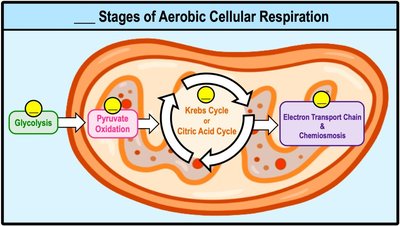
Stages of Aerobic Cellular Respiration
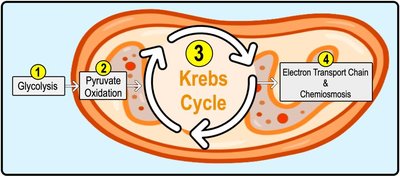
The process consists of four main stages, each contributing to the breakdown of glucose and production of ATP.
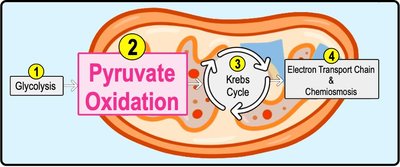
Glycolysis
Pyruvate Oxidation
Krebs Cycle (Citric Acid Cycle)
Electron Transport Chain & Chemiosmosis
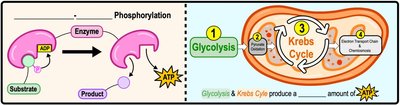
Types of Phosphorylation
ATP is synthesized during cellular respiration by two main mechanisms:
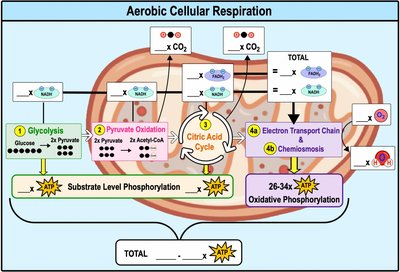
Substrate-Level Phosphorylation: Direct transfer of a phosphate group to ADP by an enzyme. Occurs in glycolysis and the Krebs cycle. Produces a small amount of ATP.
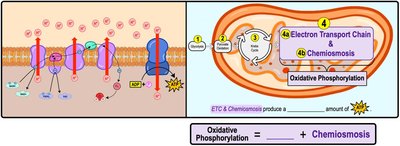
Oxidative Phosphorylation: Uses energy from redox reactions in the electron transport chain to build a proton gradient, which powers ATP synthesis via chemiosmosis. Produces the majority of ATP.
Glycolysis
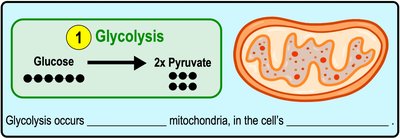
Glycolysis is the first step of cellular respiration, breaking down glucose into two pyruvate molecules. It occurs in the cytoplasm and does not require oxygen.
"Glyco" = sugar; "lysis" = to split.
Glucose (6 carbons) is converted to 2 pyruvate (3 carbons each).
Only step outside mitochondria.
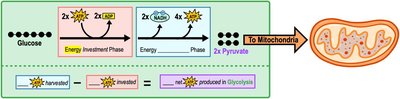
Two phases:
Energy Investment Phase: Uses 2 ATP.
Energy Harvest Phase: Produces 4 ATP and 2 NADH.
Net products: 2 pyruvate, 2 NADH, 2 ATP.
Pyruvate Oxidation
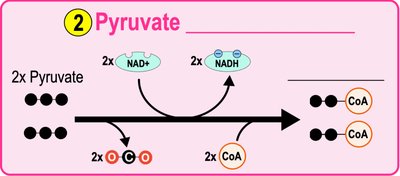
Pyruvate oxidation is the second step, converting pyruvate into acetyl-CoA in the mitochondrial matrix.
Each pyruvate yields 1 acetyl-CoA, 1 NADH, and 1 CO2.
Connects glycolysis to the Krebs cycle.
Krebs Cycle (Citric Acid Cycle)
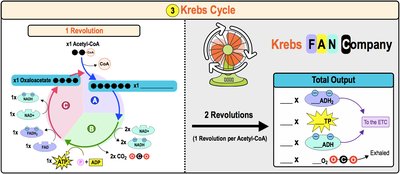
The Krebs cycle is the third stage, oxidizing acetyl-CoA to produce ATP, NADH, and FADH2.
Occurs in the mitochondrial matrix.
Each glucose molecule results in two turns of the cycle.
Produces: 2 ATP, 6 NADH, 2 FADH2, and 4 CO2 per glucose.
Key phases:
Acetyl-CoA entry
Citrate oxidation
Oxaloacetate regeneration
Electron Transport Chain (ETC)
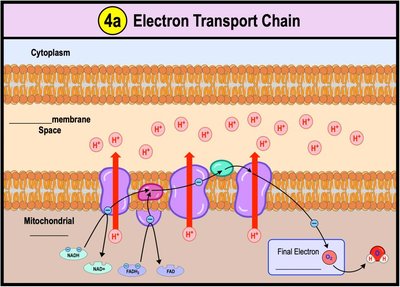
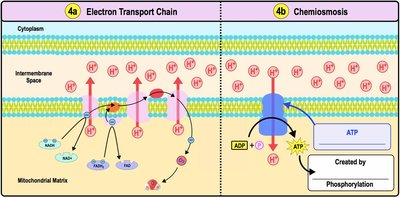
The ETC is the fourth stage, consisting of protein complexes in the mitochondrial inner membrane. It harnesses energy from NADH and FADH2 to pump H+ ions and create a gradient.
Final electron acceptor: oxygen gas (O2).
Produces water when O2 accepts electrons and combines with H+.
Chemiosmosis
Chemiosmosis captures the potential energy of the H+ gradient created by the ETC to synthesize ATP via ATP synthase.
ATP synthase facilitates the diffusion of H+ ions across the membrane, powering ATP production.
Oxidative phosphorylation = ETC + chemiosmosis.
Review of Aerobic Cellular Respiration
The four stages of aerobic cellular respiration collectively produce up to 30-38 ATP per glucose molecule. Most ATP is generated during oxidative phosphorylation.
Energy is stored in NADH and FADH2 before being converted to ATP.
Total Products Table
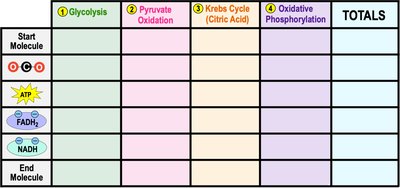
The following table summarizes the products generated at each stage of aerobic cellular respiration:
Stage | CO2 | ATP | FADH2 | NADH |
|---|---|---|---|---|
Glycolysis | 0 | 2 | 0 | 2 |
Pyruvate Oxidation | 2 | 0 | 0 | 2 |
Krebs Cycle | 4 | 2 | 2 | 6 |
Oxidative Phosphorylation | 0 | 26-34 | 0 | 0 |
Totals | 6 | 30-38 | 2 | 10 |
Fermentation & Anaerobic Respiration
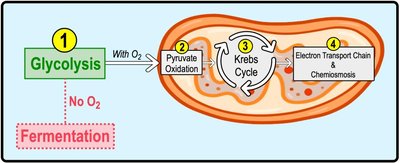
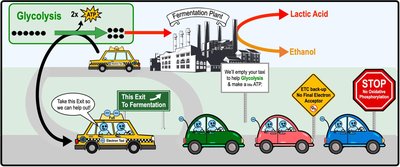
When oxygen is unavailable, cells can perform fermentation or anaerobic respiration to regenerate NAD+ and allow glycolysis to continue.
Fermentation uses electrons from NADH to reduce pyruvate, producing lactic acid or ethanol.
Regenerates NAD+ but produces very little ATP.
Anaerobic respiration uses alternative electron acceptors (e.g., nitrate, sulfate, CO2).
Lactic Acid Fermentation
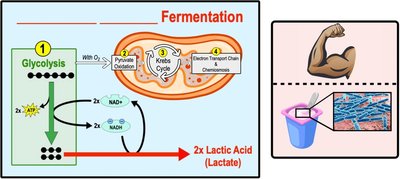
In lactic acid fermentation, pyruvate is reduced by NADH to form lactic acid (lactate) and NAD+. This occurs in human muscle cells and certain bacteria.
Alcohol Fermentation
In alcohol fermentation, pyruvate is reduced by NADH to form ethanol and NAD+. This process is used in brewing and winemaking.
Anaerobic Respiration
Some unicellular organisms can perform anaerobic respiration, using molecules other than oxygen as the final electron acceptor in the ETC. This process produces more ATP than fermentation but less than aerobic respiration.
Summary Table: Substrate-Level Phosphorylation
Process | Occurs in Glycolysis | Occurs in Krebs Cycle | Occurs in ETC |
|---|---|---|---|
Substrate-Level Phosphorylation | Yes | Yes | No |
Key Points
NAD+ is reduced to NADH during glycolysis, pyruvate oxidation, and the Krebs cycle.
Without NAD+, glycolysis cannot proceed.
