 Indietro
Cellular Respiration and Fermentation: Study Notes for General Biology
Guida di studio - Note intelligenti
 Appunti personalizzati basati sui tuoi materiali, ampliati con definizioni chiave, esempi e contesto.
Cellular Respiration and Fermentation
Catabolic Pathways and ATP Production
Cellular respiration is a fundamental metabolic process in which cells extract energy from organic molecules. It includes both aerobic and anaerobic respiration, but typically refers to aerobic respiration, which uses oxygen as the final electron acceptor.
Aerobic respiration: Consumes organic molecules and oxygen, yielding ATP.
Anaerobic respiration: Similar to aerobic, but uses compounds other than oxygen as the final electron acceptor.
Fermentation: Partial degradation of sugars without oxygen.
The Stages of Cellular Respiration: Overview
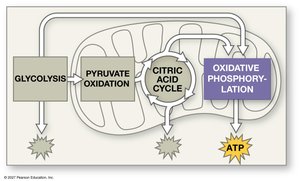
Cellular respiration consists of three main stages, each contributing to the breakdown of glucose and the production of ATP.
Glycolysis: Occurs in the cytosol, breaks down glucose into two pyruvate molecules.
Pyruvate Oxidation and Citric Acid Cycle: Completes glucose breakdown in the mitochondrion.
Oxidative Phosphorylation: Electron transport chain and chemiosmosis synthesize most ATP.
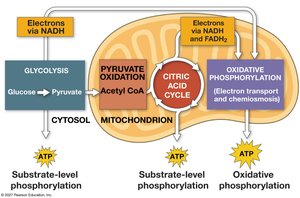
Glycolysis: Harvesting Chemical Energy
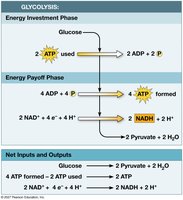
Glycolysis is the first stage of cellular respiration, occurring in the cytoplasm and consisting of two phases: energy investment and energy payoff.
Energy Investment Phase: 2 ATP are used to split glucose into two three-carbon sugars.
Energy Payoff Phase: 4 ATP are synthesized, NAD+ is reduced to NADH, and sugars are oxidized to form 2 pyruvate.
Net ATP: 2 ATP are produced by substrate-level phosphorylation.
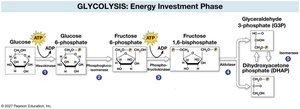
Steps of Glycolysis
Glucose is phosphorylated and rearranged to form fructose-1,6-bisphosphate.
Fructose-1,6-bisphosphate is split into two three-carbon molecules: glyceraldehyde-3-phosphate (G3P) and dihydroxyacetone phosphate (DHAP).
G3P is further processed, generating NADH and ATP, and ultimately forming pyruvate.
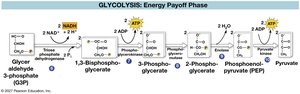
Oxidation of Pyruvate to Acetyl CoA
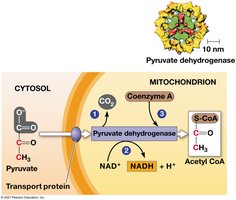
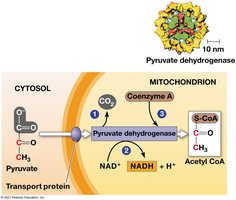
Before entering the citric acid cycle, pyruvate is converted to acetyl coenzyme A (acetyl CoA) in the mitochondrion. This conversion is catalyzed by pyruvate dehydrogenase and involves three steps:
Oxidation of pyruvate’s carboxyl group, releasing CO2.
Reduction of NAD+ to NADH.
Combination of the remaining two-carbon fragment with coenzyme A to form acetyl CoA.
The Citric Acid Cycle (Krebs Cycle)
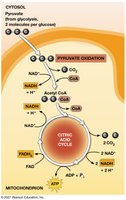
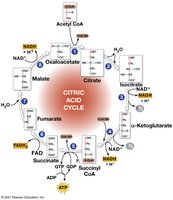
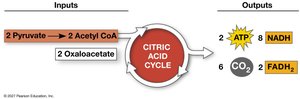
The citric acid cycle completes the breakdown of glucose, oxidizing acetyl CoA and generating ATP, NADH, FADH2, and CO2 as a waste product. The cycle runs twice per glucose molecule.
Acetyl group of acetyl CoA combines with oxaloacetate to form citrate.
Citrate is decomposed back to oxaloacetate through a series of enzyme-catalyzed steps.
NADH and FADH2 produced carry electrons to the electron transport chain.
Oxidative Phosphorylation: Electron Transport and Chemiosmosis
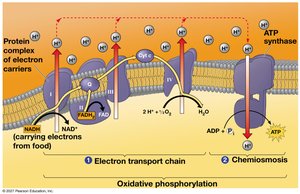
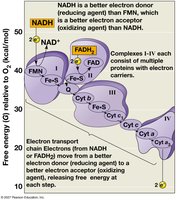
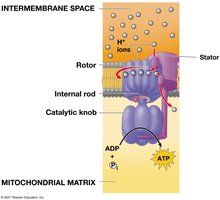
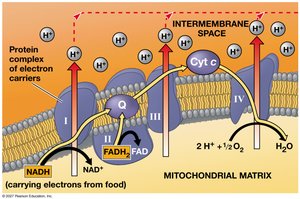
Oxidative phosphorylation is the final stage of cellular respiration, where most ATP is synthesized. NADH and FADH2 donate electrons to the electron transport chain, which is embedded in the inner mitochondrial membrane.
Electron transport chain consists of multiprotein complexes and cytochromes.
Electrons are passed through carriers, dropping in free energy and ultimately reducing oxygen to water.
No ATP is produced directly by the chain; energy released is used to pump protons (H+) across the membrane.
Chemiosmosis: The Energy-Coupling Mechanism
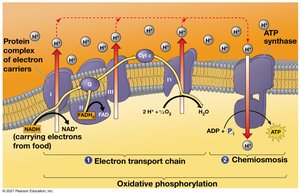
Protons are pumped from the mitochondrial matrix to the intermembrane space, creating a proton gradient.
Protons flow back through ATP synthase, driving phosphorylation of ADP to ATP.
This process is called chemiosmosis, and the proton gradient is referred to as the proton-motive force.
ATP Yield from Cellular Respiration
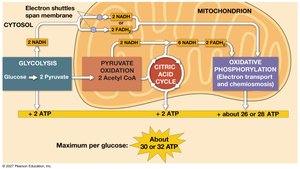
Most energy from glucose is transferred to ATP during cellular respiration. The theoretical maximum yield is about 32 ATP per glucose, but actual yield varies due to several factors.
Energy flows: Glucose → NADH/FADH2 → Electron transport chain → ATP.
About 34% of glucose energy is transferred to ATP; the rest is lost as heat.
Exact ATP yield depends on coupling efficiency and electron shuttle mechanisms.
Fermentation and Anaerobic Respiration
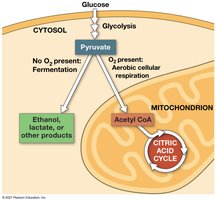
Cells can produce ATP without oxygen by coupling glycolysis with fermentation or anaerobic respiration. Anaerobic respiration uses an electron transport chain with a final electron acceptor other than oxygen, such as sulfate.
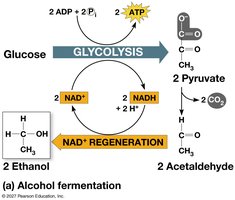
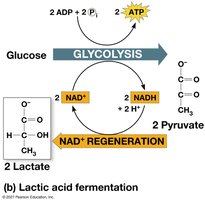
Fermentation allows glycolysis to continue by regenerating NAD+.
Alcohol fermentation: Pyruvate is converted to ethanol, releasing CO2.
Lactic acid fermentation: Pyruvate is reduced to lactate, with no CO2 released.
Comparing Fermentation, Anaerobic, and Aerobic Respiration
All three processes use glycolysis to oxidize glucose, but differ in their electron acceptors and ATP yield.
Fermentation: Produces 2 ATP per glucose by substrate-level phosphorylation.
Anaerobic respiration: Uses electron transport chain with non-oxygen acceptors.
Aerobic respiration: Yields up to 32 ATP per glucose via oxidative phosphorylation.
Catabolism of Various Molecules
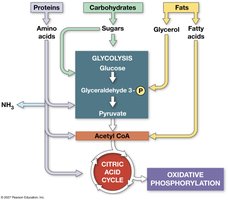
Cellular respiration can utilize carbohydrates, fats, and proteins as fuel. These molecules enter the pathway at different points, ultimately feeding into glycolysis or the citric acid cycle.
Proteins are broken down to amino acids, which enter as pyruvate or acetyl CoA.
Fats are broken down to glycerol and fatty acids, entering glycolysis and citric acid cycle.
Regulation of Cellular Respiration
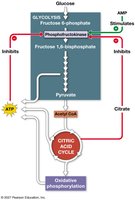
Cellular respiration is regulated by feedback mechanisms, primarily feedback inhibition. This ensures efficient energy production and prevents waste.
If ATP levels are low, respiration speeds up; if ATP is abundant, respiration slows down.
Enzyme activity is regulated at strategic points, such as phosphofructokinase in glycolysis.
Summary Tables: Key Concepts
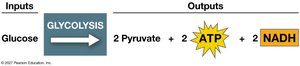
Glycolysis: Inputs and Outputs
Inputs | Outputs |
|---|---|
Glucose | 2 Pyruvate, 2 ATP, 2 NADH |
Citric Acid Cycle: Inputs and Outputs
Inputs | Outputs |
|---|---|
2 Pyruvate (as Acetyl CoA), 2 Oxaloacetate | 2 ATP, 8 NADH, 2 FADH2, 6 CO2 |
Electron Transport Chain: Inputs and Outputs
Inputs | Outputs |
|---|---|
NADH, FADH2, O2 | ATP, H2O |
Key Equations
Overall equation for aerobic cellular respiration:
ATP yield per glucose:
Additional info:
Some details about enzyme regulation and catabolism of non-glucose molecules were inferred for completeness.
