 Indietro
Cellular Respiration and Metabolic Pathways: How Cells Harvest Energy
Guida di studio - Note intelligenti
 Appunti personalizzati basati sui tuoi materiali, ampliati con definizioni chiave, esempi e contesto.
Cellular Respiration: Overview
Classification of Organisms by Energy Acquisition
Organisms are classified based on how they obtain energy for cellular processes. Autotrophs produce their own organic molecules through photosynthesis, while heterotrophs rely on organic compounds produced by other organisms. All organisms utilize cellular respiration to extract energy from organic molecules.
Cellular Respiration as a Series of Reactions
Cellular respiration involves a series of oxidation-reduction (redox) reactions. Oxidation is the loss of electrons, while reduction is the gain of electrons. Dehydrogenation refers to the loss of hydrogen atoms (each consisting of one electron and one proton).
Redox Reactions and Electron Carriers
Mechanism of Redox Reactions
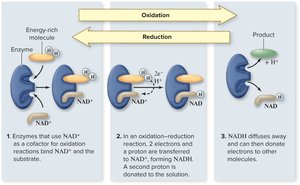
During redox reactions, electrons transfer energy from one molecule to another. Nicotinamide adenosine dinucleotide (NAD+) acts as an electron carrier and enzymatic cofactor, accepting two electrons and one proton to become NADH. This reaction is reversible.
Structure of NAD+ and NADH
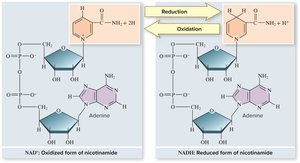
NAD+ is the oxidized form, while NADH is the reduced form. The conversion involves the transfer of electrons and protons, changing the charge on the nicotinamide group.
Energy Harvest and Electron Acceptors
Cellular respiration involves dozens of redox reactions, with various electron acceptors. The final electron acceptor determines the type of respiration:
Aerobic respiration: Oxygen (O2) is the final electron acceptor.
Anaerobic respiration: An inorganic molecule (not O2) is the final electron acceptor.
Fermentation: An organic molecule is the final electron acceptor.
Energy Release from Carbohydrates
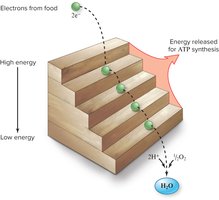
The free energy released from glucose oxidation is approximately −686 kcal/mol. This energy is released in small steps to prevent cellular damage.
ATP Synthesis and Phosphorylation Mechanisms
ATP: The Cellular Energy Currency
Cells use ATP to drive endergonic reactions. The hydrolysis of the terminal phosphate group releases −7.3 kcal/mol of free energy. ATP is synthesized by two mechanisms:
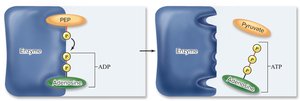
Substrate-level phosphorylation: Direct transfer of a phosphate group to ADP during glycolysis.
Oxidative phosphorylation: ATP synthase uses energy from a proton gradient.
Stages of Glucose Oxidation
Overview of Aerobic Respiration
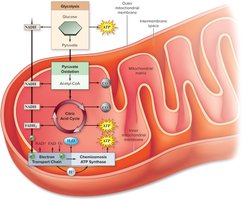
The complete oxidation of glucose occurs in four stages:
Glycolysis
Pyruvate oxidation
Citric acid cycle
Electron transport chain & chemiosmosis
Glycolysis
Glycolysis Pathway
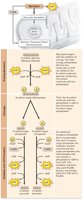
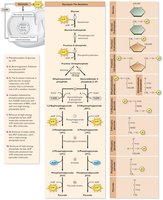
Glycolysis converts one glucose (6 carbons) into two pyruvate (3 carbons) through a 10-step pathway in the cytoplasm. It produces a net of 2 ATP molecules by substrate-level phosphorylation and 2 NADH molecules by reduction.
Detailed Glycolytic Pathway
The pathway includes priming, cleavage, and oxidation steps, resulting in the formation of pyruvate and NADH.
Regeneration of NAD+ and Fate of Pyruvate
NAD+ Recycling
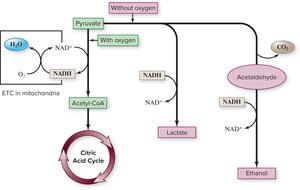
For glycolysis to continue, NADH must be recycled to NAD+ by:
Aerobic respiration: Oxygen is the final electron acceptor, producing significant ATP.
Fermentation: Occurs without oxygen; organic molecules are the final electron acceptors.
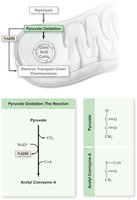
Pyruvate Oxidation
In the presence of oxygen, pyruvate is oxidized to acetyl-CoA, which enters the citric acid cycle. Without oxygen, pyruvate is reduced to regenerate NAD+ (fermentation).
Citric Acid Cycle (Krebs Cycle)
Cycle Overview and Steps
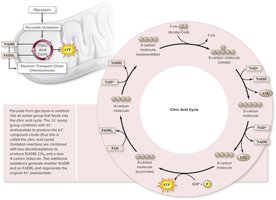
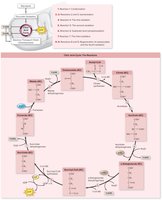
The citric acid cycle oxidizes the acetyl group from pyruvate in the mitochondrial matrix. It consists of nine steps in three segments: formation of citrate, rearrangement and decarboxylation, and regeneration of oxaloacetate.
Detailed Citric Acid Cycle
Each acetyl-CoA entering the cycle releases 2 CO2, reduces 3 NAD+ to NADH, reduces 1 FAD to FADH2, produces 1 ATP, and regenerates oxaloacetate.
Electron Transport Chain and Chemiosmosis
Electron Transport Chain (ETC)
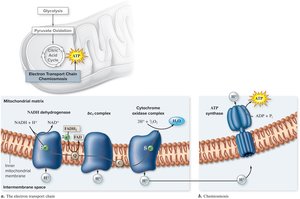
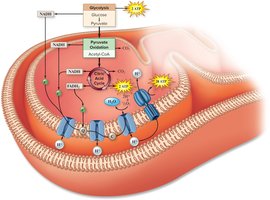
The ETC is a series of membrane-bound electron carriers in the inner mitochondrial membrane. Electrons from NADH and FADH2 are transferred through complexes, which act as proton pumps, creating a proton gradient.
ATP Synthase and Chemiosmosis
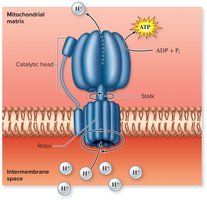
Protons re-enter the mitochondrial matrix through ATP synthase, which uses the energy of the gradient to synthesize ATP. ATP synthase consists of F0 (membrane-bound) and F1 (catalytic) subunits.
Energy Yield and Regulation of Respiration
Theoretical Energy Yield
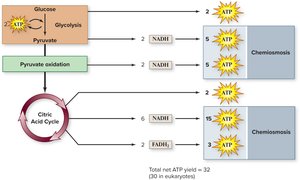
The theoretical yield is 32 ATP per glucose for bacteria and 30 ATP for eukaryotes. The phosphate-to-oxygen (P/O) ratio quantifies ATP synthesized per O2 molecule.
Regulation of Respiration
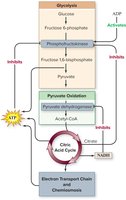
Respiration is regulated by feedback inhibition at key control points:
Glycolysis: Phosphofructokinase is inhibited by ATP and/or citrate.
Pyruvate oxidation/citric acid cycle: Pyruvate dehydrogenase is inhibited by NADH; citrate synthetase is inhibited by ATP.
Oxidation Without Oxygen: Anaerobic Respiration and Fermentation
Anaerobic Respiration
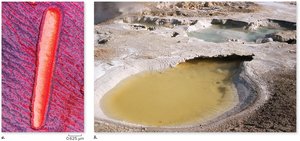
Some prokaryotes use inorganic molecules (e.g., sulfur, nitrate, CO2) as final electron acceptors. Methanogens reduce CO2 to CH4 (methane), and sulfur prokaryotes reduce sulfate to hydrogen sulfide (H2S).
Fermentation
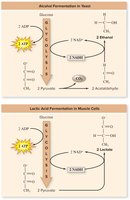
Fermentation regenerates NAD+ by reducing organic molecules. Two main types:
Ethanol fermentation: Occurs in yeast, producing CO2, ethanol, and NAD+.
Lactic acid fermentation: Occurs in animal cells, producing lactic acid.
Catabolism of Proteins and Fats
Protein Catabolism
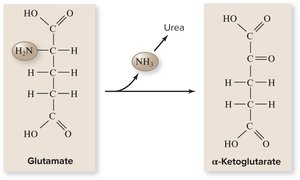
Amino acids undergo deamination to remove the amino group. The remaining molecule enters glycolysis or the citric acid cycle.
Fat Catabolism
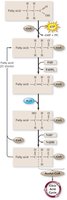
Fats are broken down to fatty acids and glycerol. Fatty acids are converted to acetyl groups by β-oxidation, an oxygen-dependent process. Respiration of a 6-carbon fatty acid yields 20% more energy than glucose.
Energy Extraction and Metabolic Integration
Energy Extraction in Cells
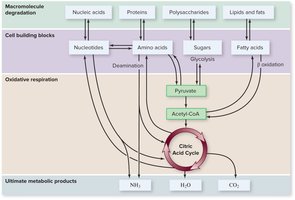
Macromolecules are degraded to building blocks, which are further processed for energy extraction. Nucleotides and amino acids can enter the citric acid cycle, sugars are broken down to pyruvate, and fatty acids undergo β-oxidation to acetyl-CoA. Ultimate metabolic products include ammonia, water, and carbon dioxide.
Evolution of Metabolism
Metabolic Pathway Evolution
The evolution of metabolism includes the development of ATP storage, glycolysis, anoxygenic and oxygenic photosynthesis, nitrogen fixation, and aerobic respiration. Glycolysis is a universal pathway found in all living organisms.
Summary Table: Energy Yield of Cellular Respiration
Stage | ATP Produced | NADH Produced | FADH2 Produced |
|---|---|---|---|
Glycolysis | 2 | 2 | 0 |
Pyruvate Oxidation | 0 | 2 | 0 |
Citric Acid Cycle | 2 | 6 | 2 |
Electron Transport Chain (Chemiosmosis) | ~28 | - | - |
Total (Eukaryotes) | 30 | 10 | 2 |
Total (Bacteria) | 32 | 10 | 2 |
Key Equations
Glucose oxidation:
ATP hydrolysis:
Substrate-level phosphorylation:
