 Indietro
Cellular Respiration and Metabolism: An Overview
Guida di studio - Note intelligenti
 Appunti personalizzati basati sui tuoi materiali, ampliati con definizioni chiave, esempi e contesto.
Metabolism: Anabolism and Catabolism
Overview of Metabolic Pathways
Metabolism encompasses all chemical reactions occurring within a cell, divided into two main categories: anabolism and catabolism. These pathways are essential for maintaining cellular structure and function.
Anabolism: The synthesis of complex molecules from simpler building blocks. Most anabolic reactions are endergonic (require energy input), often using ATP.
Catabolism: The breakdown of complex molecules into simpler ones, releasing energy (exergonic reactions) that can be captured as ATP.
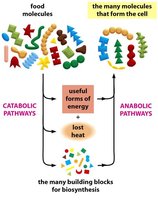
Example: The breakdown of glucose during cellular respiration is a catabolic process, while the synthesis of proteins from amino acids is anabolic.
Cellular Respiration: Capturing Energy
Definition and Types
Cellular respiration is a set of metabolic processes that convert biochemical energy from nutrients into ATP, releasing waste products. It is primarily an exergonic process.
Aerobic respiration: Requires oxygen; produces the most ATP.
Anaerobic respiration: Does not require oxygen; uses other molecules as final electron acceptors.
Fermentation: Does not require oxygen or an electron transport chain; yields less ATP.
Cellular Respiration vs. Photosynthesis
Comparative Overview
Cellular respiration and photosynthesis are complementary processes. While cellular respiration breaks down glucose to produce ATP, photosynthesis uses light energy to synthesize glucose from CO2 and H2O.
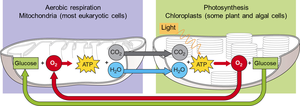
Cellular Respiration: Occurs in mitochondria; uses O2, releases CO2 and H2O.
Photosynthesis: Occurs in chloroplasts; uses CO2 and H2O, releases O2.
Stages of Aerobic Respiration
Main Stages and Locations
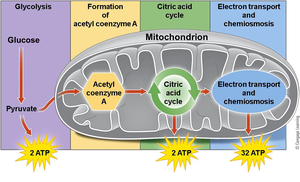
Aerobic respiration consists of four main stages, each occurring in specific cellular locations:
Glycolysis: Cytoplasm
Acetyl CoA Synthesis: Mitochondrial matrix
Citric Acid Cycle (Krebs Cycle): Mitochondrial matrix
Oxidative Phosphorylation (Electron Transport Chain): Inner mitochondrial membrane
Glycolysis
Process and Yield
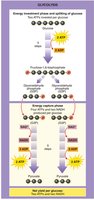
Glycolysis is the first stage of cellular respiration, occurring in the cytoplasm. It metabolizes one glucose (6C) molecule into two pyruvate (3C) molecules, producing a net gain of ATP and NADH.
Does not require oxygen (anaerobic process).
Two phases: energy investment (requires ATP) and energy payoff (produces ATP and NADH).
Net yield: 2 ATP and 2 NADH per glucose.
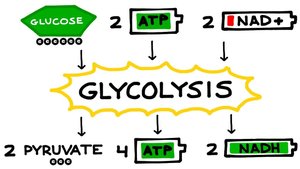
Example: Glycolysis is the only energy-yielding pathway in some anaerobic organisms.
Acetyl CoA Synthesis
Conversion of Pyruvate
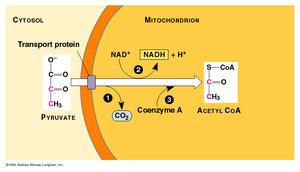
After glycolysis, pyruvate is transported into the mitochondrial matrix, where it is converted into acetyl CoA. This step links glycolysis to the citric acid cycle.
One carbon from pyruvate is released as CO2.
NAD+ is reduced to NADH.
The remaining two-carbon acetyl group is attached to coenzyme A.
Citric Acid Cycle (Krebs Cycle)
Cycle Overview and Products
The citric acid cycle occurs in the mitochondrial matrix and completes the oxidation of glucose derivatives. It generates high-energy electron carriers and releases CO2.
Acetyl CoA combines with oxaloacetate to form citrate.
Two carbons are released as CO2 per cycle.
Produces NADH, FADH2, and ATP (or GTP).
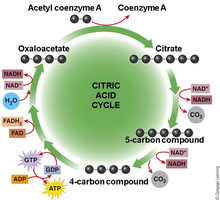
Yield per glucose (two cycles): 6 NADH, 2 FADH2, 2 ATP, 4 CO2.
Electron Transport Chain (ETC) and Oxidative Phosphorylation
Mechanism and ATP Production
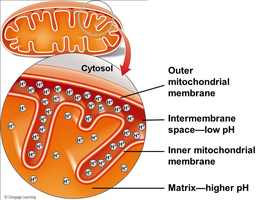
The electron transport chain is located on the inner mitochondrial membrane. Electrons from NADH and FADH2 are transferred through a series of complexes, driving proton pumping and ATP synthesis.
Four main complexes (I-IV) accept and donate electrons in redox reactions.
Proton gradient is established across the inner membrane (high H+ in intermembrane space, low in matrix).
Oxygen is the final electron acceptor, forming water.
ATP is produced by chemiosmosis via ATP synthase.
Example: Cyanide inhibits Complex IV, blocking ATP production and causing cell death.
Energy Yield from Glucose
ATP Accounting
The complete oxidation of one glucose molecule by aerobic respiration yields approximately 36-38 ATP molecules:
Glycolysis: 2 ATP (net), 2 NADH
Citric Acid Cycle: 2 ATP, 6 NADH, 2 FADH2
ETC/Oxidative Phosphorylation: ~32-34 ATP (from NADH and FADH2)
Equation:
Alternative Substrates: Proteins and Fats
Metabolism of Other Biomolecules
Cells can also extract energy from proteins and fats:
Proteins: Amino groups are removed; carbon skeletons enter glycolysis or the citric acid cycle.
Fats: Glycerol enters glycolysis; fatty acids are converted to acetyl CoA via beta-oxidation.
Anaerobic Respiration
Respiration Without Oxygen
Anaerobic respiration occurs in some prokaryotes, using electron acceptors other than oxygen (e.g., nitrate, sulfate, or carbon dioxide).
Methanogens: Use CO2 as the final electron acceptor, producing methane.
Sulfur bacteria: Use sulfate, producing sulfur dioxide.
Fermentation
ATP Production Without Oxygen or ETC
Fermentation is an anaerobic process that allows ATP production via substrate-level phosphorylation when oxygen is unavailable. It is less efficient than aerobic respiration.
Only 2 ATP per glucose are produced.
Two main types:
Alcohol fermentation: Occurs in yeast; produces ethanol and CO2.
Lactate fermentation: Occurs in some bacteria and animal muscle cells; produces lactate.
Example: Human muscle cells use lactate fermentation during intense exercise when oxygen is scarce.
Summary Table: Aerobic Respiration vs. Fermentation
Process | Oxygen Required? | ATP Yield (per glucose) | End Products |
|---|---|---|---|
Aerobic Respiration | Yes | 36-38 | CO2, H2O |
Fermentation | No | 2 | Lactate or Ethanol + CO2 |
Key Terms and Concepts
Cellular respiration: The process by which cells harvest energy from organic molecules, primarily glucose.
ATP (Adenosine Triphosphate): The main energy currency of the cell.
NADH/FADH2: Electron carriers that transfer high-energy electrons to the ETC.
Substrate-level phosphorylation: Direct transfer of a phosphate group to ADP to form ATP.
Oxidative phosphorylation: ATP synthesis powered by the transfer of electrons through the ETC and chemiosmosis.
