 Indietro
Cellular Respiration and Metabolism: Chapter 6/7 Study Guide
Guida di studio - Note intelligenti
 Appunti personalizzati basati sui tuoi materiali, ampliati con definizioni chiave, esempi e contesto.
Cellular Respiration and Metabolism
Key Terms and Concepts
This section introduces essential vocabulary and concepts related to cellular respiration and metabolism, which are fundamental to understanding how cells extract and use energy.
ATP (Adenosine Triphosphate): The primary energy carrier in cells, acting as a rechargeable battery.
ADP (Adenosine Diphosphate): The product of ATP hydrolysis; can be converted back to ATP.
NADH, NAD+, FADH2: Electron carriers involved in cellular respiration.
Glucose: The main fuel molecule for cellular respiration.
Glycolysis: The first step in cellular respiration, breaking down glucose.
Fermentation: An anaerobic pathway for ATP production.
Electron Transport Chain: The final stage of cellular respiration, producing most ATP.
Citric Acid Cycle (Krebs Cycle): A series of reactions extracting energy from acetyl-CoA.
Energy and Life
Energy from the sun is the ultimate source for nearly all life on Earth. Plants capture solar energy through photosynthesis, converting it into chemical energy stored in molecules like glucose. Animals and other organisms obtain energy by consuming these molecules and breaking them down via cellular respiration.
Kinetic Energy: Energy of motion (e.g., muscle contraction, moving water).
Potential Energy: Stored energy (e.g., chemical bonds in glucose, ATP).
Chemical Energy: A form of potential energy stored in chemical bonds.
Example: ATP stores chemical energy; when hydrolyzed to ADP, energy is released for cellular work.
Laws of Thermodynamics in Biology
The laws of thermodynamics govern energy transformations in living organisms:
First Law: Energy cannot be created or destroyed, only transformed.
Second Law: Energy transformations increase entropy (disorder); some energy is lost as heat.
When energy is converted from one form to another, the total amount remains constant, but its usefulness decreases.
ATP: The Cellular Energy Currency
ATP is a nucleotide consisting of adenine, ribose, and three phosphate groups. It acts as a universal energy source for cells, storing energy in its phosphate bonds.
Structure: Three phosphate groups attached to adenosine.
Function: Releases energy when converted to ADP and inorganic phosphate.
Rechargeable: ADP can be re-phosphorylated to ATP.
Example: ATP is used in muscle contraction, active transport, and biosynthesis.
Enzymes and Denaturation
Enzymes are biological catalysts that speed up chemical reactions by lowering activation energy. When enzymes denature (lose their shape due to heat or pH changes), they lose their function.
Function: Facilitate metabolic reactions.
Denaturation: Loss of structure leads to loss of activity.
Steps of Cellular Respiration
Overview
Cellular respiration is a multi-step process that converts glucose into ATP. It consists of glycolysis, the citric acid cycle, and the electron transport chain.
Inputs: Glucose, oxygen.
Outputs: ATP, carbon dioxide, water.
Glycolysis
Glycolysis occurs in the cytoplasm and is the universal energy-releasing pathway. It breaks down glucose into pyruvate, producing ATP and NADH.
ATP Investment: Initial ATP is used to activate glucose.
Products: 2 pyruvate, 2 NADH, 2 ATP (net gain).
Fermentation: Under anaerobic conditions, pyruvate is converted to lactic acid or ethanol.
Example: Yeast produces ethanol via fermentation; muscle cells produce lactic acid.
Citric Acid Cycle (Krebs Cycle)
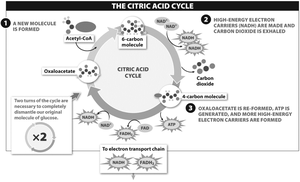
The citric acid cycle occurs in the mitochondria and extracts energy from acetyl-CoA, producing NADH, FADH2, ATP, and CO2.
Acetyl-CoA: Derived from pyruvate; enters the cycle.
Energy Production: NADH and FADH2 are produced as electron carriers.
CO2: Released as a waste product.
Electron Carriers: NADH and FADH2 transport electrons to the electron transport chain.
Example: Two turns of the cycle are needed to fully break down one glucose molecule.
Electron Transport Chain (ETC)
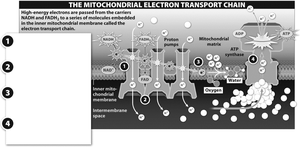
The ETC is located in the inner mitochondrial membrane and is the site of the major ATP payoff. High-energy electrons from NADH and FADH2 are passed through protein complexes, pumping protons and generating a gradient used by ATP synthase.
Electrons: Provide energy for proton pumps.
Protons (H+): Accumulate in the intermembrane space, creating a gradient.
ATP Synthase: Uses the proton gradient to convert ADP to ATP.
Oxygen: Final electron acceptor, forming water.
Equation:
Example: Up to 36-38 ATP molecules can be produced from one glucose molecule.
Anaerobic Respiration and Fermentation
When oxygen is unavailable, cells use fermentation pathways to produce ATP. Two main types are lactic acid fermentation and alcoholic fermentation.
Lactic Acid Fermentation: Produces lactic acid (e.g., in muscle cells).
Alcoholic Fermentation: Produces ethanol (e.g., in yeast).
Example: Yeast produces ethanol in wine-making; muscle cells produce lactic acid during intense exercise.
Summary Table: Cellular Respiration Steps
Step | Location | Main Inputs | Main Outputs | ATP Yield |
|---|---|---|---|---|
Glycolysis | Cytoplasm | Glucose, 2 ATP | 2 Pyruvate, 2 NADH, 4 ATP (2 net) | 2 |
Citric Acid Cycle | Mitochondria | Acetyl-CoA | CO2, NADH, FADH2, ATP | 2 |
Electron Transport Chain | Inner mitochondrial membrane | NADH, FADH2, O2 | ATP, H2O | 32-34 |
Additional info:
Carbon monoxide poisoning prevents oxygen from acting as the final electron acceptor in the ETC, halting ATP production and causing cell death.
Yeast requires anaerobic conditions to produce ethanol; if oxygen is present, it will perform aerobic respiration instead.
