 Indietro
Cellular Respiration: Electron Transport Chain, Oxidative Phosphorylation, and Fermentation
Guida di studio - Note intelligenti
 Appunti personalizzati basati sui tuoi materiali, ampliati con definizioni chiave, esempi e contesto.
Chapter 6: Cellular Respiration
Stage 3: Electron Transport Chain and Oxidative Phosphorylation
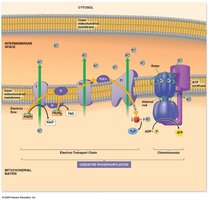
The final stage of cellular respiration is responsible for producing the majority of ATP in eukaryotic cells. This process occurs in the inner mitochondrial membrane and involves the transfer of electrons from NADH and FADH2 to oxygen, creating an electrochemical gradient that powers ATP synthesis.
Electron Transport Chain (ETC): A series of protein complexes embedded in the inner mitochondrial membrane that facilitate the transfer of electrons from NADH and FADH2 to O2.
Oxidative Phosphorylation: The synthesis of ATP driven by the energy released from electron transfer and the resulting proton gradient.
ATP Synthase: The enzyme that uses the energy from the proton gradient to convert ADP and inorganic phosphate (Pi) into ATP.
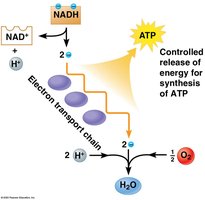
Inputs and Outputs of ETC/Oxidative Phosphorylation
Inputs (per glucose): 10 NADH, 2 FADH2, 6 O2
Outputs: 24–32 ATP, 6 H2O, 10 NAD+, 2 FAD
Mechanism of Electron Transport Chain
NADH and FADH2 donate electrons to the ETC, regenerating NAD+ and FAD. As electrons move through the chain, their energy is used to pump protons (H+) across the membrane, creating an electrochemical gradient. Oxygen acts as the final electron acceptor, combining with electrons and H+ to form water.
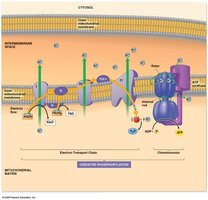
Proton Pumps and Electrochemical Gradient
Proton Pumps: Proteins in the ETC actively transport H+ from the mitochondrial matrix to the intermembrane space.
Electrochemical Gradient: The accumulation of H+ in the intermembrane space creates a gradient of both charge and concentration, representing potential energy.
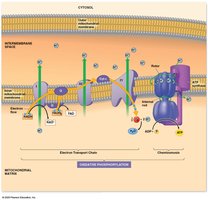
Role of Oxygen
Oxygen: Essential as the final electron acceptor. Without O2, the ETC stops, NADH cannot be oxidized, and the citric acid cycle halts, leaving only glycolysis (which produces insufficient ATP for most eukaryotes).
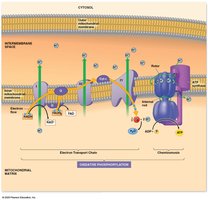
Chemiosmosis and ATP Synthesis
H+ ions diffuse back into the matrix through ATP synthase, a process called chemiosmosis. This movement provides the energy needed to synthesize ATP from ADP and Pi. The chemiosmotic theory, proposed in 1961, explains that most ATP is generated by this mechanism.
Chemiosmosis: The movement of ions down their electrochemical gradient through a membrane protein.
ATP Yield: 24–32 ATP per glucose molecule.
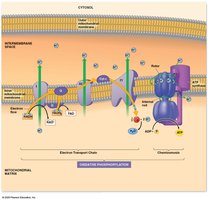
Summary of ETC and Chemiosmosis
Electrons from NADH and FADH2 power proton pumps.
Electrons combine with O2 to form water.
H+ diffuses through ATP synthase, forming ATP.
ETC and chemiosmosis together constitute oxidative phosphorylation.
Chapter 6: Cellular Respiration
Part 5: Fermentation
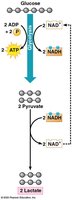
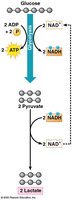
Fermentation is an anaerobic process that allows cells to extract energy from food molecules in the absence of oxygen. It is essential for regenerating NAD+ so glycolysis can continue. There are two main types: lactate fermentation and alcohol fermentation.
Lactate Fermentation
Process: Begins with glycolysis (glucose → 2 pyruvate, 2 ATP, 2 NADH). Pyruvate is reduced to lactate, regenerating NAD+.
Organisms: Bacteria (cheese, yogurt production), animal cells (during intense exercise).
Limitations: Not sustainable for long periods; lactate can be converted back to pyruvate in the liver.
Alcohol Fermentation
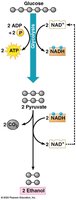
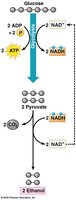
Process: Begins with glycolysis (glucose → 2 pyruvate, 2 ATP, 2 NADH). Pyruvate is reduced to ethanol, producing CO2 and regenerating NAD+.
Organisms: Yeasts (bread, wine, beer production), some fungi and bacteria.
Comparison of Fermentation Types
Type | Reactants | Products | Organisms |
|---|---|---|---|
Lactate Fermentation | Glucose, NAD+ | Lactate, ATP, NAD+ | Bacteria, animal cells |
Alcohol Fermentation | Glucose, NAD+ | Ethanol, CO2, ATP, NAD+ | Yeasts, some fungi/bacteria |
Key Equations
Oxidative Phosphorylation:
Lactate Fermentation:
Alcohol Fermentation:
Definitions
Substrate-level phosphorylation: ATP synthesis by direct transfer of a phosphate group to ADP.
Oxidative phosphorylation: ATP synthesis powered by electron transfer and chemiosmosis.
Chemiosmosis: Movement of ions across a membrane, generating ATP.
Fermentation: Anaerobic energy extraction from food molecules.
Additional info:
The chemiosmotic theory was initially controversial but is now a foundational concept in bioenergetics.
Fermentation is crucial for certain industrial and food processes, as well as for cellular survival under anaerobic conditions.
