 Indietro
Cellular Respiration, Glycolysis, and Energy Metabolism
Guida di studio - Note intelligenti
 Appunti personalizzati basati sui tuoi materiali, ampliati con definizioni chiave, esempi e contesto.
Energy and Metabolism
Introduction to Cellular Energy
All living organisms require energy to perform essential cellular functions such as growth, repair, and movement. This energy is derived from the breakdown of food molecules—primarily carbohydrates, lipids, and proteins—which are composed mainly of carbon, hydrogen, and oxygen. The process of extracting energy from these molecules involves a series of chemical reactions that follow the same physical laws as reactions in a chemistry laboratory.
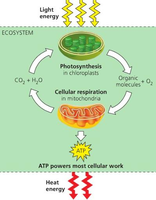
Energy Storage and Release: Energy must be released from food gradually, stored in accessible forms, and released in a controlled manner to meet cellular demands.
ATP: Adenosine triphosphate (ATP) is the primary energy currency of the cell, powering most cellular work.
Thermodynamics in Biological Systems
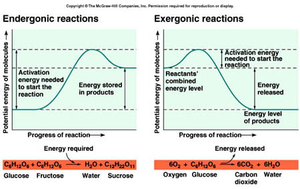
Enthalpy (ΔH): The heat content of a system, measured as the difference between the energy of bonds broken and formed during a reaction. Negative ΔH indicates exothermic reactions (release heat), while positive ΔH indicates endothermic reactions (absorb heat).
Entropy (ΔS): A measure of disorder or randomness. Positive ΔS means increased disorder; negative ΔS means decreased disorder.
Free Energy (ΔG): Determines whether a reaction is spontaneous. Calculated as (T = temperature in Kelvins). Negative ΔG (exergonic) means the reaction is spontaneous; positive ΔG (endergonic) means it is nonspontaneous.
Metabolism and Glucose Pathways
Overview of Metabolism
Metabolism encompasses all chemical reactions in an organism, organized into metabolic pathways. These pathways can be linear, cyclic, or spiral, and are tightly regulated to ensure efficient energy use and production.
Glucose: Central to energy metabolism, especially for the brain, muscles, and red blood cells.
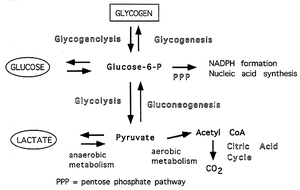
Metabolic Fates: Glucose can be stored as glycogen, converted to pyruvate via glycolysis, or enter the pentose phosphate pathway for biosynthesis.
Glycolysis
Pathway Overview
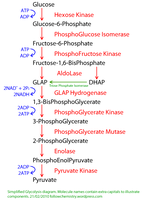
Glycolysis is a ten-step, enzyme-catalyzed pathway that converts one molecule of glucose into two molecules of pyruvate, generating a net gain of 2 ATP and 2 NADH. It occurs in the cytosol of all cells and is divided into two phases: the energy investment phase (steps 1–5) and the energy payoff phase (steps 6–10).
Energy Investment: ATP is consumed to phosphorylate glucose and its intermediates.
Energy Payoff: ATP and NADH are produced as glucose is split and oxidized.
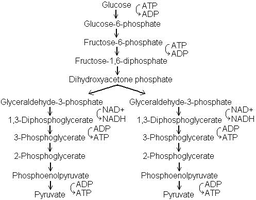
Stepwise Breakdown of Glycolysis
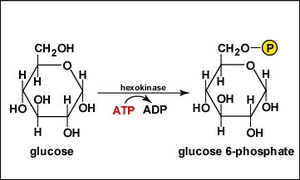
Step 1: Phosphorylation of Glucose
Enzyme: Hexokinase
Reaction: Glucose + ATP → Glucose 6-phosphate + ADP
Notes: Highly exergonic and irreversible; glucose 6-phosphate inhibits hexokinase (allosteric inhibition).
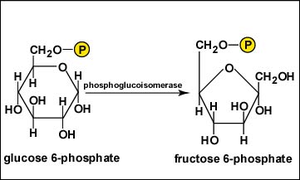
Step 2: Isomerization
Enzyme: Glucose 6-phosphate isomerase
Reaction: Glucose 6-phosphate (aldohexose) → Fructose 6-phosphate (ketohexose)
Notes: Prepares the molecule for further phosphorylation.
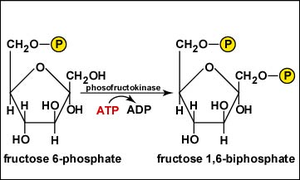
Step 3: Second Phosphorylation
Enzyme: Phosphofructokinase
Reaction: Fructose 6-phosphate + ATP → Fructose 1,6-bisphosphate + ADP
Notes: Highly exergonic and irreversible; regulated by ATP, ADP, AMP, and citrate.
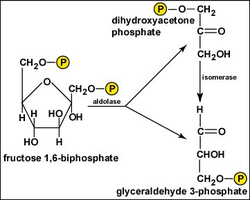
Steps 4 & 5: Cleavage and Isomerization
Enzymes: Aldolase (cleavage), Triose phosphate isomerase (isomerization)
Reaction: Fructose 1,6-bisphosphate → Dihydroxyacetone phosphate + Glyceraldehyde 3-phosphate
Notes: 6-carbon sugar split into two 3-carbon molecules.
Net Result of Glycolysis
Glucose → 2 Pyruvate
Net production: 2 ATP, 2 NADH
Equation:
Fate of Pyruvate and Fermentation
Aerobic vs. Anaerobic Conditions
The fate of pyruvate depends on oxygen availability and organism type:
Aerobic: Pyruvate is converted to acetyl-CoA, enters the citric acid cycle, and is fully oxidized to CO2.
Anaerobic: Pyruvate is converted to lactate (in animals) or ethanol (in yeast) via fermentation, regenerating NAD+ for glycolysis.
Fermentation
Alcohol Fermentation: Pyruvate → Acetaldehyde + CO2 → Ethanol (used in brewing, winemaking, baking)
Lactic Acid Fermentation: Pyruvate is reduced to lactate (used in muscle cells, cheese, yogurt production)
ATP Yield: Fermentation yields only 2 ATP per glucose, compared to up to 38 ATP in aerobic respiration.
Citric Acid Cycle and Electron Transport Chain
Citric Acid Cycle (Krebs Cycle)
The citric acid cycle occurs in the mitochondrial matrix and completes the oxidation of acetyl-CoA to CO2, generating NADH, FADH2, and GTP (converted to ATP). The cycle is regulated by cellular energy needs and allosteric effectors.
Net Reaction: Acetyl-CoA + 3 NAD+ + FAD + GDP + HOPO32- + H2O → HSCoA + 3 NADH + 3 H+ + FADH2 + GTP + 2 CO2
Regulation: Controlled by ATP, NADH, ADP, and other intermediates.
Electron Transport Chain (ETC) and Oxidative Phosphorylation
The ETC is located in the inner mitochondrial membrane. Electrons from NADH and FADH2 are transferred through a series of carriers, ultimately reducing O2 to H2O. The energy released is used to pump protons, creating a gradient that drives ATP synthesis via ATP synthase.
ATP Yield: 1 NADH yields ~2.5 ATP; 1 FADH2 yields ~1.5 ATP.
Blockers and Uncouplers: Substances like cyanide can block the ETC, while uncouplers (e.g., 2,4-dinitrophenol) disrupt ATP synthesis by dissipating the proton gradient.
ATP and Energy Transfer
ATP Hydrolysis and Synthesis
ATP Hydrolysis: , kcal/mol (exergonic)
ATP Synthesis: , kcal/mol (endergonic)
Role: ATP acts as an energy shuttle, coupling exergonic and endergonic reactions in the cell.
Oxidation-Reduction and Coenzymes
Redox Reactions in Metabolism
Oxidation: Loss of electrons, loss of hydrogen, or gain of oxygen.
Reduction: Gain of electrons, gain of hydrogen, or loss of oxygen.
Coenzymes: NAD+ and FAD act as electron carriers, cycling between oxidized and reduced forms to facilitate redox reactions.
Summary Table: Glycolysis Steps and Enzymes
Step | Enzyme | Substrate | Product | ATP/NADH |
|---|---|---|---|---|
1 | Hexokinase | Glucose | Glucose 6-phosphate | -1 ATP |
2 | Phosphoglucose isomerase | Glucose 6-phosphate | Fructose 6-phosphate | |
3 | Phosphofructokinase | Fructose 6-phosphate | Fructose 1,6-bisphosphate | -1 ATP |
4 | Aldolase | Fructose 1,6-bisphosphate | Glyceraldehyde 3-phosphate, Dihydroxyacetone phosphate | |
5 | Triose phosphate isomerase | Dihydroxyacetone phosphate | Glyceraldehyde 3-phosphate | |
6 | Glyceraldehyde 3-phosphate dehydrogenase | Glyceraldehyde 3-phosphate | 1,3-Bisphosphoglycerate | +2 NADH |
7 | Phosphoglycerate kinase | 1,3-Bisphosphoglycerate | 3-Phosphoglycerate | +2 ATP |
8 | Phosphoglycerate mutase | 3-Phosphoglycerate | 2-Phosphoglycerate | |
9 | Enolase | 2-Phosphoglycerate | Phosphoenolpyruvate | |
10 | Pyruvate kinase | Phosphoenolpyruvate | Pyruvate | +2 ATP |
Additional info: The above notes integrate foundational concepts from general biology and biochemistry, providing a comprehensive overview of cellular energy metabolism, glycolysis, fermentation, and the citric acid cycle. The included images directly support the explanations of metabolic pathways and energy transformations.
