Indietro
Cellular Respiration: Glycolysis, Citric Acid Cycle, and Electron Transport Chain
Guida di studio - Note intelligenti
 Appunti personalizzati basati sui tuoi materiali, ampliati con definizioni chiave, esempi e contesto.
Cellular Respiration
Overview of Cellular Respiration
Cellular respiration is the process by which cells extract energy from glucose and other organic molecules. It consists of three main stages: glycolysis, the citric acid cycle (Krebs cycle), and the electron transport chain. Each stage occurs in specific locations within the cell and produces different products essential for cellular energy.
Glycolysis: Occurs in the cytoplasm; breaks down glucose into pyruvate.
Citric Acid Cycle (Krebs Cycle): Occurs in the mitochondrial matrix; oxidizes acetyl-CoA to CO2.
Electron Transport Chain: Occurs in the inner mitochondrial membrane; produces ATP via oxidative phosphorylation.
Glycolysis
Glycolysis is the first step of cellular respiration, where one molecule of glucose is converted into two molecules of pyruvate. This process generates a small amount of ATP and NADH.
Location: Cytoplasm
Reactants: Glucose, 2 ATP, 2 NAD+
Products: 2 Pyruvate, 4 ATP (net gain: 2 ATP), 2 NADH
Key Steps: Energy investment phase (uses ATP), energy payoff phase (produces ATP and NADH)
Equation:
Citric Acid Cycle (Krebs Cycle)
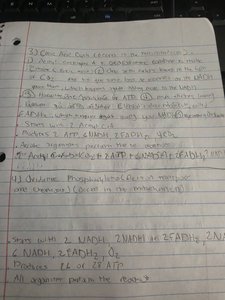
The citric acid cycle completes the breakdown of glucose by oxidizing acetyl-CoA to carbon dioxide. It produces NADH and FADH2 for use in the electron transport chain.
Location: Mitochondrial matrix
Reactants: Acetyl-CoA, NAD+, FAD, ADP
Products: CO2, NADH, FADH2, ATP
Key Steps: Acetyl-CoA combines with oxaloacetate to form citrate; cycle regenerates oxaloacetate
Equation:
Electron Transport Chain and Oxidative Phosphorylation
The electron transport chain uses electrons from NADH and FADH2 to create a proton gradient across the inner mitochondrial membrane. ATP synthase uses this gradient to produce ATP.
Location: Inner mitochondrial membrane
Reactants: NADH, FADH2, O2
Products: ATP, H2O
Key Steps: Electrons transferred through protein complexes; oxygen is the final electron acceptor
Equation:
ATP Yield: Approximately 34 ATP per glucose molecule (from oxidative phosphorylation)
Summary Table: Products of Cellular Respiration
The following table summarizes the products generated at each stage of cellular respiration:
Stage | Location | Main Products |
|---|---|---|
Glycolysis | Cytoplasm | 2 ATP, 2 NADH, 2 Pyruvate |
Citric Acid Cycle | Mitochondrial Matrix | 2 ATP, 6 NADH, 2 FADH2, 4 CO2 |
Electron Transport Chain | Inner Mitochondrial Membrane | ~34 ATP, H2O |
Additional info:
Some organisms perform fermentation instead of oxidative phosphorylation when oxygen is not available. Fermentation produces less ATP and results in products such as lactic acid or ethanol.