Indietro
Cellular Respiration: Harvesting Chemical Energy (Chapter 9 Study Guide)
Guida di studio - Note intelligenti
 Appunti personalizzati basati sui tuoi materiali, ampliati con definizioni chiave, esempi e contesto.
Cellular Respiration: Harvesting Chemical Energy
Overview of Cellular Respiration
Cellular respiration is a fundamental metabolic process in which cells extract energy from organic molecules, primarily glucose, to produce ATP. This process involves a series of catabolic pathways and redox reactions, enabling organisms to efficiently convert chemical energy into usable cellular energy.
Energy Flow: Energy enters ecosystems as light and exits as heat. Chemical elements essential to life are recycled.
Photosynthesis: Uses CO2 and H2O to make organic molecules and O2.
Cellular Respiration: Uses O2 and organic molecules to make ATP; CO2 and H2O are produced as waste.
Catabolic Pathways: Release stored energy by breaking down complex molecules.
Electron Transfer: Plays a major role in energy release during cellular respiration.
Catabolic Pathways and Redox Reactions
Catabolic pathways yield energy by oxidizing organic fuels. The breakdown of organic molecules is exergonic, releasing energy. Cellular respiration includes both aerobic and anaerobic respiration, but is often used to refer to aerobic respiration.
Fermentation: Partial degradation of sugars without oxygen.
Aerobic Respiration: Consumes organic molecules and oxygen, yielding ATP.
Anaerobic Respiration: Similar to aerobic but uses compounds other than oxygen as electron acceptors.
General Equation:
ATP Regeneration: Cells must constantly regenerate ATP from ADP and phosphate.

Oxidation-Reduction (Redox) Reactions
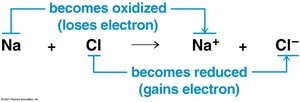
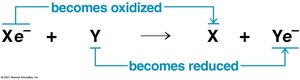
Redox reactions are chemical reactions that transfer electrons between reactants. The loss of electrons is called oxidation, while the gain of electrons is called reduction. These reactions are central to cellular respiration.
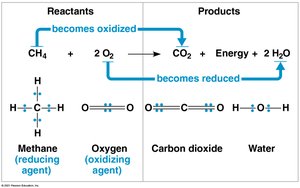
Reducing Agent: Electron donor; reduces the electron acceptor.
Oxidizing Agent: Electron acceptor; oxidizes the electron donor.
Electron Sharing: Some redox reactions involve changes in electron sharing in covalent bonds.
Redox Reactions in Biological Systems
Oxygen atoms are highly electronegative and attract electrons, leading to partial gain and loss of electrons in redox reactions. Moving electrons closer to oxygen releases energy, which is harnessed in cellular respiration.
Example: Methane and oxygen react, with methane as the reducing agent and oxygen as the oxidizing agent.
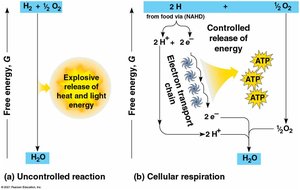
Energy Release: Electrons lose potential energy when moving toward more electronegative atoms.
Oxidation of Organic Fuel Molecules
During cellular respiration, fuel molecules such as glucose are oxidized, and oxygen is reduced. Organic molecules with abundant hydrogen are excellent sources of high-energy electrons.
Energy Transfer: Electrons move from a higher energy state in glucose to a lower energy state with oxygen, releasing energy for ATP synthesis.
Stepwise Energy Harvest via NAD+ and the Electron Transport Chain
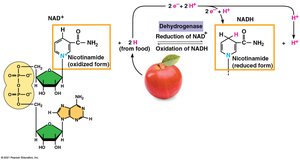
Glucose and other organic molecules are oxidized in a series of steps. Electrons are transferred to electron carriers, primarily NAD+, which functions as an oxidizing agent. NADH represents stored energy used to synthesize ATP.
Dehydrogenases: Enzymes that remove hydrogen atoms from substrates and transfer electrons to NAD+.
Electron Transport Chain: Breaks the fall of electrons to oxygen into several energy-releasing steps.
The Stages of Cellular Respiration
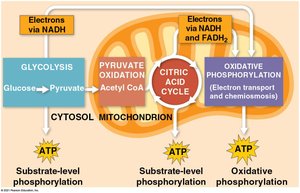
Cellular respiration consists of three main stages: glycolysis, pyruvate oxidation and the citric acid cycle, and oxidative phosphorylation. Each stage contributes to the breakdown of glucose and the production of ATP.
Glycolysis: Breaks down glucose into two molecules of pyruvate.
Pyruvate Oxidation & Citric Acid Cycle: Completes the breakdown of glucose to CO2.
Oxidative Phosphorylation: Electron transport chain and chemiosmosis synthesize most ATP.
ATP Production: Substrate-Level and Oxidative Phosphorylation
ATP is produced by two mechanisms: substrate-level phosphorylation and oxidative phosphorylation. Substrate-level phosphorylation involves direct transfer of a phosphate group to ADP by an enzyme.
Oxidative Phosphorylation: Generates almost 90% of ATP, powered by redox reactions.
Substrate-Level Phosphorylation: Occurs in glycolysis and the citric acid cycle.
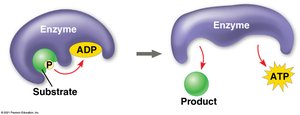
Glycolysis: Harvesting Chemical Energy
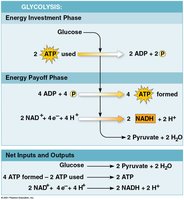
Glycolysis occurs in the cytoplasm and consists of two phases: energy investment and energy payoff. It produces a net of 2 ATP and 2 NADH per glucose molecule.
Energy Investment Phase: 2 ATP are used to split glucose.
Energy Payoff Phase: 4 ATP are synthesized, 2 NAD+ are reduced to NADH, and 2 pyruvate and 2 H2O are formed.
Net Production: 2 ATP by substrate-level phosphorylation.
Glycolysis Equation:
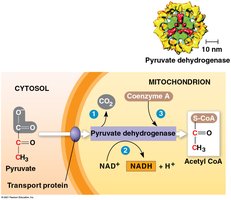
Pyruvate Oxidation and the Citric Acid Cycle
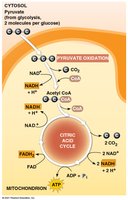
After glycolysis, pyruvate is converted to acetyl CoA before entering the citric acid cycle. Pyruvate dehydrogenase catalyzes this conversion, releasing CO2, reducing NAD+ to NADH, and forming acetyl CoA.
Citric Acid Cycle (Krebs Cycle): Oxidizes organic fuel, generating 1 ATP, 3 NADH, and 1 FADH2 per turn.
Cycle Runs Twice: For each glucose molecule, the cycle runs twice.
Electron Carriers: NADH and FADH2 carry electrons to the electron transport chain.
Oxidative Phosphorylation and Chemiosmosis
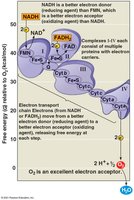
Oxidative phosphorylation couples electron transport to ATP synthesis via chemiosmosis. The electron transport chain is embedded in the inner mitochondrial membrane, and electrons are passed through carrier molecules, including cytochromes.
Electron Transport Chain: Electrons drop in free energy as they are transferred down the chain, finally passing to O2 to form H2O.
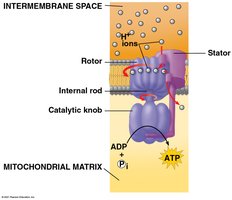
ATP Synthase: H+ gradient drives ATP synthesis as protons move through ATP synthase.
Proton-Motive Force: The H+ gradient's capacity to do work.
Fermentation and Anaerobic Respiration
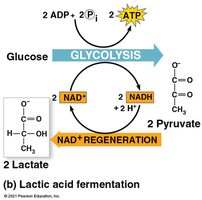
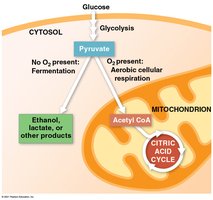
Cells can produce ATP without oxygen through fermentation or anaerobic respiration. Fermentation extends glycolysis by oxidizing NADH and transferring electrons to pyruvate or its derivatives.
Alcohol Fermentation: Pyruvate is converted to ethanol, releasing CO2 and regenerating NAD+.
Lactic Acid Fermentation: Pyruvate is reduced directly by NADH to form lactate and NAD+.
ATP Yield: Fermentation produces 2 ATP per glucose.
Comparing Fermentation, Anaerobic, and Aerobic Respiration
All three processes use glycolysis to oxidize glucose, but differ in their mechanisms for oxidizing NADH and their ATP yield.
Fermentation: Uses organic molecules as final electron acceptors.
Anaerobic Respiration: Uses electron transport chain with non-oxygen acceptors.
Aerobic Respiration: Uses oxygen as the final electron acceptor, yielding up to 32 ATP per glucose.
Facultative Anaerobes: Can survive using either fermentation or cellular respiration.
Connections to Other Metabolic Pathways
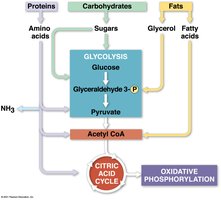
Glycolysis and the citric acid cycle are central to many catabolic and anabolic pathways. Carbohydrates, proteins, and fats can all be used as fuel for cellular respiration.
Proteins: Digested to amino acids; amino groups removed by deamination.
Fats: Digested to glycerol and fatty acids; fatty acids undergo beta oxidation to yield acetyl CoA, NADH, and FADH2.
ATP Yield: Fats produce more ATP per gram than carbohydrates.
Regulation of Cellular Respiration
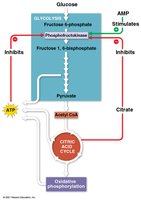
Cellular respiration is regulated by feedback mechanisms, primarily feedback inhibition. Enzyme activity is controlled at strategic points in the pathway to prevent wasteful production.
ATP Concentration: If ATP drops, respiration speeds up; if ATP is abundant, respiration slows down.
Enzyme Regulation: Catabolism is controlled by regulating key enzymes.