 Indietro
Cellular Respiration II: Electron Transport, Chemiosmosis, and Fermentation
Guida di studio - Note intelligenti
 Appunti personalizzati basati sui tuoi materiali, ampliati con definizioni chiave, esempi e contesto.
Cellular Respiration: Electron Transport Chain and Chemiosmosis
The Citric Acid Cycle: Completing the Carbon Journey
The citric acid cycle (Krebs cycle) is a central metabolic pathway that completes the oxidation of glucose-derived carbons. It occurs in the mitochondrial matrix and produces electron carriers for the next stage of respiration.
Per turn: Releases 2 CO2, loads 3 NADH, 1 FADH2, and produces 1 ATP.
Per glucose: Two turns yield 4 CO2, 6 NADH, 2 FADH2, and 2 ATP.
Oxygen usage: No O2 is consumed in the citric acid cycle; all six carbons from glucose are released as CO2.
Electron Transport Chain: The Staircase Down to Oxygen
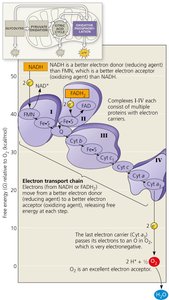
The electron transport chain (ETC) is a series of protein complexes (I-IV) embedded in the inner mitochondrial membrane. It transfers electrons from NADH and FADH2 to O2, the final electron acceptor, in a stepwise manner, releasing energy at each step.
NADH and FADH2: NADH unloads electrons at complex I; FADH2 at complex II.
Energy release: Each transfer releases energy, which is used to pump protons (H+) across the membrane.
Oxygen's role: O2 accepts electrons at the end, forming water.
Proton Gradient: The Dam
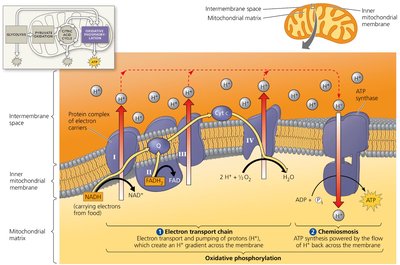
As electrons move through the ETC, complexes I, III, and IV pump H+ from the matrix to the intermembrane space, creating a concentration and charge gradient known as the proton-motive force.
Proton-motive force: The gradient stores energy, like water behind a dam.
ATP production: The energy is harnessed as protons flow back through ATP synthase.
ATP Synthase and Chemiosmosis: The Turbine in the Dam
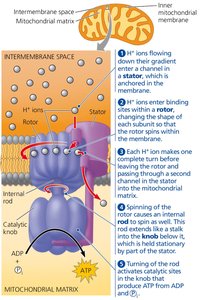
ATP synthase is a rotary enzyme that uses the energy of the H+ gradient to synthesize ATP from ADP and inorganic phosphate (Pi). This process is called chemiosmosis.
Mechanism: H+ flows through ATP synthase, spinning its rotor and catalyzing ATP formation.
Yield: Each full turn of ATP synthase produces 3 ATP molecules.
Oxidative phosphorylation: The combined process of ETC and chemiosmosis, producing 26–28 of the 30–32 ATP per glucose.
Effects of Poisons and Uncouplers
Cyanide blocks complex IV, halting electron flow, collapsing the proton gradient, and stopping ATP synthesis. Uncouplers (e.g., DNP) make the membrane leaky to H+, causing the ETC to run but ATP production to fall, with energy released as heat.
Cyanide: O2 use stops, NADH accumulates, ATP synthesis collapses.
Uncouplers: ETC continues, ATP falls, heat output rises.
Fermentation: Respiration Without Oxygen
Why Cells Ferment
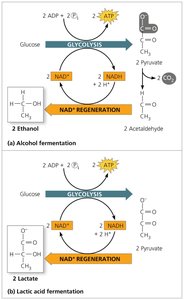
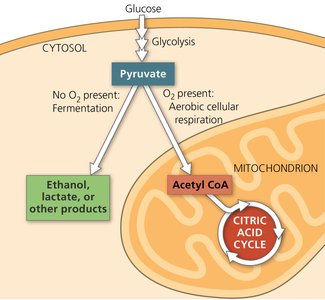
When O2 is unavailable, the ETC backs up, NAD+ runs out, and glycolysis cannot proceed. Fermentation regenerates NAD+ by transferring electrons from NADH to pyruvate or its derivatives.
Lactic acid fermentation: Pyruvate + NADH → Lactate + NAD+ (muscle cells, yogurt bacteria).
Alcohol fermentation: Pyruvate releases CO2, then is reduced to ethanol (yeast).
ATP yield: Only 2 ATP per glucose, compared to ~30 in aerobic respiration.
Pathways After Glycolysis
Pyruvate, the end product of glycolysis, can enter aerobic respiration (citric acid cycle) if O2 is present, or fermentation if O2 is absent.
Respiration and Photosynthesis: The Turn and the Tree
Where Does a Tree's Mass Come From?
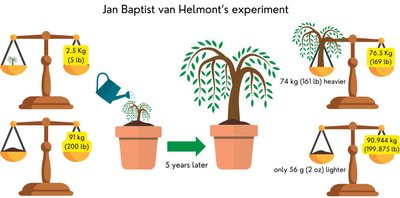
Van Helmont's experiment demonstrated that a tree's mass does not come from the soil. Most of the mass is derived from carbon dioxide in the air, fixed by photosynthesis.
Photosynthesis: Converts CO2 and H2O into glucose and O2, lifting electrons from water.
Respiration: Uses glucose and O2, releasing CO2 and H2O.
Key Terms and Definitions
Electron transport chain: Proteins in the inner mitochondrial membrane passing electrons from NADH/FADH2 to O2.
Cytochrome: Iron-containing protein in the chain; complex IV hands electrons to O2.
Final electron acceptor: Molecule that receives electrons at the end of the chain (O2 in aerobic respiration).
Cristae: Folds of the inner mitochondrial membrane holding the chain and ATP synthase.
Proton-motive force: H+ gradient across the inner membrane.
Chemiosmosis: Using an H+ gradient to drive ATP synthesis.
ATP synthase: Rotary enzyme making ATP as H+ flows through.
Oxidative phosphorylation: ATP synthesis powered by ETC and chemiosmosis.
Uncoupler: Substance allowing H+ to leak, reducing ATP production.
Fermentation: Glycolysis plus NAD+ regeneration without O2.
Lactic acid fermentation: Pyruvate reduced to lactate.
Alcohol fermentation: Pyruvate converted to ethanol and CO2.
Anaerobic respiration: Respiration with a final acceptor other than O2.
NAD+ regeneration: Turning NADH back into NAD+ for glycolysis.
Photosynthesis: Light-driven synthesis of sugar from CO2 and H2O.
Autotroph: Organism making organic molecules from CO2.
Heterotroph: Organism obtaining organic molecules by eating others.
Summary Table: ATP Yield from Cellular Respiration
Stage | ATP Produced | NADH | FADH2 | O2 Used |
|---|---|---|---|---|
Glycolysis | 2 | 2 | 0 | 0 |
Pyruvate Oxidation | 0 | 2 | 0 | 0 |
Citric Acid Cycle | 2 | 6 | 2 | 0 |
Electron Transport & Chemiosmosis | 26–28 | - | - | 6 |
Total | 30–32 | - | - | 6 |
Practice Questions
What happens to O2 consumption, the H+ gradient, ATP synthesis, and heat output when complex IV is blocked or the membrane is made leaky to H+?
Why does glucose consumption rise in yeast switched from aerobic to anaerobic conditions?
What did van Helmont's willow experiment show about the source of a tree's mass?
Key Equations
Cellular respiration:
Photosynthesis (reverse):
Electron transport (final step):
Additional info: Academic context was added to clarify the mechanisms of electron transport, chemiosmosis, and fermentation, and to explain the significance of van Helmont's experiment in plant biology.
