 Indietro
Cellular Respiration: Mechanisms and Energy Yield
Guida di studio - Note intelligenti
 Appunti personalizzati basati sui tuoi materiali, ampliati con definizioni chiave, esempi e contesto.
Cellular Respiration
Overview and Importance
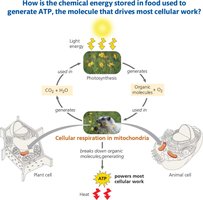
Cellular respiration is a fundamental metabolic process by which cells extract energy from organic molecules, primarily glucose, to produce ATP, the energy currency of the cell. This process occurs in both plant and animal cells and is essential for cellular work such as movement, synthesis, and transport. - Key Point 1: Cellular respiration involves the breakdown of carbohydrates, fats, and proteins to release energy. - Key Point 2: The process is tightly linked to photosynthesis, as the products of photosynthesis (oxygen and organic molecules) are used in respiration, and the waste products of respiration (CO2 and H2O) are used in photosynthesis. - Example: A marmot eating plants obtains energy through cellular respiration, recycling chemical elements but allowing energy to flow through the ecosystem. 
Learning Objectives
After studying this chapter, students should be able to:
Explain how redox reactions in catabolic pathways yield energy by oxidizing organic fuels.
Trace the pathway of glucose oxidation during glycolysis.
Describe the oxidation of pyruvate and further oxidation in the citric acid cycle.
Identify the steps of oxidative phosphorylation and account for total ATP produced per glucose molecule.
Name two types of fermentation and explain their role in ATP production.
Illustrate interactions of glycolysis and the citric acid cycle with other metabolic pathways.
Catabolic Pathways and ATP Production
Energy Extraction from Food
Catabolic pathways systematically degrade complex organic molecules, releasing energy that is used to synthesize ATP. - Key Point 1: Aerobic respiration is the most efficient catabolic pathway, requiring oxygen as a reactant. - Key Point 2: Anaerobic respiration occurs in some prokaryotes, using substances other than oxygen. - Example: Starch in animal diets is broken down into glucose, which is then used as fuel. 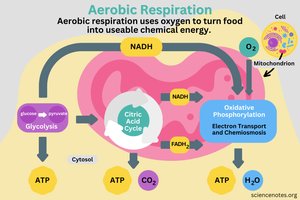
Redox Reactions: Oxidation and Reduction
Mechanism of Energy Release
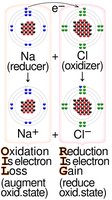
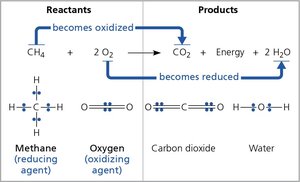
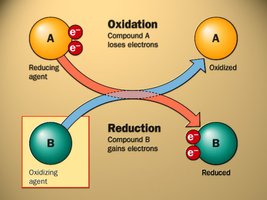
The transfer of electrons during chemical reactions releases energy stored in organic molecules, which is used to synthesize ATP. These reactions are called oxidation-reduction (redox) reactions. - Key Point 1: Oxidation is the loss of electrons; reduction is the gain of electrons. - Key Point 2: The electron donor is the reducing agent, and the electron acceptor is the oxidizing agent. - Example: In the reaction Na + Cl → Na+ + Cl-, Na is oxidized and Cl is reduced. 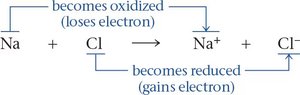
NAD+ and the Electron Transport Chain
Role of Electron Carriers
Cellular respiration breaks down glucose in a series of steps, with electrons transferred to electron carriers such as NAD+. - Key Point 1: NAD+ is reduced to NADH by accepting electrons and a proton (H+), acting as an oxidizing agent. - Key Point 2: Dehydrogenase enzymes facilitate the transfer of hydrogen atoms from glucose to NAD+. - Example: NAD+ cycles between oxidized and reduced forms, shuttling electrons to the electron transport chain. 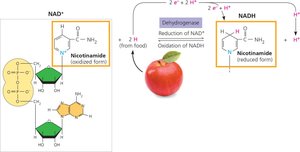
Electron Transport Chain
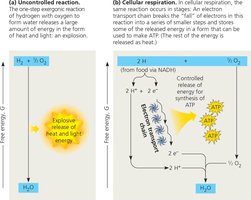
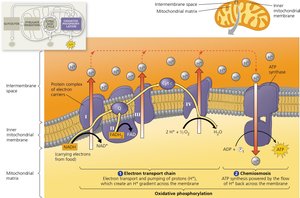
The electron transport chain is a series of membrane proteins that shuttle electrons through redox reactions, releasing energy to make ATP. - Key Point 1: Electrons from NADH and FADH2 are transferred down the chain to oxygen, the terminal electron acceptor. - Key Point 2: Each carrier in the chain has a greater affinity for electrons than the previous, ensuring a stepwise release of energy. 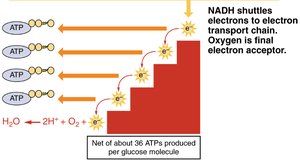
Stages of Cellular Respiration
Three Major Stages
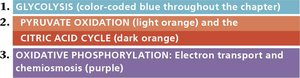
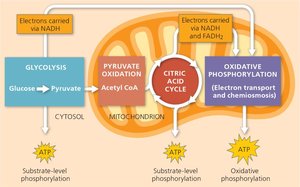
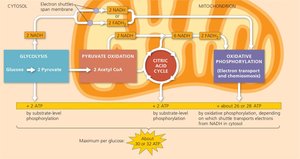
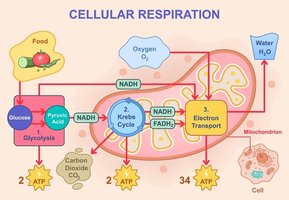
Cellular respiration consists of three main stages: glycolysis, pyruvate oxidation and the citric acid cycle, and oxidative phosphorylation.
Stage | Location | Main Products |
|---|---|---|
Glycolysis | Cytosol | 2 ATP, 2 NADH, 2 Pyruvate |
Pyruvate Oxidation & Citric Acid Cycle | Mitochondrion | 2 ATP, 8 NADH, 2 FADH2, 6 CO2 |
Oxidative Phosphorylation | Mitochondrion | 26-28 ATP, H2O |
Glycolysis
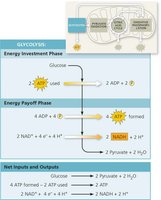
Glycolysis is the first step, breaking down glucose into two pyruvate molecules in the cytosol. - Key Point 1: Consists of an energy investment phase (uses ATP) and an energy payoff phase (produces ATP and NADH). - Key Point 2: Net yield per glucose: 2 ATP and 2 NADH. 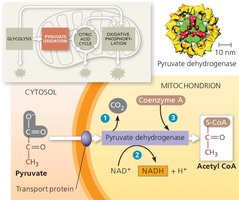
Pyruvate Oxidation
Pyruvate is transported into the mitochondrion and converted to acetyl CoA by pyruvate dehydrogenase. - Key Point 1: Each pyruvate yields 1 NADH and 1 CO2. - Key Point 2: Acetyl CoA enters the citric acid cycle. 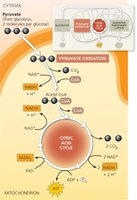
Citric Acid Cycle
The citric acid cycle completes the breakdown of glucose, generating ATP, NADH, and FADH2. - Key Point 1: Each acetyl CoA combines with oxaloacetate to form citrate, which is oxidized in a series of steps. - Key Point 2: Net yield per glucose: 2 ATP, 6 NADH, 2 FADH2. 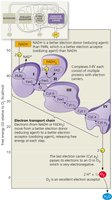
Oxidative Phosphorylation
This stage includes the electron transport chain and chemiosmosis, producing the majority of ATP. - Key Point 1: NADH and FADH2 donate electrons to the chain, which powers ATP synthesis via ATP synthase. - Key Point 2: Cristae in mitochondria increase surface area for electron transport components. 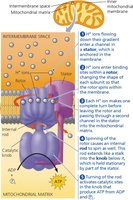
Energy Yield of Cellular Respiration
ATP Production Summary
The complete oxidation of one glucose molecule yields a maximum of 30-32 ATP molecules.
Stage | ATP Yield |
|---|---|
Glycolysis | 2 ATP |
Citric Acid Cycle | 2 ATP |
Oxidative Phosphorylation | 26-28 ATP |
Total | 30-32 ATP |

Additional info:
- The process of cellular respiration is highly regulated and interconnected with other metabolic pathways, such as fermentation and biosynthesis. - ATP synthase is a molecular rotary motor, converting the energy of a proton gradient into chemical energy. - The efficiency of cellular respiration is increased by the stepwise transfer of electrons, minimizing heat loss. ----------------------------------------
