 Indietro
Cellular Respiration: Mechanisms and Pathways
Guida di studio - Note intelligenti
 Appunti personalizzati basati sui tuoi materiali, ampliati con definizioni chiave, esempi e contesto.
Cellular Respiration
Overview of Cellular Respiration
Cellular respiration is the process by which cells extract energy from glucose and other organic molecules to produce ATP, the energy currency of the cell. This process occurs in several stages and involves both aerobic and anaerobic pathways.
Purpose: To convert biochemical energy from nutrients into ATP.
Main Stages: Glycolysis, Pyruvate Oxidation, Citric Acid Cycle (Krebs Cycle), Electron Transport Chain (ETC), and Chemiosmosis.
Location: Cytoplasm (glycolysis) and mitochondria (other stages).
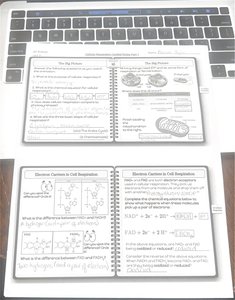
Electron Carriers in Cell Respiration
Electron carriers are molecules that transport electrons during cellular respiration. They play a crucial role in transferring energy from food molecules to the electron transport chain.
NAD+ (Nicotinamide adenine dinucleotide): Accepts electrons and becomes NADH.
FAD (Flavin adenine dinucleotide): Accepts electrons and becomes FADH2.
Redox Reactions: Involve the transfer of electrons from one molecule (oxidation) to another (reduction).
Key Equations:
Stages of Cellular Respiration
Glycolysis
Glycolysis is the first step in cellular respiration, occurring in the cytoplasm. It breaks down one molecule of glucose into two molecules of pyruvate, producing a small amount of ATP and NADH.
Location: Cytoplasm
Inputs: Glucose, 2 NAD+, 2 ATP
Outputs: 2 Pyruvate, 2 NADH, 4 ATP (net gain: 2 ATP)
Pyruvate Oxidation
Pyruvate produced in glycolysis is transported into the mitochondria, where it is converted into Acetyl-CoA, releasing CO2 and generating NADH.
Location: Mitochondrial matrix
Inputs: 2 Pyruvate, 2 NAD+, 2 CoA
Outputs: 2 Acetyl-CoA, 2 NADH, 2 CO2
Citric Acid Cycle (Krebs Cycle)
The Citric Acid Cycle completes the breakdown of glucose by oxidizing Acetyl-CoA to CO2. It generates NADH and FADH2 for the electron transport chain.
Location: Mitochondrial matrix
Inputs: 2 Acetyl-CoA, 6 NAD+, 2 FAD, 2 ADP
Outputs: 4 CO2, 6 NADH, 2 FADH2, 2 ATP
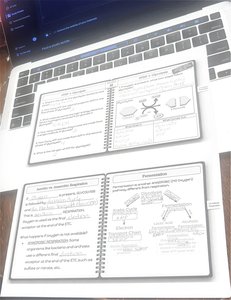
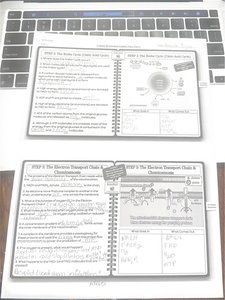
Electron Transport Chain (ETC) and Chemiosmosis
The ETC is a series of protein complexes in the inner mitochondrial membrane that transfer electrons from NADH and FADH2 to oxygen, the final electron acceptor. This process creates a proton gradient used to produce ATP via chemiosmosis.
Location: Inner mitochondrial membrane
Inputs: NADH, FADH2, O2
Outputs: ATP, H2O
ATP Yield: Approximately 34 ATP per glucose molecule
Substrate-Level vs. Oxidative Phosphorylation
ATP can be generated by two main mechanisms during cellular respiration: substrate-level phosphorylation and oxidative phosphorylation.
Substrate-Level Phosphorylation: Direct transfer of a phosphate group to ADP from a phosphorylated intermediate.
Oxidative Phosphorylation: ATP synthesis powered by the transfer of electrons through the ETC and the resulting proton gradient.
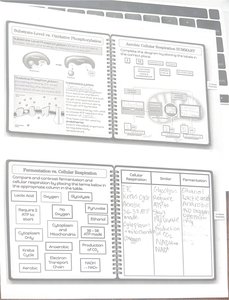
Fermentation vs. Cellular Respiration
Fermentation
Fermentation is an anaerobic process that allows glycolysis to continue in the absence of oxygen by regenerating NAD+. It produces less ATP than cellular respiration.
Types: Lactic acid fermentation (in animals), Alcoholic fermentation (in yeast)
Location: Cytoplasm
ATP Yield: 2 ATP per glucose
Comparison Table: Cellular Respiration vs. Fermentation
Feature | Cellular Respiration | Fermentation |
|---|---|---|
Oxygen Requirement | Required (aerobic) | Not required (anaerobic) |
Location | Cytoplasm & Mitochondria | Cytoplasm |
ATP Yield | ~36-38 ATP per glucose | 2 ATP per glucose |
End Products | CO2, H2O | Lactic acid or ethanol + CO2 |
Summary
Cellular respiration is a multi-step process that efficiently extracts energy from glucose.
Electron carriers (NADH, FADH2) are essential for transferring energy to the ETC.
ATP is produced by both substrate-level and oxidative phosphorylation.
Fermentation provides an alternative pathway for ATP production when oxygen is unavailable, but is less efficient.
