 Indietro
Cellular Respiration: Mechanisms, Efficiency, and Fermentation
Guida di studio - Note intelligenti
 Appunti personalizzati basati sui tuoi materiali, ampliati con definizioni chiave, esempi e contesto.
Cellular Respiration: Overview and Efficiency
General Reaction and Energy Yield
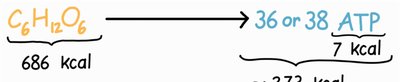
Cellular respiration is the process by which cells convert glucose and oxygen into carbon dioxide, water, and ATP, the cell's energy currency. The efficiency of this process is determined by how much of the energy stored in glucose is captured in ATP versus lost as heat.
Overall Reaction:
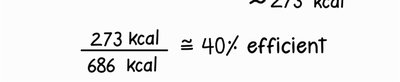
Energy Distribution: About 40% of glucose's energy is captured as ATP, while 60% is released as heat.
Efficiency Calculation:


Types of Human Cells and Oxygen Requirements
Classification Based on Oxygen Use
Human cells can be classified by their oxygen requirements, which affects their metabolic pathways.
Obligate/Strict Aerobes: Require oxygen; e.g., neurons.
Obligate/Strict Anaerobes: Do not require oxygen; e.g., erythrocytes (RBCs).
Facultative Anaerobes: Prefer oxygen but can switch to anaerobic metabolism; e.g., skeletal muscle cells.
Phases of Cellular Respiration
Major Steps and Locations
Cellular respiration consists of four main phases, each occurring in specific cellular locations and involving distinct biochemical pathways.
Glycolysis: Occurs in the cytoplasm; O2-independent.
Transition Phase: Occurs in the mitochondrial matrix.
Krebs Cycle (Citric Acid Cycle): Occurs in the mitochondrial matrix.
Electron Transport System (ETS): Occurs in the mitochondrial cristae; requires O2.
Coenzymes in Cellular Respiration
NAD+ and FAD: Structure and Function
Coenzymes are essential for carrying electrons during cellular respiration.
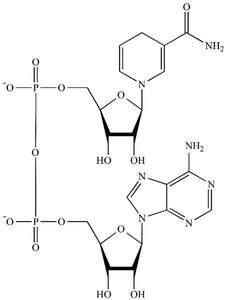
NAD+ (Nicotinamide Adenine Dinucleotide): Consists of two nucleotides (ribose, phosphate, nitrogenous bases: adenine and nicotinamide). Accepts electrons and hydrogen, becoming reduced to NADH.
FAD (Flavin Adenine Dinucleotide): Composed of adenine and flavin bases, ribose sugars, and phosphate groups. Accepts electrons and hydrogen, becoming reduced to FADH2.
NAD+ Reduction Reaction
Reaction:
Mechanism: NAD+ accepts one full hydrogen atom and only the electron from the second hydrogen atom.


FAD Reduction Reaction
Reaction:

Substrate-Level Phosphorylation (SLP)
Mechanism and Example
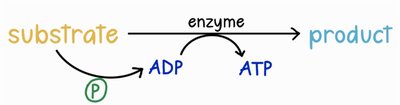
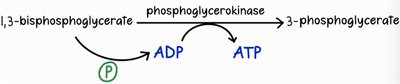
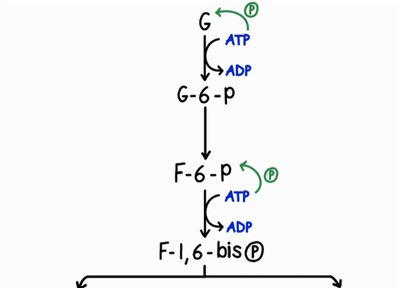
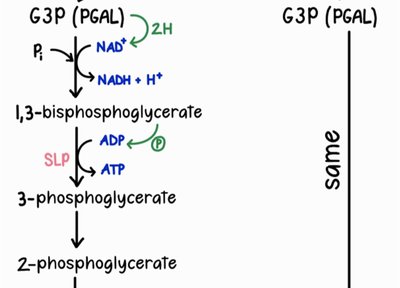
Substrate-level phosphorylation is a process where a phosphate group is directly transferred from a substrate to ADP, forming ATP.
Definition: The substrate is dephosphorylated, and ADP is phosphorylated.
Example: In glycolysis, the enzyme phosphoglycerokinase catalyzes the transfer from 1,3-bisphosphoglycerate to ADP, forming 3-phosphoglycerate and ATP.
Glycolysis: Net Reaction and Products
Summary and Ionization of Pyruvic Acid
Glycolysis is the first phase of cellular respiration, breaking down glucose into pyruvate and generating ATP and NADH.
Net Products: 2 ATP, 2 NADH, 2 H2O, and 2 pyruvic acid molecules.
Pyruvic Acid Ionization: Pyruvic acid ionizes to pyruvate, releasing a proton.


Krebs Cycle (Citric Acid Cycle)
Overview and First Intermediate
The Krebs cycle is a series of reactions that further oxidize pyruvate, producing CO2, NADH, FADH2, and ATP.
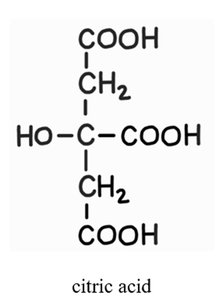
First Intermediate: Citric acid, a tricarboxylic acid.
Alternative Names: Citric acid cycle, tricarboxylic acid cycle (TCA).
ATP Yield by Substrate-Level Phosphorylation
Comparison Table
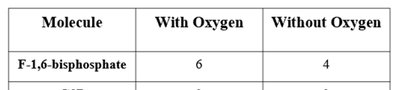
The net ATP yield from substrate-level phosphorylation varies depending on the molecule and oxygen availability.
Molecule | With Oxygen | Without Oxygen |
|---|---|---|
F-1,6-bisphosphate | 6 | 4 |
G3P | 3 | 2 |
PEP | 2 | 1 |
Acetyl CoA | 1 | 0 |

Reducing and Oxidizing Agents in Cellular Respiration
Definitions and Examples
Reducing Agents: Donate electrons/hydrogen; are oxidized in the process. Examples: isocitrate, α-ketoglutarate, succinate, malate (Krebs cycle).
Oxidizing Agents: Accept electrons/hydrogen; are reduced in the process. Examples: NAD+, FAD, O2 (final electron acceptor).
Fermentation: Anaerobic Pathways
Lactic Acid and Ethanol Fermentation
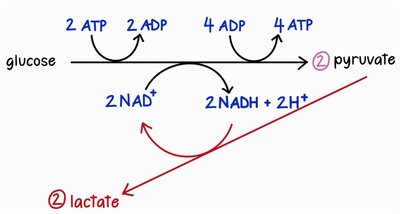
Fermentation occurs in the absence of oxygen and serves to regenerate NAD+ for glycolysis.
Lactic Acid Fermentation: NADH is oxidized to NAD+, and pyruvate is reduced to lactate.
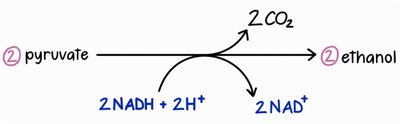
Ethanol Fermentation: Pyruvate is converted to ethanol and CO2, regenerating NAD+.
Significance: Allows glycolysis to continue in anaerobic conditions.
Efficiency of Fermentation vs. Cellular Respiration
Energy Yield and Heat Loss
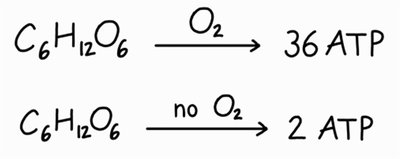
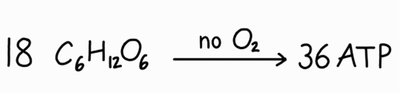
Fermentation is much less efficient than aerobic respiration, producing only 2 ATP per glucose and releasing most energy as heat.
Efficiency: About 2% of glucose's energy is captured as ATP; 98% is lost as heat.
Comparison: Aerobic respiration yields 36–38 ATP (40% efficient), fermentation yields 2 ATP (2% efficient).
Summary Table: Cellular Respiration Inventory
Net Products per Glucose
Phase | ATP | NADH | FADH2 | CO2 | H2O |
|---|---|---|---|---|---|
Glycolysis | 2 (SLP) | 2 | 0 | 0 | 2 |
Transition | 0 | 2 | 0 | 2 | 0 |
Krebs | 2 (SLP) | 6 | 2 | 4 | -2 |
ETS | 32 or 34 (OP) | -10 | -2 | 0 | 6 |
Net | 36 or 38 | 0 | 0 | 6 | 6 |

Electron Transport System (ETS) and Oxidative Phosphorylation
ATP Production and Coenzyme Yield
The ETS is the final stage of cellular respiration, where most ATP is produced via oxidative phosphorylation.
FADH2: Yields 2 ATP per molecule.
Mitochondrial NADH: Yields 3 ATP per molecule.
Cytoplasmic NADH: Yields 2 ATP in most cells, 3 ATP in liver and heart cells.

Summary Reaction for Three Turns of the Krebs Cycle
Stoichiometry
Reaction:
Key Concepts and Review Questions
Redox Reactions in Fermentation
What is reduced in lactate fermentation? Pyruvate
What is oxidized in lactate fermentation? NADH
Reducing agent: NADH
Oxidizing agent: Pyruvate
ATP Yield Comparison
With O2:
Without O2:
Additional info:
Cellular respiration is a central topic in General Biology, covering energy transformation, metabolic pathways, and cell physiology.
Tables and diagrams are used to clarify ATP yield, coenzyme function, and metabolic steps.
