 Indietro
Cellular Respiration: Pathways and Energy Yield CH.8
Guida di studio - Note intelligenti
 Appunti personalizzati basati sui tuoi materiali, ampliati con definizioni chiave, esempi e contesto.
Cellular Respiration
Overview of Cellular Respiration
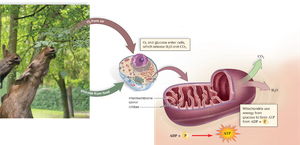
Cellular respiration is a series of metabolic processes by which cells harvest energy from organic molecules, primarily glucose, to produce ATP. This process occurs in both the cytoplasm and mitochondria of eukaryotic cells and involves both aerobic and anaerobic pathways.
Definition: Cellular respiration is the process by which cells convert biochemical energy from nutrients into ATP, releasing waste products.
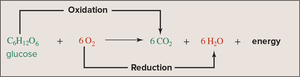
Overall Equation: The general equation for aerobic cellular respiration is:
Importance: Provides energy for cellular activities and maintains biological organization.
Phases of Cellular Respiration
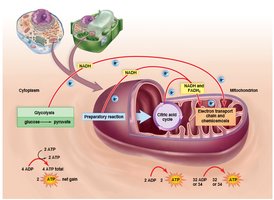
Cellular respiration consists of four main phases, each with distinct locations and functions:
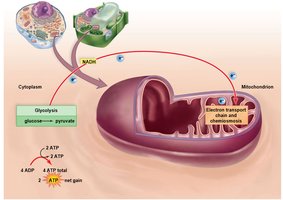
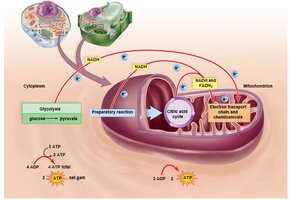
Glycolysis: Breakdown of glucose into two molecules of pyruvate in the cytoplasm. Anaerobic process (does not require oxygen).
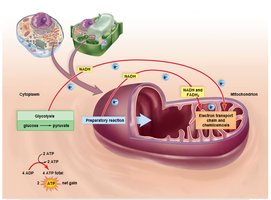
Preparatory (Prep) Reaction: Conversion of pyruvate to acetyl-CoA in the mitochondrial matrix, releasing CO2 and generating NADH.
Citric Acid Cycle (Krebs Cycle): Acetyl-CoA is oxidized, producing NADH, FADH2, ATP, and CO2.
Electron Transport Chain (ETC) and Chemiosmosis: Electrons from NADH and FADH2 are transferred through protein complexes in the inner mitochondrial membrane, driving ATP synthesis and forming water.
Glycolysis
Inputs and Outputs of Glycolysis
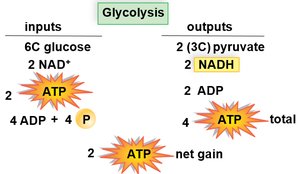
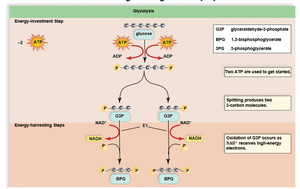
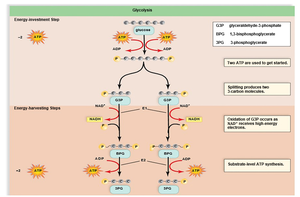
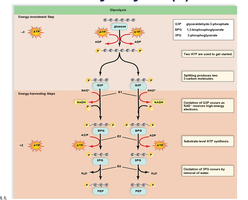
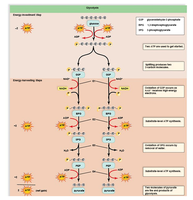
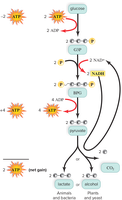
Glycolysis is the first step in cellular respiration, occurring in the cytoplasm. It splits one glucose molecule (6C) into two pyruvate molecules (3C each), producing a small amount of ATP and NADH.
Inputs: 1 glucose (6C), 2 NAD+, 2 ATP, 4 ADP + 4 P
Outputs: 2 pyruvate (3C), 2 NADH, 2 ADP, 4 ATP (total), net gain of 2 ATP
Mechanism of ATP Synthesis in Glycolysis
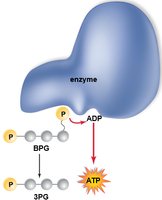
ATP is produced in glycolysis by substrate-level phosphorylation, where a phosphate group is directly transferred from a substrate to ADP by an enzyme.
Substrate-level phosphorylation: Direct enzymatic transfer of a phosphate group to ADP, forming ATP.
Key intermediates: BPG (1,3-bisphosphoglycerate) and 3PG (3-phosphoglycerate).
Steps of Glycolysis
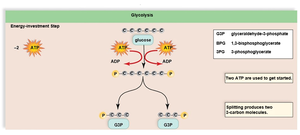
Glycolysis consists of two main phases: the energy-investment phase and the energy-harvesting phase.
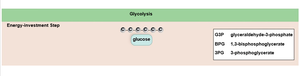
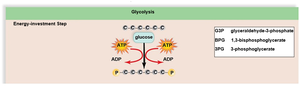
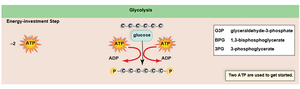
Energy-Investment Phase: 2 ATP are used to phosphorylate glucose and its intermediates, preparing them for cleavage.
Energy-Harvesting Phase: 4 ATP and 2 NADH are produced as the 3-carbon intermediates are oxidized and converted to pyruvate.
Fermentation
Fermentation Process
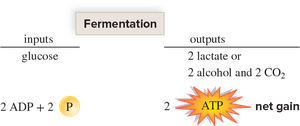
Fermentation is an anaerobic process that allows cells to regenerate NAD+ from NADH, enabling glycolysis to continue in the absence of oxygen. Pyruvate is reduced to either lactate or alcohol and CO2.
Alcoholic fermentation: Occurs in yeasts, producing ethanol and CO2.
Lactic acid fermentation: Occurs in certain bacteria and animal muscle cells, producing lactate.
Commercial uses: Production of bread, alcoholic beverages, cheese, yogurt, and sauerkraut.
Inputs and Outputs of Fermentation
Inputs | Outputs |
|---|---|
Glucose | 2 lactate or 2 alcohol + 2 CO2 |
2 ADP + 2 P | 2 ATP (net gain) |
Advantages and Disadvantages of Fermentation
Advantages: Provides a rapid supply of ATP for short bursts of muscular activity.
Disadvantages: End products (lactate, alcohol) are toxic; lactate causes muscle fatigue and oxygen debt; yeast die from alcohol accumulation.
Efficiency: Only 2 ATP per glucose (about 2.1% of the energy in glucose), compared to 36–38 ATP per glucose in aerobic respiration.
Inside the Mitochondria
Preparatory Reaction
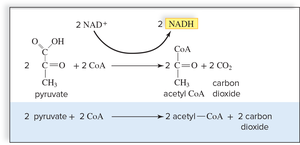
The preparatory reaction converts pyruvate into acetyl-CoA, producing NADH and releasing CO2. This step links glycolysis to the citric acid cycle and occurs in the mitochondrial matrix.
Equation:
Mitochondrion Structure and Function
Mitochondria are double-membraned organelles where the prep reaction, citric acid cycle, and electron transport chain occur. The inner membrane forms cristae, increasing surface area for ATP production.
Outer membrane: Encloses the organelle.
Inner membrane (cristae): Site of the electron transport chain and ATP synthase.
Matrix: Contains enzymes for the prep reaction and citric acid cycle.
Intermembrane space: Involved in chemiosmosis and proton gradient formation.
Citric Acid Cycle (Krebs Cycle)
Citric Acid Cycle Process
The citric acid cycle completes the breakdown of glucose by oxidizing acetyl-CoA to CO2. It generates NADH, FADH2, ATP, and releases CO2.
Main steps:
Acetyl group (2C) combines with a 4C molecule to form citrate (6C).
Oxidation reactions produce NADH and FADH2.
Two CO2 are released per cycle.
One ATP is produced by substrate-level phosphorylation.
Cycle regenerates the original 4C molecule.
Electron Transport Chain and Chemiosmosis
Organization and Function of the Electron Transport Chain (ETC)
The ETC is a series of protein complexes in the inner mitochondrial membrane. Electrons from NADH and FADH2 are transferred through the chain, powering the movement of protons into the intermembrane space. The resulting proton gradient drives ATP synthesis via ATP synthase (chemiosmosis).
Final electron acceptor: Oxygen, which combines with electrons and protons to form water.
ATP yield: Most ATP from glucose metabolism is produced here (32–34 ATP per glucose).
Energy Yield from Glucose Metabolism
ATP Accounting
Stage | ATP Produced |
|---|---|
Glycolysis | 2 |
Citric Acid Cycle | 2 |
Electron Transport Chain | 32–34 |
Total | 36–38 |
Efficiency: About 39% of the energy in glucose is captured as ATP; the rest is lost as heat.
Metabolism and the Metabolic Pool
Catabolism and Anabolism
Metabolism includes all chemical reactions in the cell, divided into catabolic (breakdown, exergonic) and anabolic (synthesis, endergonic) pathways. Intermediates from cellular respiration serve as building blocks for biosynthesis (anabolism) of carbohydrates, fats, and proteins.
Catabolism: Degradative reactions that release energy.
Anabolism: Synthetic reactions that consume energy.
Metabolic pool: Intermediates from catabolic pathways can be used for anabolic processes.
Photosynthesis Versus Cellular Respiration
Photosynthesis and cellular respiration are complementary processes. Photosynthesis captures solar energy to produce glucose and oxygen, while cellular respiration breaks down glucose to produce ATP, releasing CO2 and H2O.
Photosynthesis: Occurs in chloroplasts; converts CO2 and H2O into glucose and O2 using sunlight.
Cellular Respiration: Occurs in mitochondria; converts glucose and O2 into CO2, H2O, and ATP.
