 Indietro
Cellular Respiration: Pathways and Energy Yield
Guida di studio - Note intelligenti
 Appunti personalizzati basati sui tuoi materiali, ampliati con definizioni chiave, esempi e contesto.
Cellular Respiration
Overview of Cellular Respiration
Cellular respiration is a series of metabolic processes by which cells harvest energy from organic molecules, primarily glucose, to produce ATP. This process occurs in both the cytoplasm and mitochondria of eukaryotic cells and involves both aerobic and anaerobic pathways.
Purpose: To convert biochemical energy from nutrients into ATP, the energy currency of the cell.
Overall Equation:
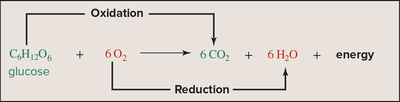
Redox Reactions: Glucose is oxidized, and oxygen is reduced during cellular respiration.
Phases of Cellular Respiration
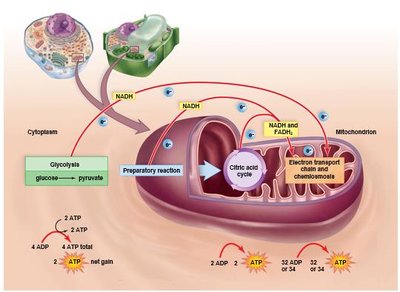
Cellular respiration consists of four main phases:
Glycolysis (cytoplasm): Glucose is split into two molecules of pyruvate. ATP and NADH are produced. Anaerobic process.
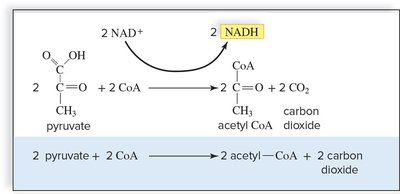
Preparatory (Prep) Reaction (mitochondrial matrix): Pyruvate is oxidized to acetyl-CoA, producing NADH and releasing CO2.
Citric Acid Cycle (Krebs Cycle) (mitochondrial matrix): Acetyl-CoA is broken down, generating NADH, FADH2, ATP, and CO2.
Electron Transport Chain and Chemiosmosis (inner mitochondrial membrane): NADH and FADH2 donate electrons, driving ATP synthesis and forming water.
Glycolysis
Inputs and Outputs of Glycolysis
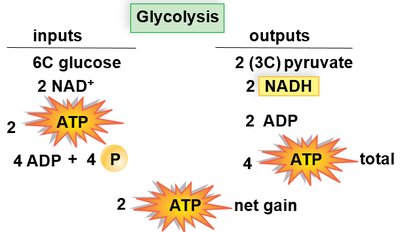
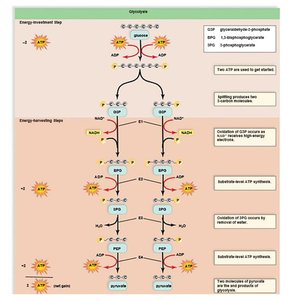
Glycolysis is the first step in cellular respiration and occurs in the cytoplasm. It does not require oxygen and results in the partial oxidation of glucose.
Inputs: 1 glucose (6C), 2 NAD+, 2 ATP, 4 ADP + 4 P
Outputs: 2 pyruvate (3C each), 2 NADH, 4 ATP (2 net gain), 2 ADP
Substrate-Level ATP Synthesis
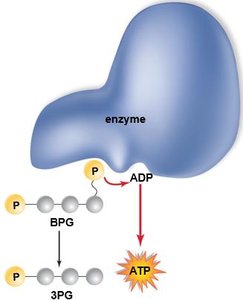
During glycolysis, ATP is produced directly by transferring a phosphate group from a substrate to ADP, a process known as substrate-level phosphorylation.
Steps of Glycolysis
Glycolysis consists of two main phases: the energy-investment phase and the energy-harvesting phase.
Energy-Investment Phase: 2 ATP are used to phosphorylate glucose and its intermediates.
Energy-Harvesting Phase: 4 ATP and 2 NADH are produced as glucose is split into two pyruvate molecules.
Fermentation
Fermentation Process
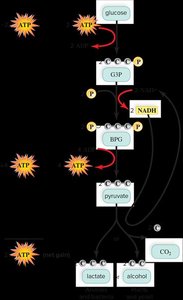
Fermentation is an anaerobic process that allows glycolysis to continue in the absence of oxygen by regenerating NAD+ from NADH. Pyruvate is reduced to either lactate or ethanol and CO2, depending on the organism.
Alcoholic Fermentation: Occurs in yeasts; produces ethanol and CO2.
Lactic Acid Fermentation: Occurs in some bacteria and animal muscle cells; produces lactate.
Inputs and Outputs of Fermentation
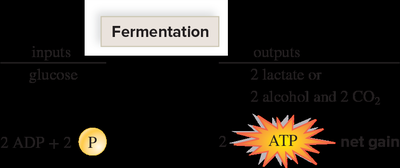
Inputs | Outputs |
|---|---|
Glucose | 2 lactate or 2 alcohol + 2 CO2 |
2 ADP + 2 P | 2 ATP (net gain) |
Advantages and Disadvantages of Fermentation
Advantages: Provides a quick burst of ATP for short-term, vigorous activity.
Disadvantages: End products (lactate, alcohol) are toxic; low ATP yield (2 ATP per glucose).
Efficiency: Only about 2.1% of the energy in glucose is captured as ATP during fermentation.
Inside the Mitochondria
Preparatory Reaction
Pyruvate from glycolysis is transported into the mitochondrial matrix, where it is converted to acetyl-CoA. This step produces NADH and releases CO2.
Mitochondrion Structure and Function
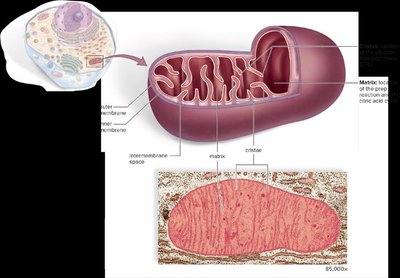
The mitochondrion is the site of the preparatory reaction, citric acid cycle, and electron transport chain. It has a double membrane, with the inner membrane folded into cristae to increase surface area for ATP production.
Citric Acid Cycle (Krebs Cycle)
Citric Acid Cycle Process
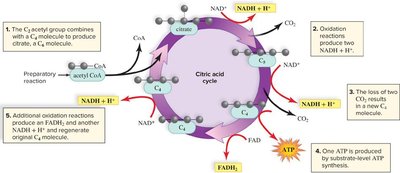
The citric acid cycle completes the breakdown of glucose by oxidizing acetyl-CoA to CO2. It generates NADH, FADH2, and ATP.
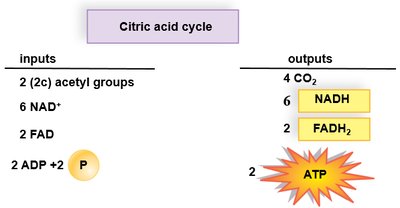
Inputs: 2 acetyl-CoA, 6 NAD+, 2 FAD, 2 ADP + 2 P
Outputs: 4 CO2, 6 NADH, 2 FADH2, 2 ATP
Inputs | Outputs |
|---|---|
2 (2C) acetyl groups | 4 CO2 |
6 NAD+ | 6 NADH |
2 FAD | 2 FADH2 |
2 ADP + 2 P | 2 ATP |
Electron Transport Chain and Chemiosmosis
Organization and Function
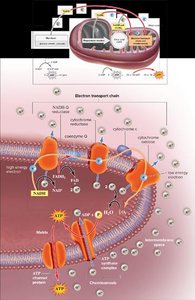
The electron transport chain (ETC) is a series of protein complexes in the inner mitochondrial membrane. Electrons from NADH and FADH2 are transferred through the chain, releasing energy used to pump protons and generate a proton gradient. ATP synthase uses this gradient to produce ATP (chemiosmosis).
Energy Yield from Glucose Metabolism
ATP Yield:
Glycolysis: 2 ATP
Citric Acid Cycle: 2 ATP
Electron Transport Chain: 32–34 ATP
Total: 36–38 ATP per glucose molecule
Efficiency: About 39% of the energy in glucose is captured as ATP; the rest is lost as heat.
Metabolism and the Metabolic Pool
Catabolism and Anabolism
Metabolism includes all chemical reactions in the cell. Catabolic reactions break down molecules and release energy, while anabolic reactions build molecules and consume energy. Intermediates from cellular respiration can be used for biosynthesis of carbohydrates, fats, and proteins.
Catabolism: Degradative, exergonic reactions.
Anabolism: Synthetic, endergonic reactions.
The Metabolic Pool Concept
All metabolic compounds are part of a metabolic pool, allowing flexibility in how cells use nutrients for energy or biosynthesis. For example, acetyl-CoA can be used to synthesize fatty acids or enter the citric acid cycle.
Photosynthesis Versus Cellular Respiration
Photosynthesis and cellular respiration are complementary processes. Photosynthesis captures solar energy to produce glucose and oxygen, while cellular respiration breaks down glucose to produce ATP, releasing CO2 and H2O.
Photosynthesis: Occurs in chloroplasts; stores energy in glucose.
Cellular Respiration: Occurs in mitochondria; releases energy from glucose.
