 Indietro
Cellular Respiration: Pathways and Regulation
Guida di studio - Note intelligenti
 Appunti personalizzati basati sui tuoi materiali, ampliati con definizioni chiave, esempi e contesto.
Cellular Respiration and Redox Reactions
Oxidation and Reduction
Cellular respiration is a series of metabolic processes that convert chemical energy in food into ATP, the energy currency of the cell. Central to these processes are redox reactions, which involve the transfer of electrons between molecules.
Oxidation: The loss of electrons from a substance.
Reduction: The gain of electrons by a substance (reducing its positive charge).
During cellular respiration, fuel molecules like glucose are oxidized, and oxygen is reduced.
Organic molecules rich in hydrogen are excellent sources of high-energy electrons.
Oxidizing glucose moves electrons from a high energy state to a lower energy state near oxygen atoms, releasing energy used to synthesize ATP.
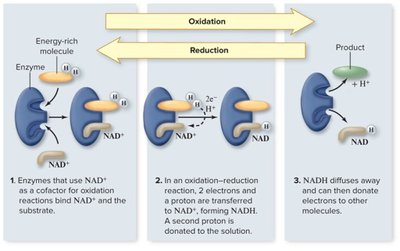
NAD+ and the Electron Transport Chain
NAD+ (nicotinamide adenine dinucleotide): A coenzyme that acts as an electron carrier.
Enzymes called dehydrogenases remove a pair of hydrogen atoms (2 electrons, 2 protons) from the substrate; 2 electrons and 1 proton transfer to NAD+ forming NADH, and the other proton is released as a hydrogen ion.
NADH represents stored energy that can be tapped to make ATP.
Hydrogen atoms are usually passed first to electron carriers rather than directly to oxygen.
Stages of Cellular Respiration
Overview of the Three Stages
Glycolysis: Occurs in the cytosol.
Pyruvate oxidation and Citric Acid Cycle: Occur in the mitochondrial matrix.
Oxidative phosphorylation (electron transport and chemiosmosis): Occurs in the inner mitochondrial membrane.
Glycolysis
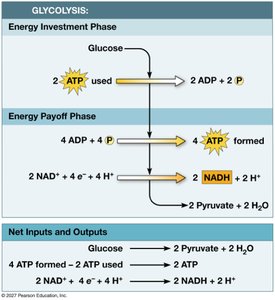
Glycolysis is the first stage of cellular respiration, breaking down glucose into two molecules of pyruvate. It consists of two phases:
Energy Investment Phase: 2 ATP are used to split glucose into two three-carbon sugars.
Energy Payoff Phase: 4 ATP are synthesized, NAD+ is reduced to NADH, and the small sugars are oxidized to form 2 pyruvate.
A net of 2 ATP is produced by substrate-level phosphorylation during glycolysis.
All carbon originally in glucose ends up in the two pyruvate molecules.
Glycolysis does not release any CO2 and occurs whether or not oxygen is present.
Citric Acid Cycle (Krebs Cycle)
The citric acid cycle completes the oxidation of organic molecules, generating electron carriers and releasing CO2 as waste.
If oxygen is present, pyruvate enters the mitochondrion and is converted to acetyl CoA before entering the citric acid cycle.
Pyruvate dehydrogenase catalyzes three reactions: oxidation of pyruvate's carboxyl group (releasing CO2), reduction of NAD+ to NADH, and combination of the remaining two-carbon fragment with coenzyme A to form acetyl CoA.
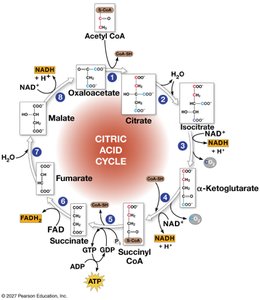
The citric acid cycle oxidizes fuel from pyruvate, generating per turn: 1 ATP, 3 NADH, 1 FADH2, and releasing 2 molecules of CO2.
Because 2 pyruvate are produced per glucose, the cycle runs twice per glucose molecule.
The cycle has eight steps; the acetyl group of acetyl CoA combines with oxaloacetate to form citrate, and the remaining steps decompose citrate back to oxaloacetate.
Fermentation and Anaerobic Respiration
Fermentation
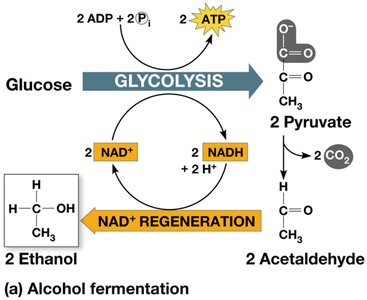
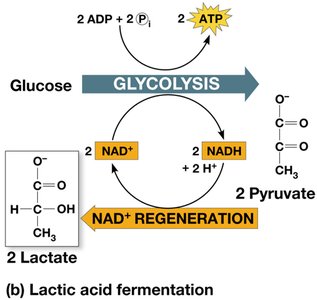
Fermentation allows cells to produce ATP without oxygen by regenerating NAD+ so glycolysis can continue.
Alcohol Fermentation: Pyruvate is converted to acetaldehyde (releasing CO2), then to ethanol. Used in brewing, winemaking, and baking.
Lactic Acid Fermentation: Pyruvate is reduced directly by NADH to form lactate; no CO2 is released. Used to make cheese and yogurt.
Anaerobic Respiration
Anaerobic respiration uses an electron transport chain with a final electron acceptor other than oxygen (e.g., sulfate ion, producing hydrogen sulfide).
Regulation of Cellular Respiration
Feedback Regulation
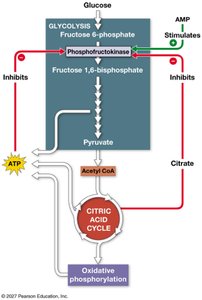
Cellular respiration is regulated by feedback inhibition, preventing excess ATP production and maintaining metabolic balance.
If ATP concentration drops, respiration speeds up; if ATP is plentiful, respiration slows down.
Catabolism is controlled by regulating the activity of enzymes at strategic points, especially phosphofructokinase, which converts fructose 6-phosphate to fructose 1,6-bisphosphate early in glycolysis.
ATP and citrate inhibit phosphofructokinase; AMP stimulates it.
Key Terms and Concepts
Cellular respiration: The process of converting chemical energy in food to ATP.
Fermentation: ATP production without oxygen, regenerating NAD+.
Aerobic respiration: Cellular respiration using oxygen as the final electron acceptor.
Anaerobic respiration: Cellular respiration using a final electron acceptor other than oxygen.
Redox reaction: Chemical reaction involving electron transfer.
Oxidation: Loss of electrons.
Reduction: Gain of electrons.
Dehydrogenation: Removal of hydrogen atoms.
Decarboxylation: Removal of a carboxyl group (CO2).
NAD+ / NADH: Electron carrier and its reduced form.
Electron transport chain: Series of molecules transferring electrons to generate ATP.
Substrate-level phosphorylation: ATP formation by direct transfer of phosphate group.
Oxidative phosphorylation: ATP formation powered by redox reactions in the electron transport chain.
Glycolysis: Breakdown of glucose to pyruvate.
Pyruvate: Three-carbon product of glycolysis.
Pyruvate oxidation: Conversion of pyruvate to acetyl CoA.
Acetyl CoA: Entry molecule for the citric acid cycle.
Citric acid cycle: Series of reactions oxidizing acetyl CoA.
FAD / FADH2: Electron carrier and its reduced form.
Chemiosmosis: Use of a proton gradient to drive ATP synthesis.
ATP synthase: Enzyme that synthesizes ATP using proton gradient.
Proton-motive force: Potential energy stored as a proton gradient.
Cristae: Folds of the inner mitochondrial membrane.
Alcohol fermentation: Conversion of pyruvate to ethanol.
Lactic acid fermentation: Conversion of pyruvate to lactate.
Deamination: Removal of amino group from amino acids.
Beta oxidation: Breakdown of fatty acids to acetyl CoA.
Phosphofructokinase: Key regulatory enzyme in glycolysis.
Feedback inhibition: Regulation by end-product inhibition.
Anabolic pathway: Pathway that builds complex molecules from simpler ones.
Summary: How Chemical Energy in Food Generates ATP
The chemical energy stored in food is released through a series of redox reactions, transferring electrons from high-energy molecules like glucose to lower-energy molecules like oxygen. This transfer releases energy, which is used to synthesize ATP via substrate-level and oxidative phosphorylation. ATP then powers most cellular work, enabling life processes.
