 Indietro
Cellular Respiration: Pathways, Mechanisms, and Biological Context
Guida di studio - Note intelligenti
 Appunti personalizzati basati sui tuoi materiali, ampliati con definizioni chiave, esempi e contesto.
Cellular Respiration: Overview
Relationship Between Photosynthesis and Cellular Respiration
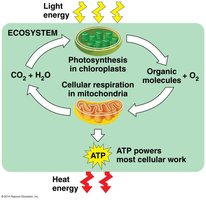
Cellular respiration is a fundamental metabolic process in which cells convert organic molecules into energy (ATP), carbon dioxide, and water. It is tightly linked to photosynthesis, which produces the organic molecules and oxygen used in respiration. Together, these processes sustain life and energy flow in ecosystems.
Photosynthesis in chloroplasts converts light energy, CO2, and H2O into organic molecules and O2.
Cellular respiration in mitochondria breaks down organic molecules, releasing CO2 and H2O, and producing ATP.
ATP powers most cellular work; heat energy is released as a byproduct.
Catabolic Pathways and RedOx Reactions
Cellular respiration involves catabolic pathways that release stored energy by transferring electrons through RedOx reactions. These reactions are essential for the production of ATP.
Reduction: Molecule gains electrons and is reduced.
Oxidation: Molecule loses electrons and is oxidized.
During respiration, fuel molecules are oxidized and electron acceptors are reduced.
Major Pathways of Cellular Respiration
Pathway Outline and Color Coding
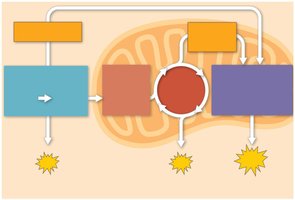
Cellular respiration consists of three major pathways, each with distinct steps and locations within the cell. Color coding is often used to help students track these pathways:
Glycolysis (blue): Occurs in the cytosol.
Pyruvate Oxidation and Citric Acid Cycle (orange): Occur in the mitochondrion.
Oxidative Phosphorylation (purple): Occurs in the mitochondrion.

Cellular Respiration Pathways
Each pathway produces ATP, but in varying amounts. Prokaryotes and eukaryotes both utilize these pathways, though prokaryotes exhibit greater metabolic diversity.
Glycolysis: Glucose is broken down into pyruvate, producing ATP and NADH.
Citric Acid Cycle: Pyruvate is further oxidized, generating CO2, ATP, NADH, and FADH2.
Oxidative Phosphorylation: Electron transport chain and chemiosmosis produce the majority of ATP.
Glycolysis
Energy Investment and Payoff Phases
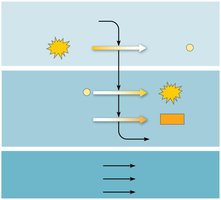
Glycolysis is the first step in cellular respiration, occurring in the cytosol. It consists of two phases: energy investment and energy payoff.
Energy Investment Phase: 2 ATP are used to phosphorylate glucose and prepare it for cleavage.
Cleavage Phase: Glucose is split into two three-carbon molecules.
Energy Payoff Phase: 4 ATP are produced (net gain of 2 ATP), along with 2 NADH and 2 pyruvate.
Detailed Steps of Glycolysis
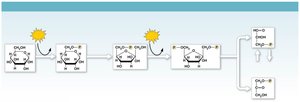
Each step in glycolysis involves specific enzymes and small molecular changes. The process starts as soon as glucose enters the cell.
Key enzymes: Hexokinase, Phosphoglucoisomerase, Phosphofructokinase, Aldolase, Isomerase.
Products: Glyceraldehyde 3-phosphate (G3P), Dihydroxyacetone phosphate (DHAP).
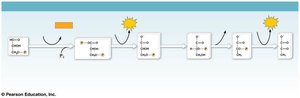
Substrate-Level Phosphorylation
ATP is produced directly in glycolysis and the citric acid cycle by substrate-level phosphorylation, where a phosphate group is transferred from a substrate molecule to ADP.
Nicotinamide adenine dinucleotide (NAD+): An electron carrier that is reduced to NADH during glycolysis.
Pyruvate Oxidation
Conversion of Pyruvate to Acetyl CoA
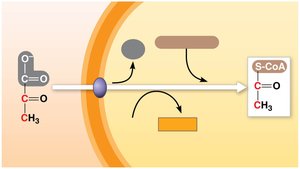
Pyruvate produced in glycolysis is transported into the mitochondrion (in eukaryotes) and converted to acetyl CoA, NADH, and CO2. This reaction is catalyzed by a multi-enzyme complex.
Occurs in the mitochondrial matrix (eukaryotes) or cytosol (prokaryotes).
Inputs: Pyruvate, NAD+, Coenzyme A.
Outputs: Acetyl CoA, NADH, CO2.
Citric Acid Cycle (Krebs Cycle, TCA Cycle)
Cycle Steps and Products
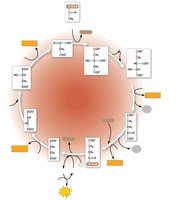
The citric acid cycle completes the breakdown of glucose by oxidizing acetyl CoA to CO2. It generates ATP, NADH, and FADH2 for use in oxidative phosphorylation.
Key intermediates: Citrate, Isocitrate, α-Ketoglutarate, Succinyl CoA, Succinate, Fumarate, Malate, Oxaloacetate.
Each turn of the cycle produces: 2 CO2, 3 NADH, 1 FADH2, 1 ATP (or GTP).
Oxidative Phosphorylation
Electron Transport Chain and Chemiosmosis
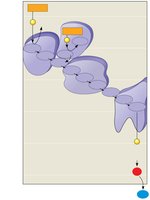
Oxidative phosphorylation is the final stage of cellular respiration, where most ATP is produced. Electrons from NADH and FADH2 are transferred through a series of protein complexes, ultimately reducing oxygen to water.
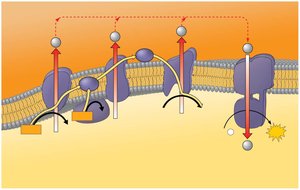
Electron Transport Chain (ETC): Series of multiprotein complexes (I-IV) embedded in the inner mitochondrial membrane.
Electrons flow from NADH/FADH2 to O2, releasing energy used to pump protons (H+) across the membrane.
Chemiosmosis: The proton gradient drives ATP synthesis via ATP synthase.
Aerobic vs Anaerobic Cellular Respiration
Final Electron Acceptors
The main difference between aerobic and anaerobic respiration is the final electron acceptor in the electron transport chain.
Aerobic respiration: Oxygen is the final electron acceptor.
Anaerobic respiration: Other molecules (e.g., sulfate, nitrate, CO2) serve as electron acceptors; only occurs in prokaryotes.
Fermentation
Alternative Pathway When Oxygen Is Absent
Fermentation is an anaerobic process that allows glycolysis to continue by recycling NADH to NAD+. It does not fully break down organic molecules to CO2 and H2O, so products retain energy.
Occurs in muscle cells (lactic acid fermentation) and yeast (alcohol fermentation).
Solves two problems: detoxifies pyruvate and recycles NADH.
Products: Lactic acid or ethanol, depending on organism.
Cellular Respiration in Prokaryotes
Metabolic Diversity and Membrane Organization
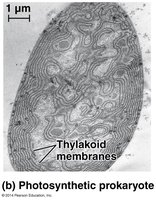
Prokaryotes perform cellular respiration using their cell membrane, which may be infolded to increase surface area for electron transport and chemiosmosis.
Extreme metabolic diversity: use a variety of electron acceptors.
Electron transport and ATP synthesis occur on membrane folds.
Origin of Eukaryotes and Mitochondria
Endosymbiotic Theory
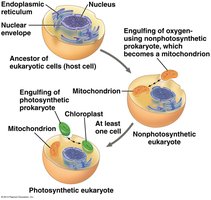
The origin of mitochondria and chloroplasts in eukaryotes is explained by the endosymbiotic theory, which proposes that these organelles originated from engulfed prokaryotic cells.
Mitochondria: Derived from oxygen-using nonphotosynthetic prokaryotes.
Chloroplasts: Derived from photosynthetic prokaryotes.
Summary Table: Cellular Respiration Pathways
Pathway | Location | Main Inputs | Main Outputs | ATP Yield |
|---|---|---|---|---|
Glycolysis | Cytosol | Glucose, 2 ATP, 2 NAD+ | 2 Pyruvate, 2 NADH, 4 ATP (net 2 ATP) | 2 ATP |
Pyruvate Oxidation | Mitochondrial matrix | 2 Pyruvate, 2 NAD+, 2 CoA | 2 Acetyl CoA, 2 NADH, 2 CO2 | 0 ATP |
Citric Acid Cycle | Mitochondrial matrix | 2 Acetyl CoA, 6 NAD+, 2 FAD, 2 ADP | 4 CO2, 6 NADH, 2 FADH2, 2 ATP | 2 ATP |
Oxidative Phosphorylation | Inner mitochondrial membrane | NADH, FADH2, O2, ADP | H2O, ATP | ~26-28 ATP |
Key Terms and Concepts
ATP (Adenosine Triphosphate): The main energy currency of the cell.
NAD+, FAD: Electron carriers that shuttle electrons to the electron transport chain.
Substrate-level phosphorylation: Direct transfer of phosphate to ADP to form ATP.
Oxidative phosphorylation: ATP synthesis driven by the electron transport chain and chemiosmosis.
Fermentation: Anaerobic process that regenerates NAD+ for glycolysis.
Equations
The overall equation for cellular respiration is:
Photosynthesis (reverse process):
Additional info:
Plants perform glycolysis, citric acid cycle, and require O2 for cellular respiration.
All eukaryotes use aerobic respiration; only prokaryotes can perform anaerobic respiration.
