 Indietro
CHP9
Guida di studio - Note intelligenti
 Appunti personalizzati basati sui tuoi materiali, ampliati con definizioni chiave, esempi e contesto.
Cellular Respiration
Introduction to Cellular Respiration
Cellular respiration is a fundamental metabolic pathway that enables cells to harvest energy from organic molecules, primarily glucose, and convert it into ATP, the cell’s energy currency. This process is essential for all aerobic organisms and connects energy and carbon cycling within ecosystems.
Ultimate Source of Energy: Sunlight is the primary energy source for ecosystems. Plants convert solar energy into chemical energy via photosynthesis, producing glucose.
Energy and Carbon Cycling: Energy flows through ecosystems as sunlight, is stored in organic molecules, and released as heat. Carbon cycles as CO2 is fixed by producers and released by consumers during respiration.
Catabolic Pathway: Cellular respiration is a catabolic pathway, breaking down complex molecules to release energy.
Aerobic Process: Requires oxygen to fully oxidize glucose.
Overall Equation: Glucose + Oxygen → Carbon dioxide + Water + Energy (ATP)
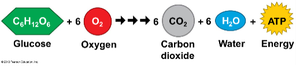
Oxidation and Reduction: Glucose is oxidized (loses electrons), oxygen is reduced (gains electrons).
Coenzymes: NAD+ and FAD act as electron carriers, becoming NADH and FADH2 when reduced.
ATP Synthesis: Occurs via substrate-level phosphorylation (direct transfer of phosphate) and oxidative phosphorylation (driven by electron transport chain and chemiosmosis).
Major Stages: Glycolysis, Citric Acid Cycle, Oxidative Phosphorylation.
Redox Reactions in Cellular Respiration
Redox reactions (oxidation-reduction) are central to cellular respiration, facilitating the transfer of electrons and energy release.
Oxidation: Loss of electrons (and hydrogen) from a molecule.
Reduction: Gain of electrons (and hydrogen) by a molecule.
Electron Carriers: NAD+ and FAD accept electrons during oxidation of glucose, forming NADH and FADH2.
Energy Release: Electrons "fall" from glucose to oxygen, releasing energy used to synthesize ATP.
Stages of Cellular Respiration
Cellular respiration consists of three main stages, each contributing to the breakdown of glucose and production of ATP.
Glycolysis: Occurs in the cytoplasm; splits glucose into two pyruvate molecules. Net gain: 2 ATP, 2 NADH.
Citric Acid Cycle (Krebs Cycle): Occurs in the mitochondrial matrix; completes oxidation of pyruvate. Net gain per glucose: 2 ATP, 6 NADH, 2 FADH2, 4 CO2.
Oxidative Phosphorylation: Occurs in the inner mitochondrial membrane; includes electron transport chain and chemiosmosis. Produces most ATP (~28-32 per glucose).
Glycolysis
Glycolysis is the first stage of cellular respiration, breaking down glucose into pyruvate and generating ATP and NADH.
Location: Cytoplasm
Inputs: Glucose, 2 ATP, 2 NAD+
Outputs: 2 Pyruvate, 4 ATP (net 2), 2 NADH
Phases:
Energy Investment: 2 ATP used to activate glucose.
Energy Payoff: 4 ATP produced, 2 NADH formed, pyruvate generated.
Oxygen Requirement: Glycolysis can occur without oxygen.
Pyruvate Oxidation and Citric Acid Cycle
Pyruvate is converted to acetyl-CoA, which enters the citric acid cycle to complete the oxidation of glucose.
Pyruvate Oxidation: Occurs in mitochondrial matrix; produces acetyl-CoA, NADH, CO2.
Citric Acid Cycle: Acetyl-CoA combines with oxaloacetate to form citrate; cycle regenerates oxaloacetate. Each turn produces 1 ATP, 3 NADH, 1 FADH2, 2 CO2.
Cycle Turns: Twice per glucose (once per pyruvate).
CO2 Production: Occurs during pyruvate oxidation and citric acid cycle.
Oxidative Phosphorylation and Electron Transport Chain
Oxidative phosphorylation is the final stage, where most ATP is produced via the electron transport chain and chemiosmosis.
Location: Inner mitochondrial membrane
Electron Transport Chain: Series of protein complexes (including cytochromes) that transfer electrons from NADH/FADH2 to O2.
Chemiosmosis: Energy from electron transport pumps H+ into intermembrane space; H+ flows back through ATP synthase, driving ATP production.
Oxygen: Final electron acceptor; forms water.
ATP Yield: ~28-32 ATP per glucose.
Efficiency: About 34% of glucose energy is converted to ATP; remainder lost as heat.
Fermentation and Anaerobic Respiration
When oxygen is unavailable, cells use fermentation or anaerobic respiration to produce ATP.
Fermentation: Glycolysis plus reactions that regenerate NAD+; produces 2 ATP per glucose.
Alcohol Fermentation: Pyruvate converted to ethanol and CO2; carried out by yeast.
Lactic Acid Fermentation: Pyruvate converted to lactate; carried out by bacteria and muscle cells.
Obligate Anaerobes: Cannot survive in O2; use fermentation or anaerobic respiration.
Facultative Anaerobes: Can use either fermentation or respiration.
Lactate: Not responsible for muscle fatigue; can be converted to glucose in liver.
Metabolic Pathways and Regulation
Cellular respiration is interconnected with other metabolic pathways, allowing cells to utilize various nutrients and regulate energy production.
Catabolic Pathways: Proteins, fats, and carbohydrates can enter glycolysis or citric acid cycle after appropriate modifications.
Beta Oxidation: Fatty acids broken down to acetyl-CoA, NADH, FADH2; fats yield more ATP than carbohydrates.
Feedback Inhibition: High ATP or citrate levels inhibit glycolysis; metabolic control is achieved by regulating enzyme activity.
Evolutionary Significance of Glycolysis
Glycolysis is considered an ancient metabolic pathway, used by early prokaryotes before atmospheric oxygen was available. Its occurrence in the cytosol and independence from organelles highlights its evolutionary importance.
Ancient Process: Used by prokaryotes before O2 was present in the atmosphere.
Universality: Occurs in all living cells, indicating evolutionary conservation.
Key Terms and Definitions
Aerobic/Anaerobic: Aerobic requires O2; anaerobic does not.
Cellular Respiration: Process of converting glucose and O2 into ATP, CO2, and H2O.
Redox Reactions: Chemical reactions involving electron transfer.
NAD+ & NADH: Electron carrier; NAD+ is oxidized, NADH is reduced.
FAD & FADH2: Electron carrier; FAD is oxidized, FADH2 is reduced.
Glycolysis: Breakdown of glucose to pyruvate.
Citric Acid Cycle: Series of reactions completing glucose oxidation.
Substrate-level Phosphorylation: Direct transfer of phosphate to ADP.
Oxidative Phosphorylation: ATP synthesis driven by electron transport chain and chemiosmosis.
Electron Transport Chain: Series of proteins transferring electrons to O2.
Chemiosmosis: ATP synthesis using H+ gradient.
Cytochromes: Electron transport proteins with heme groups.
Fermentation: Anaerobic ATP production.
Obligate Anaerobes: Require anaerobic conditions.
Facultative Anaerobes: Can use aerobic or anaerobic pathways.
Beta Oxidation: Fatty acid breakdown to acetyl-CoA.
Cellular Respiration Equation (LaTeX)
ATP Yield Table
Stage | ATP Produced (per glucose) |
|---|---|
Glycolysis | 2 |
Citric Acid Cycle | 2 |
Oxidative Phosphorylation | 28-32 |
Total | ~32 |
Additional info: The notes have been expanded to include definitions, examples, and context for each stage and process, as well as a summary table for ATP yield.
