 Indietro
Cellular Respiration: Pathways, Mechanisms, and Energy Yield
Guida di studio - Note intelligenti
 Appunti personalizzati basati sui tuoi materiali, ampliati con definizioni chiave, esempi e contesto.
Cellular Respiration: Overview
Energy Flow in Ecosystems
Cellular respiration is a fundamental process by which cells extract energy from organic molecules, primarily glucose, to produce ATP, the cell's energy currency. This process is tightly linked to photosynthesis in the ecosystem, forming a cycle of energy transformation. - Photosynthesis in chloroplasts converts solar energy into chemical energy stored in glucose. - Cellular respiration in mitochondria breaks down glucose to release energy as ATP. - ATP is used for cellular work, and energy is eventually lost as heat. 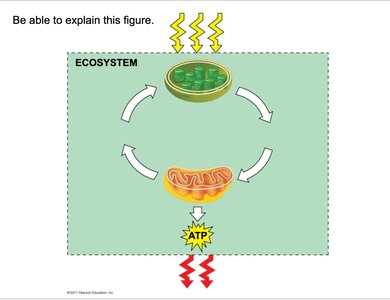
Redox Reactions in Cellular Respiration
Oxidation and Reduction
Redox reactions are central to cellular respiration, involving the transfer of electrons between molecules. - Oxidation: Loss of electrons from a molecule. - Reduction: Gain of electrons by a molecule. - Oxidizing agent: Accepts electrons and becomes reduced. - Reducing agent: Donates electrons and becomes oxidized. 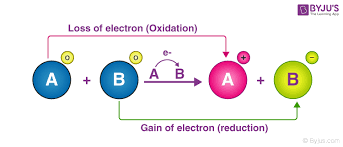
Redox in Cellular Respiration
During cellular respiration, glucose is oxidized and oxygen is reduced. - Glucose loses electrons (and hydrogens) to become carbon dioxide. - Oxygen gains electrons (and hydrogens) to become water. 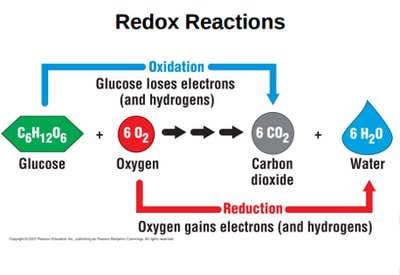
Mitochondria: The Site of Cellular Respiration
Mitochondrial Structure
The mitochondrion is the organelle where most steps of cellular respiration occur. - Outer membrane: Surrounds the organelle. - Inner membrane: Highly folded (cristae) to increase surface area. - Matrix: The innermost compartment, site of the citric acid cycle. 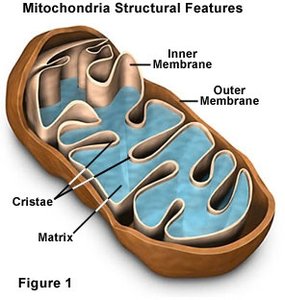
Stages of Cellular Respiration
Glycolysis
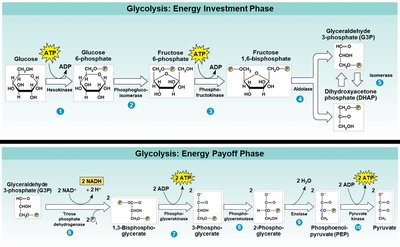
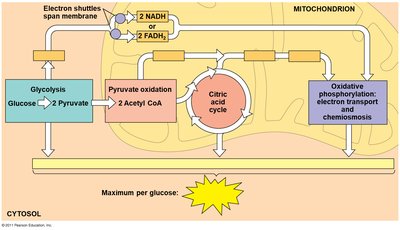
Glycolysis is the first stage of cellular respiration, occurring in the cytosol. It breaks down glucose into two molecules of pyruvate. - Energy investment phase: 2 ATP are consumed. - Energy payoff phase: 4 ATP are produced (net gain of 2 ATP), and 2 NADH are generated. - Net output: 2 pyruvate, 2 ATP, 2 NADH. 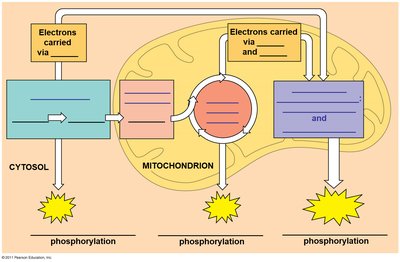
Pyruvate Oxidation
Pyruvate oxidation occurs in the mitochondrial matrix. Each pyruvate is converted into an acetyl group, which attaches to coenzyme A, producing acetyl CoA, CO₂, and NADH. - Inputs: 2 pyruvate, 2 NAD+, 2 coenzyme A - Outputs: 2 acetyl CoA, 2 CO₂, 2 NADH 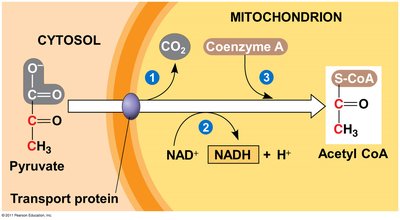
Citric Acid Cycle (Krebs Cycle)
The citric acid cycle takes place in the mitochondrial matrix. Acetyl CoA enters the cycle, combining with oxaloacetate to form citrate. The cycle produces ATP, NADH, FADH₂, and CO₂. - Inputs: 2 acetyl CoA, 6 NAD+, 2 FAD, 2 ADP - Outputs: 4 CO₂, 6 NADH, 2 FADH₂, 2 ATP - Oxaloacetate is regenerated at the end of the cycle, allowing the cycle to continue. 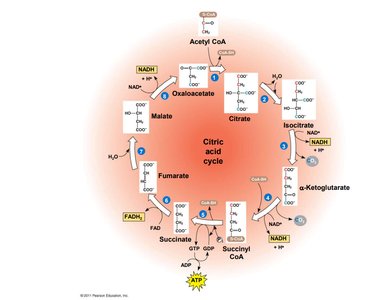
Phosphorylation Mechanisms
Substrate-Level Phosphorylation
Substrate-level phosphorylation is the direct transfer of a phosphate group from a substrate to ADP, catalyzed by an enzyme. - Occurs during glycolysis and the citric acid cycle. - Produces a small amount of ATP. 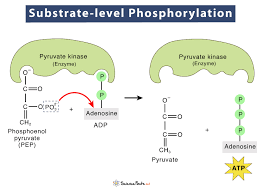
Oxidative Phosphorylation
Oxidative phosphorylation involves the electron transport chain and chemiosmosis in the inner mitochondrial membrane. - Redox reactions create a proton (H+) gradient. - ATP synthase uses this gradient to produce ATP. - Produces the majority of ATP in cellular respiration. 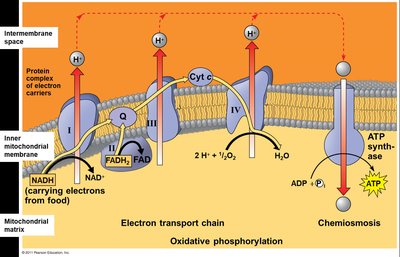
Summary Table: Stages of Cellular Respiration
Comparison of Pathways
Stage | Location | Inputs | Outputs |
|---|---|---|---|
Glycolysis | Cytosol | Glucose, 2 ATP, 2 NAD+ | 2 Pyruvate, 2 ATP (net), 2 NADH |
Pyruvate Oxidation | Mitochondrial Matrix | 2 Pyruvate, 2 NAD+, 2 CoA | 2 Acetyl CoA, 2 CO₂, 2 NADH |
Citric Acid Cycle | Mitochondrial Matrix | 2 Acetyl CoA, 6 NAD+, 2 FAD, 2 ADP | 4 CO₂, 6 NADH, 2 FADH₂, 2 ATP |
Oxidative Phosphorylation | Inner Mitochondrial Membrane | NADH, FADH₂, O₂, ADP | ATP, H₂O |
Fermentation
Lactic Acid Fermentation
When oxygen is unavailable, cells can perform fermentation to regenerate NAD+ and allow glycolysis to continue. - Lactic acid fermentation converts pyruvate to lactic acid. - High lactic acid levels indicate anaerobic metabolism, often due to hypoxia (low oxygen), as seen in septic shock. 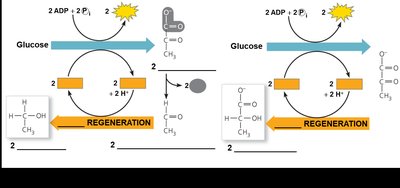
Key Terms and Enzymes
Enzyme Types in Cellular Respiration
- Kinases: Add or remove phosphate groups. - Isomerases: Rearrange molecular structure without changing formula. - Dehydrogenases: Remove hydride ions (H-) and facilitate oxidation.
Additional info:
- The ATP-ADP cycle is central to energy transfer in cells. - Substrate-level phosphorylation is less efficient than oxidative phosphorylation. - The electron transport chain requires oxygen as the final electron acceptor. - Fermentation is less efficient, producing only 2 ATP per glucose.
