 Indietro
MODULE 6 - CELLULAR RESPIRATION
Guida di studio - Note intelligenti
 Appunti personalizzati basati sui tuoi materiali, ampliati con definizioni chiave, esempi e contesto.
Cellular Respiration
Overview of Cellular Respiration
Cellular respiration is the process by which cells extract energy and carbon from food molecules, primarily glucose, to produce ATP, the universal energy currency. This process occurs in both eukaryotic and prokaryotic cells, though the location and mechanisms may differ. Cellular respiration can be aerobic (requiring oxygen) or anaerobic (not requiring oxygen), with distinct metabolic pathways and energy yields.
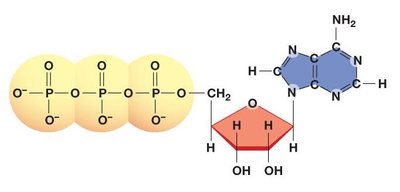
ATP (Adenosine Triphosphate): Immediate energy storage molecule used by all cells.
Energy Release: ATP is hydrolyzed to ADP and inorganic phosphate, releasing energy for cellular work.
Cell Types: Both eukaryotic and prokaryotic cells require ATP, but their methods of production differ due to structural differences.

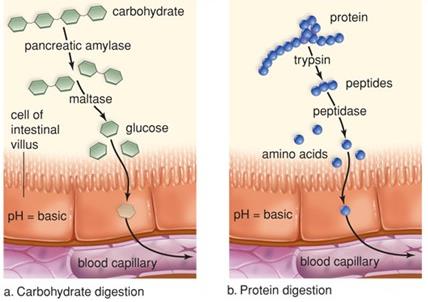
Pathway of Energy and Matter in Food
Food is digested and absorbed, with nutrients transported via the circulatory system to individual cells. Cells use food for biosynthesis (building cellular components) or for energy production through cellular respiration.
Biosynthesis: Raw materials from food are used to build cellular structures.
Cellular Fuel: Food is oxidized to produce ATP.
Stages of Cellular Respiration
Summary Table: Stages of Cellular Respiration
Stage | Location | Inputs | Outputs | Oxygen Required? | Net ATP (per glucose) |
|---|---|---|---|---|---|
Glycolysis | Cytoplasm | Glucose, NAD+, ADP | Pyruvate, NADH, ATP | No | 2 |
Pyruvate Processing | Mitochondrial Matrix | Pyruvate, NAD+, CoA | Acetyl CoA, NADH, CO2 | Yes | 0 |
Citric Acid Cycle | Mitochondrial Matrix | Acetyl CoA, NAD+, FAD, ADP | CO2, NADH, FADH2, ATP | Yes | 2 |
Oxidative Phosphorylation | Inner Mitochondrial Membrane | NADH, FADH2, O2, ADP | ATP, H2O | Yes | ~34 |
Step 1: Glycolysis
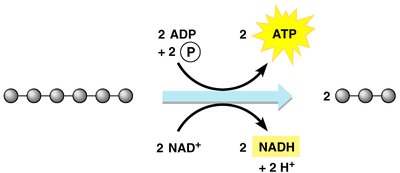
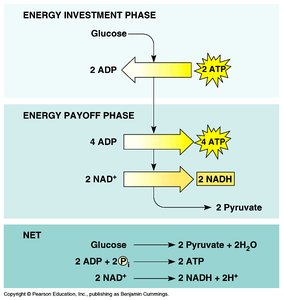
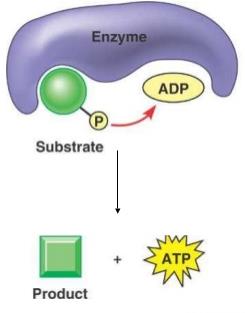
Glycolysis is the breakdown of glucose (6C) into two molecules of pyruvate (3C each). It occurs in the cytoplasm and does not require oxygen. ATP is produced via substrate-level phosphorylation, where an enzyme transfers a phosphate group from a substrate to ADP.
Inputs: Glucose, 2 NAD+, 2 ADP
Outputs: 2 Pyruvate, 2 NADH, 2 ATP
ATP Yield: 2 net ATP per glucose
Redox Reactions: NAD+ is reduced to NADH
Step 2: Pyruvate Processing
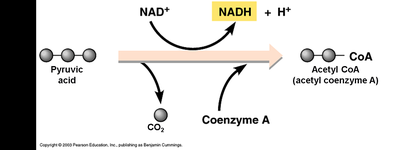
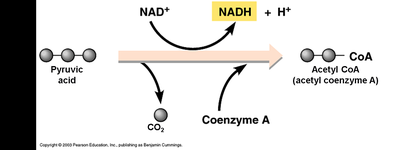
Pyruvate is transported into the mitochondrial matrix and converted to Acetyl CoA. This process produces NADH and releases CO2. It is oxygen-dependent and prepares substrates for the citric acid cycle.
Inputs: Pyruvate, NAD+, Coenzyme A
Outputs: Acetyl CoA, NADH, CO2
Step 3: Citric Acid Cycle (Krebs Cycle)
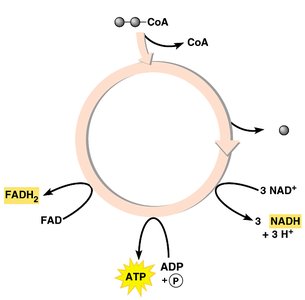
The citric acid cycle completes the oxidation of food molecules, generating NADH, FADH2, ATP, and CO2. It occurs in the mitochondrial matrix and is oxygen-dependent. Each turn of the cycle (per Acetyl CoA) produces 1 ATP, 3 NADH, 1 FADH2, and 2 CO2.
Inputs: Acetyl CoA, NAD+, FAD, ADP
Outputs: CO2, NADH, FADH2, ATP
ATP Yield: 2 ATP per glucose (since 2 Acetyl CoA are produced per glucose)
Step 4: Electron Transport Chain & Chemiosmosis
The electron transport chain (ETC) is located in the inner mitochondrial membrane. It accepts electrons from NADH and FADH2, creating a proton gradient (proton motive force). Chemiosmosis uses this gradient to drive ATP synthesis via ATP synthase. Oxygen is the final electron acceptor, forming water as a byproduct. This step produces the majority of ATP (~34 per glucose).
Inputs: NADH, FADH2, O2, ADP
Outputs: ATP, H2O
ATP Yield: ~34 ATP per glucose
Oxidative Phosphorylation: ATP production via ETC and ATP synthase
Anaerobic Respiration: Fermentation
Fermentation Pathways
When oxygen is unavailable, cells can produce ATP via fermentation. Fermentation occurs in the cytoplasm and regenerates NAD+ for glycolysis. It yields only 2 ATP per glucose, much less than aerobic respiration. Two major types are lactic acid fermentation and alcoholic fermentation.
Lactic Acid Fermentation: Pyruvate is reduced to lactic acid; occurs in muscle cells and some bacteria.
Alcoholic Fermentation: Pyruvate is converted to ethanol and CO2; occurs in yeast and some bacteria.
ATP Production: Only via substrate-level phosphorylation in glycolysis.
Comparison: Cellular Respiration vs. Fermentation
Process | Location | Oxygen Required? | ATP Yield (per glucose) | End Products |
|---|---|---|---|---|
Cellular Respiration | Cytoplasm & Mitochondria | Yes | ~38 | CO2, H2O |
Fermentation | Cytoplasm | No | 2 | Lactic acid or ethanol + CO2 |
Key Terms and Concepts
Substrate-Level Phosphorylation: Direct transfer of phosphate to ADP by an enzyme.
Oxidative Phosphorylation: ATP synthesis driven by ETC and chemiosmosis.
NAD+ / NADH: Electron carriers involved in redox reactions.
FAD / FADH2: Additional electron carriers in the citric acid cycle and ETC.
Proton Motive Force: Gradient of H+ across the mitochondrial membrane used to drive ATP synthesis.
Summary of Glucose Oxidation
Glucose is oxidized through glycolysis, pyruvate processing, citric acid cycle, and oxidative phosphorylation, resulting in the production of ATP, CO2, and H2O. Most energy is transferred via electrons, not carbons, through NADH and FADH2 to the ETC.
Equations
Overall Cellular Respiration Equation:
ATP Hydrolysis:
Additional info:
All foods (carbohydrates, fats, proteins) can be used as fuel for cellular respiration, entering at different points in the pathway.
Prokaryotes, lacking mitochondria, perform cellular respiration across their cell membranes.
Endosymbiotic theory explains the origin of mitochondria in eukaryotes, supporting differences in ATP production mechanisms.
