 Indietro
Cellular Respiration: Chapter 8
Guida di studio - Note intelligenti
 Appunti personalizzati basati sui tuoi materiali, ampliati con definizioni chiave, esempi e contesto.
Cellular Respiration
Introduction to Cellular Respiration
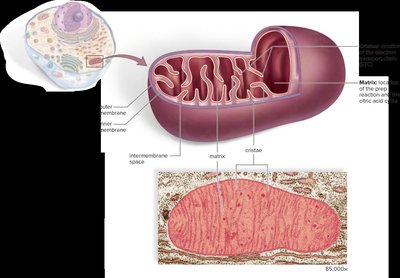
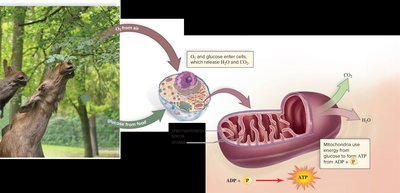
Cellular respiration is a fundamental metabolic process in all aerobic organisms, responsible for breaking down nutrient molecules produced by photosynthesis to generate ATP, the cell's energy currency. This process occurs primarily in the mitochondria and involves the consumption of oxygen and the release of carbon dioxide.
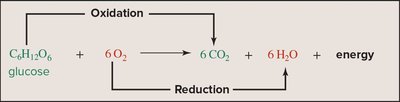
Definition: Cellular respiration is the complete breakdown of glucose (C6H12O6) to produce CO2 and H2O, releasing energy.
Key reactants: Oxygen (O2) is consumed; carbon dioxide (CO2) and water (H2O) are released.
Location: Most steps occur in the mitochondria, except glycolysis and fermentation, which occur in the cytoplasm.
Oxidation-Reduction in Cellular Respiration
Cellular respiration is a series of oxidation-reduction (redox) reactions, where electrons are transferred from glucose to oxygen, resulting in energy release.
Oxidation: Glucose is oxidized, losing electrons.
Reduction: Oxygen is reduced, gaining electrons and forming water.
Overall equation:
Coenzymes in Cellular Respiration
Two key coenzymes, NAD+ and FAD, are essential for electron transfer during cellular respiration.
NAD+ (nicotinamide adenine dinucleotide): Accepts electrons and becomes NADH; recycled throughout the process.
FAD (flavin adenine dinucleotide): Accepts electrons and hydrogen ions to form FADH2.
Phases of Cellular Respiration
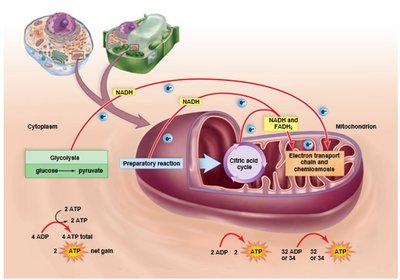
Cellular respiration consists of four main phases, each with distinct locations and functions.
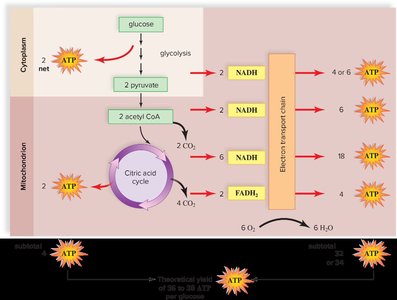
Glycolysis: Breakdown of glucose into two pyruvate molecules; occurs in the cytoplasm; anaerobic; net gain of 2 ATP.
Preparatory (Prep) Reaction: Oxidizes pyruvate to acetyl-CoA; occurs in the mitochondrial matrix; releases CO2 and stores energy in NADH.
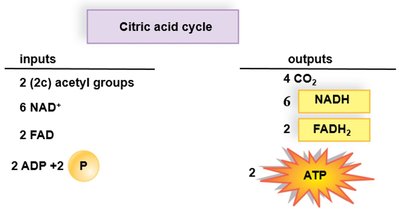
Citric Acid Cycle (Krebs Cycle): Completes glucose breakdown; occurs in the matrix; produces NADH, FADH2, CO2, and 2 ATP per glucose.
Electron Transport Chain (ETC): Major site of ATP production; occurs on the cristae; extracts energy from NADH and FADH2; produces 32–34 ATP.
Glycolysis and Fermentation
Glycolysis
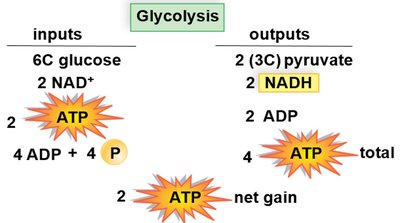
Glycolysis is the first step in cellular respiration, breaking down glucose into pyruvate in the cytoplasm. It is an anaerobic process and results in a net gain of 2 ATP.
Location: Cytoplasm
Steps: 10 reactions; 2 ATP invested, 4 ATP produced (net gain 2 ATP)
Products: 2 pyruvate, 2 NADH, 2 ATP (net)
Fermentation
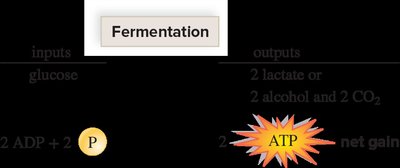
Fermentation occurs when oxygen is unavailable, allowing cells to continue producing ATP anaerobically. Pyruvate is reduced to either lactate or alcohol, depending on the organism.
Alcoholic fermentation: Produces CO2 and ethyl alcohol; common in yeasts.
Lactic acid fermentation: Produces CO2 and lactate; occurs in animal cells and some bacteria.
Efficiency: Only 2 ATP per glucose (2.1% efficiency); much less than aerobic respiration.
Advantages: Quick ATP production during intense activity.
Disadvantages: Toxic byproducts (lactate, alcohol); causes muscle fatigue and cell death.
Preparatory Reaction and Citric Acid Cycle
Preparatory Reaction
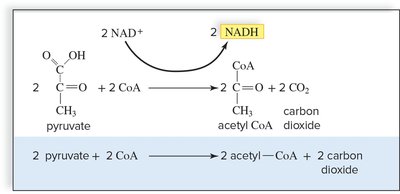
The preparatory reaction links glycolysis to the citric acid cycle, converting pyruvate into acetyl-CoA and releasing CO2.
Location: Mitochondrial matrix
Products: 2 acetyl-CoA, 2 CO2, 2 NADH per glucose
Citric Acid Cycle (Krebs Cycle)
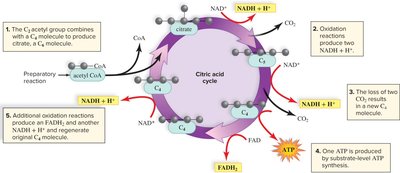
The citric acid cycle completes the oxidation of glucose, producing high-energy electron carriers and ATP.
Location: Mitochondrial matrix
Steps: Acetyl-CoA combines with oxaloacetate to form citrate; cycle turns twice per glucose.
Products per glucose: 4 CO2, 2 ATP, 6 NADH, 2 FADH2
Electron Transport Chain (ETC)
Mechanism and ATP Production
The electron transport chain is the final stage of cellular respiration, where most ATP is produced via oxidative phosphorylation and chemiosmosis.
Location: Cristae of mitochondria (or plasma membrane in prokaryotes)
Process: Electrons from NADH and FADH2 are passed through carrier molecules, releasing energy to pump H+ and create an electrochemical gradient.
ATP synthase: Uses H+ flow to synthesize ATP.
Oxygen: Final electron acceptor; combines with H+ to form water.
Yield: 32–34 ATP per glucose
Metabolism: Energy Yield and Usage
ATP Yield and Efficiency
Cellular respiration is highly efficient compared to fermentation, converting a significant portion of glucose's energy into ATP.
Net ATP yield: 36–38 ATP per glucose
Energy content: Glucose = 686 kCal; 36 ATP = 263 kCal; efficiency ≈ 39%
Energy loss: Remaining energy lost as heat
Catabolism and Anabolism
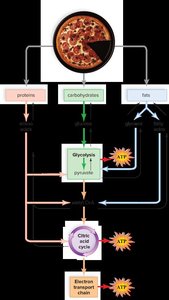
Metabolism includes both catabolic (breakdown) and anabolic (synthesis) reactions, integrating various biomolecules into cellular respiration.
Catabolism: Degradative reactions; glucose, fats, and proteins are broken down for energy.
Anabolism: Synthetic reactions; intermediates from respiration are used to build carbohydrates, fats, and proteins.
Deamination: Removal of amino groups from amino acids; produces ammonia, converted to urea in the liver.
Essential amino acids: 9 must be obtained from diet; 11 can be synthesized by adult humans.
Energy Organelles: Chloroplasts and Mitochondria
Comparison and Energy Flow
Chloroplasts and mitochondria are key organelles for energy transformation in cells. Both utilize membranes and electron transport chains to produce ATP, but differ in their substrates and products.
Chloroplasts: Site of photosynthesis; thylakoid membranes; produce carbohydrates from sunlight.
Mitochondria: Site of cellular respiration; cristae membranes; produce ATP from carbohydrates.
Energy flow: Sun → chloroplasts → carbohydrates → mitochondria → ATP
Chemical cycling: Both organelles permit energy flow and chemical cycling in organisms.
Summary Table: Phases of Cellular Respiration
Phase | Location | Main Inputs | Main Outputs | ATP Yield |
|---|---|---|---|---|
Glycolysis | Cytoplasm | Glucose, NAD+, ADP | Pyruvate, NADH, ATP | 2 ATP (net) |
Preparatory Reaction | Mitochondrial Matrix | Pyruvate, NAD+, CoA | Acetyl-CoA, NADH, CO2 | 0 ATP |
Citric Acid Cycle | Mitochondrial Matrix | Acetyl-CoA, NAD+, FAD, ADP | CO2, NADH, FADH2, ATP | 2 ATP |
Electron Transport Chain | Cristae | NADH, FADH2, O2, ADP | ATP, H2O | 32–34 ATP |
Example: During intense exercise, muscle cells rely on lactic acid fermentation for rapid ATP production, resulting in muscle fatigue due to lactate accumulation.
Additional info: The notes integrate textbook-level explanations and visual aids to reinforce understanding of cellular respiration, its phases, and metabolic context.
