 Indietro
Central Dogma, Cell Division, and Genetic Variation: Study Guide for General Biology
Guida di studio - Note intelligenti
 Appunti personalizzati basati sui tuoi materiali, ampliati con definizioni chiave, esempi e contesto.
Central Dogma of Molecular Biology
Overview
The Central Dogma describes the flow of genetic information within a biological system. It explains how DNA is used as a template for replication, transcription, and translation, ultimately resulting in protein synthesis.
DNA Replication: DNA serves as a template to produce identical DNA molecules.
Transcription: DNA is transcribed into messenger RNA (mRNA).
Translation: mRNA is translated into a polypeptide (protein).
Key Takeaway: Each step has a distinct purpose: replication for copying DNA, transcription for creating RNA, and translation for synthesizing proteins.
DNA Replication
Replication Forks and Bubbles
DNA replication occurs at regions called replication forks and bubbles, where the double helix unwinds and new strands are synthesized.
Leading Strand: Synthesized continuously in the 5' to 3' direction.
Lagging Strand: Synthesized discontinuously as Okazaki fragments.
Key Enzymes:
DNA Polymerase: Synthesizes new DNA strands.
Primase: Adds RNA primers to initiate synthesis.
Ligase: Joins Okazaki fragments.
Replication forks and bubbles refer to the same concept: sites of active DNA synthesis. 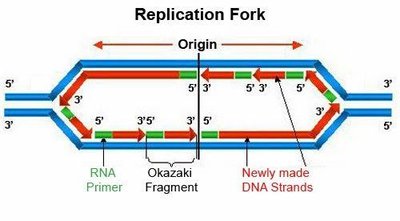
Cell Division
Mitosis
Mitosis is the process by which a cell divides to produce two genetically identical daughter cells. It consists of several phases:
Prophase: Chromosomes condense; nuclear membrane breaks down; spindle fibers form.
Metaphase: Chromosomes align at the cell's equator.
Anaphase: Sister chromatids are pulled apart to opposite poles.
Telophase: Nuclear membranes reform; chromosomes decondense.
Cytokinesis: Cell splits into two identical cells.
Key Takeaway: Mitosis produces identical cells; do not confuse with meiosis.
Meiosis
Meiosis is the process that produces gametes (sperm and egg cells) with half the chromosome number of the original cell. It occurs in two stages:
Meiosis I: Separates homologous chromosomes.
Prophase I: Homologous chromosomes pair and undergo crossing over.
Metaphase I: Pairs align at the equator.
Anaphase I: Homologs separate; sister chromatids stay together.
Telophase I + Cytokinesis: Cell splits; chromosomes are still doubled.
Meiosis II: Separates sister chromatids.
Prophase II: Chromosomes condense; spindles form.
Metaphase II: Chromosomes align at the equator.
Anaphase II: Sister chromatids separate.
Telophase II + Cytokinesis: Cells split again.
Key Takeaway: Meiosis generates genetic variation and reduces chromosome number.
Cell Cycle
Phases of the Cell Cycle
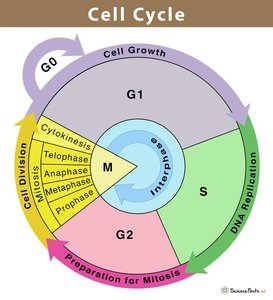
The cell cycle is the series of events that cells go through as they grow and divide.
G1 Phase: Cell growth and preparation for DNA replication.
S Phase: DNA replication (chromosomes are duplicated).
G2 Phase: Preparation for mitosis.
M Phase: Cell division (mitosis and cytokinesis).
G0 Phase: Resting phase; cells may exit the cycle.
Transcription and RNA Processing
DNA Transcription
Transcription is the process by which a segment of DNA is copied into mRNA.
Template Strand: The DNA strand running 3' to 5' from the promoter is used as the template.
Transcription Factors: Proteins that bind to the promoter region to initiate transcription.
RNA Splicing
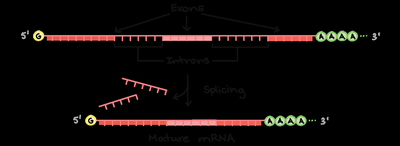
Before translation, the primary mRNA transcript undergoes splicing to remove non-coding regions (introns) and join coding regions (exons).
Exons: Coding sequences that exit the nucleus as part of mature mRNA.
Introns: Non-coding sequences that stay in the nucleus.
Translation
Protein Synthesis
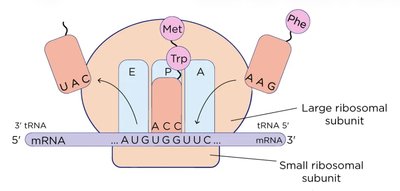
Translation is the process by which mRNA is decoded to synthesize a polypeptide.
Direction: mRNA is read from 5' to 3'.
Ribosome Sites:
A site: tRNA enters with amino acid.
P site: Peptide bond forms.
E site: tRNA is ejected.
Anticodon: Found on tRNA, complementary to mRNA codon.
Genetics and Probability
Test Crosses and Probability
Understanding Punnett squares and probability is essential for predicting genetic outcomes.
Example: Two carriers (heterozygous) for a recessive disease have a child. The probability that their next two children will be affected is calculated using probability rules.
Mendel's Laws
Independent Assortment: Random alignment of homologous chromosomes during metaphase I of meiosis.
Segregation of Alleles: Separation of homologous chromosomes during anaphase I.
Genetic Variation
Sources of Genetic Variation
Genetic variation is crucial for evolution and is generated by several mechanisms:
Mutation: Changes in DNA sequence.
Independent Assortment: Random chromosome combinations during meiosis I.
Crossover (Homologous Recombination): Exchange of DNA between homologous chromosomes in prophase I.
Random Fertilization: Random combination of gametes.
Meiosis is the key process for generating genetic variation, especially during meiosis I.
Biomolecule Application in Central Dogma
Biomolecules Involved
Promoter Sequences: Made of nucleic acids (DNA).
Transcription Factors: Made of proteins.
Practice and Exam Preparation
Common Exam Topics
Fill in codon tables and interpret mRNA sequences.
Punnett squares, test crosses, and pedigree analysis.
Drawing examples of independent assortment.
Ploidy diagrams comparing mitosis and meiosis.
Additional info: Practice interpreting strand directionality, identifying coding/template/mRNA/tRNA strands, and understanding genetic probability for exam success.
