 Indietro
Central Dogma: Transcription and Translation Sequence Grid
Guida di studio - Note intelligenti
 Appunti personalizzati basati sui tuoi materiali, ampliati con definizioni chiave, esempi e contesto.
Q1. Fill in the sequence grid for DNA, mRNA, tRNA, and polypeptide, identifying template/coding strands, end polarities, and using the codon table to determine the polypeptide sequence.
Background
Topic: Central Dogma of Molecular Biology (Transcription and Translation)
This question tests your understanding of how genetic information flows from DNA to RNA to protein. You are asked to identify the template and coding DNA strands, transcribe DNA to mRNA, match tRNA anticodons, and use the codon table to translate the mRNA into a polypeptide sequence.
Key Terms and Formulas
Template DNA strand: The DNA strand used by RNA polymerase to synthesize mRNA (complementary to mRNA).
Coding (non-template) DNA strand: The DNA strand with the same sequence as mRNA (except T for U).
Transcription: Synthesis of mRNA from the DNA template strand.
Translation: Synthesis of a polypeptide using the mRNA codons and tRNA anticodons.
Codon: A sequence of three mRNA nucleotides that codes for an amino acid.
Anticodon: A sequence of three tRNA nucleotides complementary to the mRNA codon.
Polarity: DNA and RNA have directionality (5' to 3'); polypeptides have N-terminus to C-terminus.

Step-by-Step Guidance
Identify the directionality (5' and 3' ends) for each DNA strand. Remember, the template strand is read 3' to 5' by RNA polymerase, and the mRNA is synthesized 5' to 3'.
Determine which DNA strand is the template and which is the coding (non-template) strand. The mRNA sequence will be complementary to the template strand and identical to the coding strand (except U replaces T).
Fill in the missing DNA nucleotides in both strands, making sure base pairing rules are followed (A-T, G-C in DNA; A-U, G-C in RNA).
Transcribe the DNA template strand to mRNA by writing the complementary RNA bases (A-U, T-A, C-G, G-C).
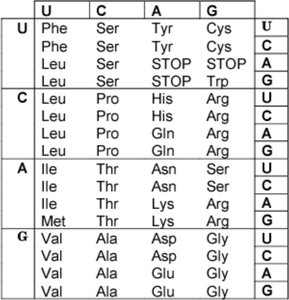
Divide the mRNA sequence into codons (groups of three nucleotides) and use the codon table to determine the corresponding amino acid for each codon. Write the tRNA anticodon (complementary to the mRNA codon) below each codon.
Try solving on your own before revealing the answer!
Final Answer:
1. DNA Strands: Top: Coding (non-template) strand, 5' to 3' Bottom: Template strand, 3' to 5'
2. Polarity: DNA coding: 5' (left) to 3' (right) DNA template: 3' (left) to 5' (right) mRNA: 5' (left) to 3' (right) Polypeptide: N-terminus (left) to C-terminus (right)
3. Nucleotide Sequences: DNA coding: 5' T A C G G C A 3' DNA template: 3' A T G C C G T 5' mRNA: 5' A C G G C A U 3'
4. tRNA Anticodons: U G C C G U A
5. Polypeptide: GLY (for GGC codon)
Each step follows the central dogma: DNA (template) → mRNA (transcription) → tRNA (translation) → polypeptide (amino acid sequence). The codon GGC codes for glycine (GLY), as shown in the codon table.
