 Indietro
Chapter 1: Evolution, Themes of Biology, and Scientific Inquiry – Study Notes
Guida di studio - Note intelligenti
 Appunti personalizzati basati sui tuoi materiali, ampliati con definizioni chiave, esempi e contesto.
Introduction to Biology
Definition of Biology
Biology is the scientific study of life. It encompasses the investigation of living organisms, their structure, function, growth, origin, evolution, and distribution.
Themes in Biology
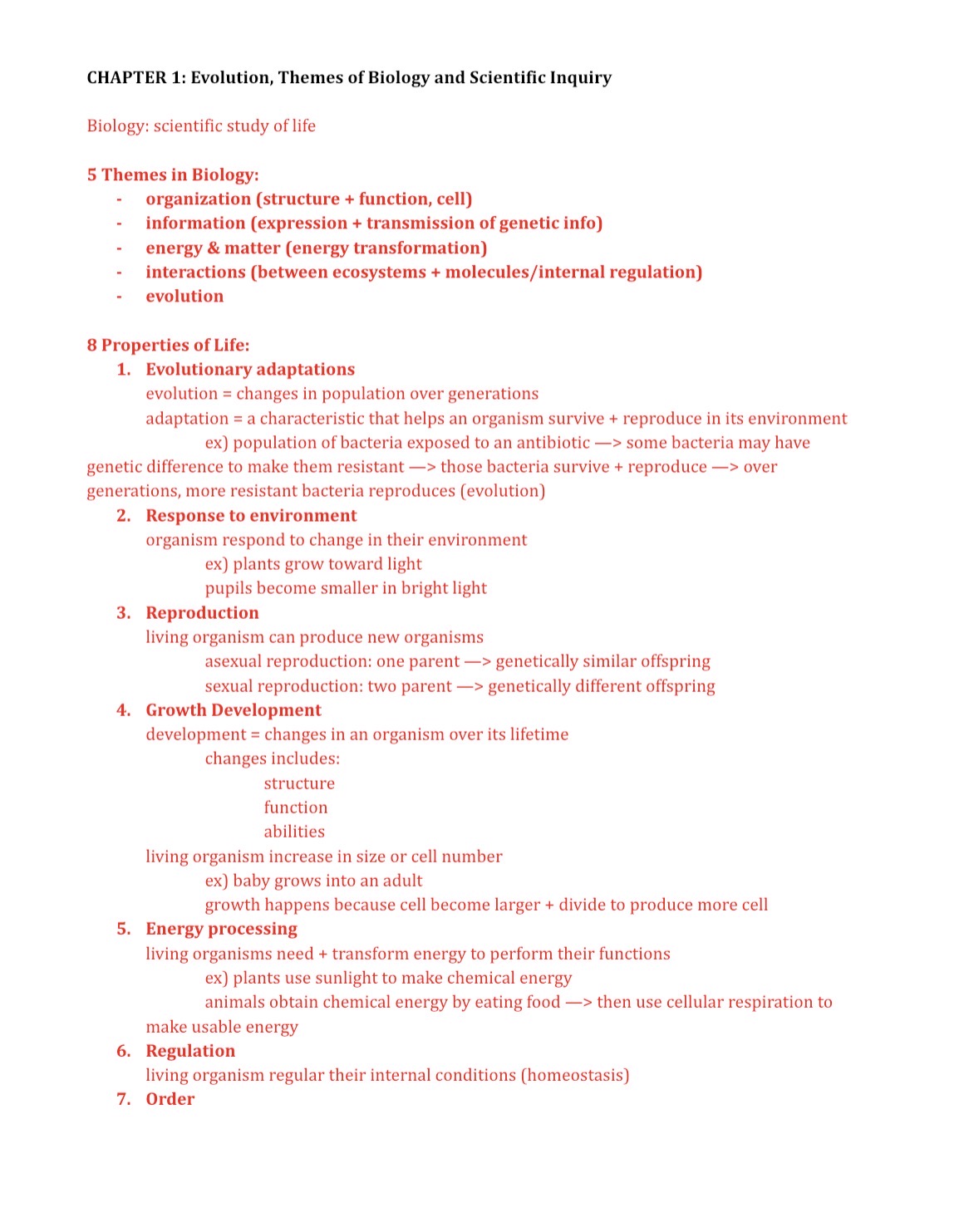
Five Major Themes
Modern biology is organized around several unifying themes that help explain the complexity and diversity of life:
Organization (structure + function, cell): Biological systems are structured in a hierarchical manner, from molecules to the biosphere. The structure of a biological component often determines its function.
Information (expression and transmission of genetic information): Living organisms store genetic information in DNA, which is expressed and transmitted across generations.
Energy & Matter (energy transformation): Life requires the transfer and transformation of energy and matter to grow, develop, and reproduce.
Interactions (between ecosystems, molecules, and internal regulation): Organisms interact with each other and their environment, maintaining internal stability (homeostasis) and contributing to ecosystem dynamics.
Evolution: Evolution explains the unity and diversity of life, as populations change over generations through adaptation and natural selection.
Properties of Life
Eight Key Properties
All living organisms share a set of fundamental properties that distinguish them from non-living matter:
Evolutionary Adaptations: Populations of organisms change over generations through the process of evolution. Adaptation refers to characteristics that enhance an organism's ability to survive and reproduce in a specific environment. Example: A population of bacteria exposed to antibiotics may contain individuals with genetic differences that confer resistance. These resistant bacteria survive and reproduce, leading to a population with increased resistance over time.
Response to Environment: Organisms can detect and respond to environmental stimuli. Examples: Plants grow toward light (phototropism); human pupils constrict in bright light to protect the eyes.
Reproduction: Living organisms produce new individuals, ensuring the continuation of their species. - Asexual reproduction: One parent produces genetically similar offspring. - Sexual reproduction: Two parents produce genetically diverse offspring.
Growth and Development: Organisms undergo regulated growth and developmental changes throughout their life cycle, including changes in structure, function, and abilities. Example: A baby grows into an adult as cells increase in size and number through cell division.
Energy Processing: Organisms acquire and use energy to power biological processes. Examples: Plants convert sunlight into chemical energy via photosynthesis; animals obtain energy by consuming food and converting it into usable energy through cellular respiration.
Regulation: Organisms maintain stable internal conditions (homeostasis) despite changes in their external environment. Example: Humans regulate body temperature, blood sugar, and other physiological parameters.
Order: Living things exhibit complex but ordered organization, from molecules to cells to entire organisms.
Additional info: The property of 'Order' refers to the highly organized structure of living organisms, which distinguishes them from non-living matter. Homeostasis is a key aspect of regulation, involving mechanisms that maintain internal balance.
