 Indietro
Chapter 10: Photosynthesis – Harnessing Sunlight to Make Carbohydrates
Guida di studio - Note intelligenti
 Appunti personalizzati basati sui tuoi materiali, ampliati con definizioni chiave, esempi e contesto.
NPhotosynthesis: The Foundation of Life
Introduction to Photosynthesis
Photosynthesis is a fundamental biological process by which autotrophic organisms convert sunlight into chemical energy, producing carbohydrates that sustain life on Earth. This process is essential for the generation of oxygen and the maintenance of atmospheric balance.
Autotrophs: Organisms capable of synthesizing their own food from inorganic substances using sunlight (e.g., plants, algae, cyanobacteria).
Heterotrophs: Organisms that must obtain organic molecules by consuming other organisms.
Overall Reaction: Photosynthesis requires sunlight, carbon dioxide, and water, and produces oxygen as a by-product.
Photosynthesis Links Life to the Power of the Sun
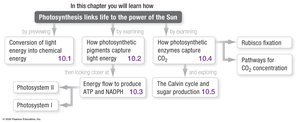
This chapter explores how photosynthesis connects the energy of the sun to the biosphere, focusing on the conversion of light energy to chemical energy, the mechanisms of light capture, and the enzymatic processes involved in sugar production.
10.1 Photosynthesis Harnesses Sunlight to Make Carbohydrates
Conversion of Electromagnetic Energy to Chemical Energy
Photosynthesis transforms solar energy into chemical energy stored in carbohydrates. The process is the reverse of cellular respiration, which breaks down carbohydrates to release energy.
Requirements: Sunlight, CO2, and H2O.
Products: O2 (oxygen) and carbohydrates (e.g., glucose).
General Equation:
Two Linked Sets of Reactions
Photosynthesis consists of two interconnected stages: the light-capturing reactions and the Calvin cycle reactions.
Light-capturing reactions: Occur in the thylakoid membranes; water is split to form O2, and electrons are excited by light energy. High-energy electrons are transferred to NADP+, forming NADPH.
Calvin cycle reactions: Occur in the stroma; ATP and NADPH are used to reduce CO2 to sugar, regenerating ADP, Pi, and NADP+ for the light reactions.
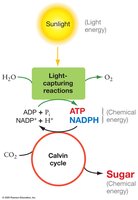
Photosynthesis: Mechanistic Overview
Photosystems and Electron Flow
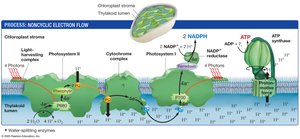
Photosynthesis relies on two photosystems (Photosystem II and Photosystem I) embedded in the thylakoid membrane. These systems work together to drive the flow of electrons, resulting in the production of ATP and NADPH.
Photosystem II: Initiates the splitting of water and the release of O2. Electrons are transferred through an electron transport chain, generating ATP via chemiosmosis.
Photosystem I: Receives electrons from Photosystem II and further excites them with light energy. Electrons are used to reduce NADP+ to NADPH.
Noncyclic Electron Flow: Electrons move from water through both photosystems to NADP+, producing both ATP and NADPH.
The Calvin Cycle
The Calvin cycle is the set of reactions that use ATP and NADPH to reduce CO2 to sugar. It is a cyclic pathway that regenerates its starting materials and is essential for carbon fixation.
ATP and NADPH: Provide energy and reducing power for the conversion of CO2 into carbohydrates.
Regeneration: ADP, Pi, and NADP+ are recycled back to the light reactions.
Key Enzyme: Rubisco catalyzes the fixation of CO2.
Summary Table: Photosynthesis Components
Component | Main Function | Location |
|---|---|---|
Light-capturing reactions | Produce O2, ATP, NADPH | Thylakoid membrane |
Calvin cycle | Reduce CO2 to sugar | Chloroplast stroma |
Photosystem II | Splits water, releases O2, generates ATP | Thylakoid membrane |
Photosystem I | Produces NADPH | Thylakoid membrane |
Example: Importance of Photosynthesis
Photosynthesis is the primary source of organic matter for nearly all life forms. It also maintains atmospheric oxygen levels, which are essential for aerobic respiration.
Additional info: The chapter roadmap (image_2) outlines the logical progression from light energy capture to sugar production, emphasizing the integration of photosystems and the Calvin cycle. The diagrams (image_3 and image_4) visually reinforce the mechanistic steps and electron flow in photosynthesis.
