 Indietro
Chapter 10: Photosynthesis – Mechanisms and Significance
Guida di studio - Note intelligenti
 Appunti personalizzati basati sui tuoi materiali, ampliati con definizioni chiave, esempi e contesto.
Photosynthesis: The Foundation of Life
Introduction to Photosynthesis
Photosynthesis is the process by which autotrophic organisms convert sunlight into chemical energy, producing carbohydrates and oxygen. This process is fundamental to life on Earth, as it provides the primary energy source for most living organisms and shapes the planet's atmosphere.
Autotrophs: Organisms capable of synthesizing their own food from inorganic substances using light or chemical energy.
Heterotrophs: Organisms that obtain energy by consuming other organisms.
Overall Reaction: Photosynthesis is essentially the reverse of cellular respiration.
10.1 Photosynthesis Harnesses Sunlight to Make Carbohydrates
Conversion of Electromagnetic Energy to Chemical Energy
Photosynthesis requires sunlight, carbon dioxide, and water, and produces oxygen as a by-product. The process involves the reduction and oxidation of molecules, as illustrated in electron transfer reactions.
Key Inputs: Sunlight, CO2, H2O
Key Outputs: Carbohydrates, O2
Photosynthesis: Two Linked Sets of Reactions
Light-Capturing and Calvin Cycle Reactions
Photosynthesis consists of two interconnected sets of reactions:
Light-capturing reactions: Occur in the thylakoid membranes, where water is split and electrons are excited by light energy. High-energy electrons are transferred to NADP+, forming NADPH.
Calvin cycle reactions: Occur in the stroma, where ATP and NADPH are used to reduce CO2 and produce sugars.
Photosynthesis Occurs in Chloroplasts
Structure and Function of Chloroplasts
Chloroplasts are the site of photosynthesis in plants and algae. They contain thylakoids, grana, stroma, and pigments such as chlorophyll.
Thylakoids: Flattened membrane structures where light reactions occur.
Grana: Stacks of thylakoids.
Stroma: Fluid-filled space surrounding thylakoids, site of the Calvin cycle.
Pigments: Molecules that absorb specific wavelengths of light; chlorophyll is the most common pigment, reflecting green light.
How Do Pigments Capture Light Energy?
Electromagnetic Radiation and Pigment Function
Light is a form of electromagnetic radiation, characterized by wavelength and photon energy. Pigments absorb certain wavelengths, and the energy of photons is inversely proportional to their wavelength.
Visible Light: The portion of the electromagnetic spectrum visible to humans.
Photon Energy: Shorter wavelengths have higher energy.
Photosynthetic Pigments Absorb Light
Types and Functions of Pigments
Plants contain two major classes of pigments:
Chlorophylls: Absorb red and blue light, reflect green.
Carotenoids: Absorb blue and green light, reflect yellow, orange, and red.
Accessory pigments like carotenoids extend the range of light absorption and protect chlorophyll from damage.
Excited States and Energy Transfer
Electron Excitation and Photosystems
When chlorophyll absorbs photons, electrons are promoted to higher energy states. Energy can be transferred as heat, light (fluorescence), or used to drive photosynthesis.
Photosystems: Complexes of chlorophyll and accessory pigments that function as light-gathering antennae.
Antenna Pigments: Transfer energy via resonance to the reaction center.
Reaction Center: Site where electromagnetic energy is converted to chemical energy.
Discovery of Photosystems I and II
Enhancement Effect and Dual Photosystems
Photosynthesis is more efficient when both Photosystem I and II operate together, as shown by the enhancement effect. Each photosystem absorbs different wavelengths and contributes to the overall process.
Mechanisms of Photosystem II
Electron Transport and ATP Production
Photosystem II initiates electron transport by splitting water and transferring electrons through an electron transport chain (ETC), generating a proton gradient used to synthesize ATP via photophosphorylation.
Photophosphorylation: ATP synthesis driven by light energy.
Oxygenic Photosynthesis: Water splitting produces oxygen as a by-product.
Mechanisms of Photosystem I
NADPH Production
Photosystem I receives electrons from Photosystem II and further excites them, ultimately reducing NADP+ to NADPH, a key molecule for the Calvin cycle.
The Z Scheme: Integration of Photosystems
Electron Flow and Energy Production
The Z scheme describes the linear flow of electrons from water through Photosystem II and I, resulting in the production of ATP and NADPH. This process is called noncyclic electron flow.
Cyclic Electron Flow: Occurs when electrons are recycled to produce additional ATP without NADPH formation.
Oxygenic Photosynthesis and Earth's Evolution
Impact on Atmosphere and Life
The release of oxygen from photosynthesis was critical for the evolution of aerobic life and the formation of the ozone layer, which protects organisms from harmful UV radiation.
Carbon Dioxide Capture and the Calvin Cycle
Stomata and Carbon Fixation
Plants capture CO2 through stomata, pores regulated by guard cells. The Calvin cycle fixes carbon, converting CO2 into organic molecules using the enzyme Rubisco.
Rubisco: Ribulose-1,5-biphosphate carboxylase/oxygenase, the most abundant enzyme in plants.
Photorespiration: A process that consumes oxygen and reduces photosynthetic efficiency.
Mechanisms for Increasing CO2 Concentration
C4 and CAM Pathways
Plants in hot, dry environments use C4 and CAM pathways to increase CO2 concentration and minimize photorespiration.
C4 Pathway: Spatial separation of carbon fixation and the Calvin cycle.
CAM Pathway: Temporal separation; carbon fixation occurs at night, Calvin cycle during the day.
Reduction of Captured Carbon Dioxide
The Calvin Cycle Steps
The Calvin cycle consists of three phases:
Fixation: CO2 reacts with RuBP, producing 3-phosphoglycerate (3PGA).
Reduction: 3PGA is phosphorylated and reduced to glyceraldehyde-3-phosphate (G3P).
Regeneration: G3P is used to regenerate RuBP, enabling the cycle to continue.
Regulation of Photosynthesis
Control Mechanisms
Photosynthesis is regulated by light availability, sugar concentration, and the activity of Rubisco. High sugar levels inhibit photosynthetic protein production and stimulate storage protein synthesis.
Fate of Photosynthetic Products
Glucose, Sucrose, and Starch Formation
G3P produced by the Calvin cycle is used to synthesize glucose and fructose, which combine to form sucrose. Excess glucose is polymerized into starch for storage.
Sucrose: Synthesized in the cytosol.
Starch: Produced in the chloroplast.
Summary Table: Photosynthesis Components and Functions
Component | Function |
|---|---|
Chloroplast | Site of photosynthesis |
Thylakoid | Location of light reactions |
Stroma | Location of Calvin cycle |
Chlorophyll | Main pigment for light absorption |
Rubisco | Enzyme for carbon fixation |
ATP & NADPH | Energy carriers for Calvin cycle |
Stomata | CO2 entry and O2 exit |
Relevant Images
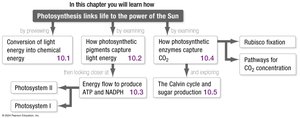
Figure: Chapter roadmap summarizing the main topics of photosynthesis, including energy conversion, pigment function, enzyme activity, and carbon fixation pathways.
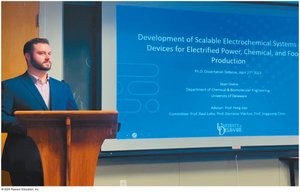
Example: Research on artificial photosynthetic systems demonstrates the application of photosynthesis principles in engineering and food production.
*Additional info: Academic context was added to clarify the Calvin cycle steps, the regulation of photosynthesis, and the significance of oxygenic photosynthesis for Earth's evolution.*
