 Indietro
Chapter 10: Photosynthesis – Structure, Function, and Mechanisms
Guida di studio - Note intelligenti
 Appunti personalizzati basati sui tuoi materiali, ampliati con definizioni chiave, esempi e contesto.
Photosynthesis: Feeding the Biosphere
Introduction to Photosynthesis
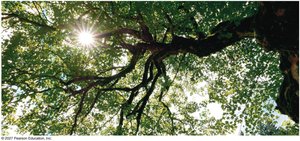
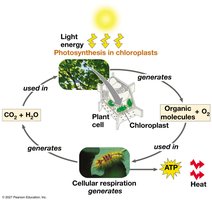
Photosynthesis is the fundamental process by which plants, algae, and certain prokaryotes convert solar energy into chemical energy, sustaining nearly all life on Earth. This process occurs within specialized organelles called chloroplasts and is essential for the production of organic molecules and oxygen.
Autotrophs: Organisms that produce their own food from inorganic substances. They are the primary producers in ecosystems.
Photoautotrophs: Autotrophs that use sunlight to synthesize organic compounds.
Heterotrophs: Organisms that obtain organic material by consuming other organisms.
Decomposers: Heterotrophs that consume dead organic matter or waste.
Fossil fuels: Ancient stores of solar energy, formed from the remains of organisms.
Photoautotroph Diversity
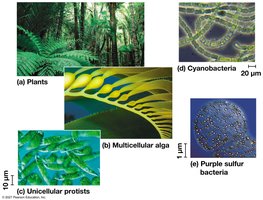
Photoautotrophs include plants, multicellular algae, unicellular protists, cyanobacteria, and purple sulfur bacteria. These organisms are crucial for the biosphere's energy flow.
Chloroplasts: The Sites of Photosynthesis
Chloroplast Structure and Function
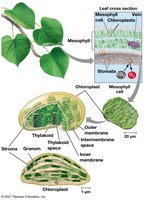
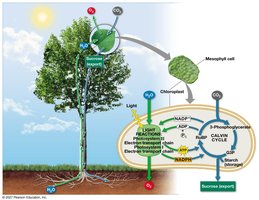
Chloroplasts are found mainly in the mesophyll cells of leaves. They have a double membrane and contain a dense fluid called the stroma. Thylakoids, which may be stacked into grana, house the pigment chlorophyll responsible for capturing light energy.
Stomata: Microscopic pores for gas exchange.
Veins: Transport water and sugars.
Thylakoids: Membranous sacs where light reactions occur.
Grana: Stacks of thylakoids.
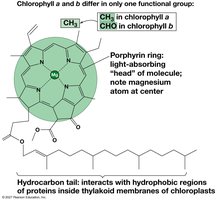
Chlorophyll: Green pigment absorbing light for photosynthesis.
Photosynthesis: Chemical Overview
Photosynthesis Equation and Redox Process
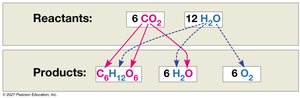
Photosynthesis is a redox process, reversing the electron flow of cellular respiration. Water is split, providing electrons and protons, and oxygen is released as a by-product. The overall equation is:
Photosynthesis equation:

The Two Stages of Photosynthesis
Light Reactions and Calvin Cycle
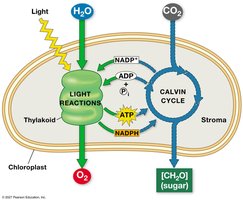
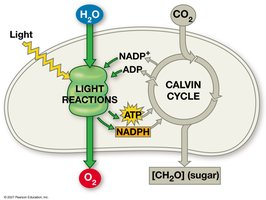
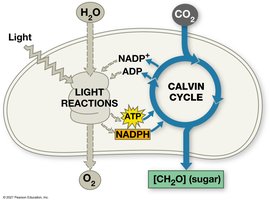
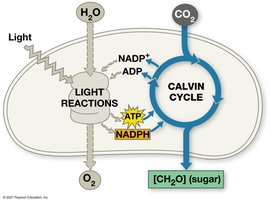
Photosynthesis consists of two stages: the light reactions and the Calvin cycle. The light reactions occur in the thylakoids, splitting water, releasing oxygen, reducing NADP+ to NADPH, and generating ATP. The Calvin cycle occurs in the stroma, using ATP and NADPH to fix carbon dioxide and produce sugars.
Light reactions: Split water, release O2, produce ATP and NADPH.
Calvin cycle: Fixes CO2, produces G3P (a sugar), regenerates RuBP.
The Nature of Sunlight
Electromagnetic Spectrum and Light Energy
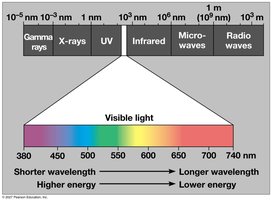
Light is electromagnetic energy, traveling in waves. The electromagnetic spectrum includes all wavelengths, but only visible light (380–740 nm) drives photosynthesis. Light also behaves as photons, each with energy inversely related to wavelength.
Shorter wavelengths: Higher energy.
Longer wavelengths: Lower energy.
Photosynthetic Pigments: Light Receptors
Pigment Types and Light Absorption
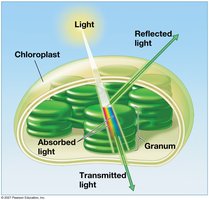
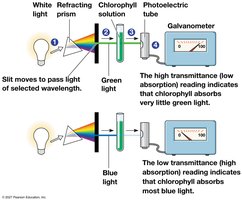
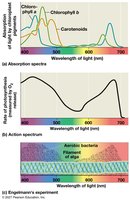
Pigments absorb specific wavelengths of light. Chlorophyll a is the main pigment, while chlorophyll b and carotenoids are accessory pigments. Leaves appear green because chlorophyll absorbs violet-blue and red light, reflecting green.
Absorption spectrum: Graph of pigment absorption vs. wavelength.
Action spectrum: Effectiveness of different wavelengths for photosynthesis.
Excitation of Chlorophyll by Light
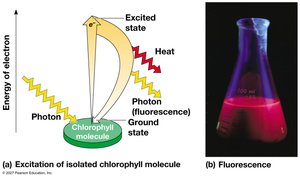
When chlorophyll absorbs light, electrons are excited to a higher energy state. In isolation, these electrons return to the ground state, releasing energy as heat or fluorescence.
Photosystems and Electron Flow
Structure and Function of Photosystems
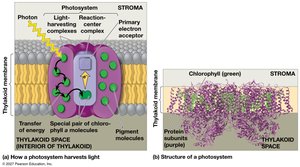
A photosystem consists of a reaction-center complex surrounded by light-harvesting complexes. There are two types: Photosystem II (P680) and Photosystem I (P700), each absorbing different wavelengths.
Reaction-center complex: Special pair of chlorophyll a molecules and primary electron acceptor.
Light-harvesting complex: Pigment molecules bound to proteins, transferring energy to the reaction center.
Linear Electron Flow
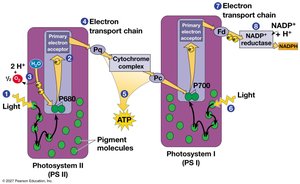
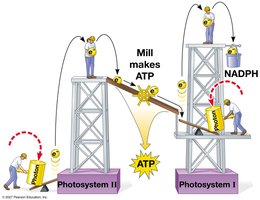
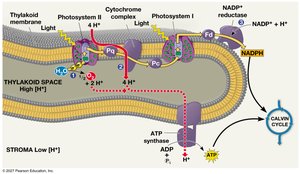
Linear electron flow is the primary pathway during light reactions, involving both photosystems and producing ATP and NADPH. Water is split, electrons are transferred through an electron transport chain, and a proton gradient drives ATP synthesis.
Key steps: Photon absorption, water splitting, electron transport, ATP and NADPH production.
Cyclic Electron Flow
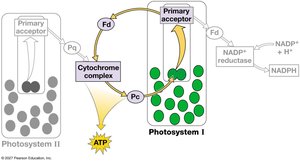
Cyclic electron flow involves only Photosystem I and produces ATP without NADPH or O2. It is an alternative pathway, possibly an evolutionary relic, and may provide photoprotection.
Chemiosmosis: Chloroplasts vs. Mitochondria
Comparison of ATP Generation
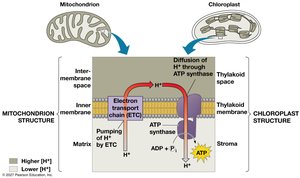
Both chloroplasts and mitochondria generate ATP by chemiosmosis, using electron transport chains to pump protons and ATP synthase to couple proton diffusion to ATP production. The spatial organization differs, but the mechanism is similar.
Chloroplasts: Protons pumped into thylakoid space, ATP produced in stroma.
Mitochondria: Protons pumped into intermembrane space, ATP produced in matrix.
The Calvin Cycle: Sugar Synthesis
Phases of the Calvin Cycle
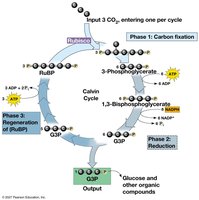
The Calvin cycle uses ATP and NADPH to reduce CO2 to sugar. It has three phases: carbon fixation, reduction, and regeneration of the CO2 acceptor (RuBP). For each G3P produced, the cycle must run three times, fixing three CO2 molecules.
Phase 1: Carbon fixation by rubisco.
Phase 2: Reduction to G3P.
Phase 3: Regeneration of RuBP.
Alternative Carbon Fixation Mechanisms
C4 and CAM Pathways
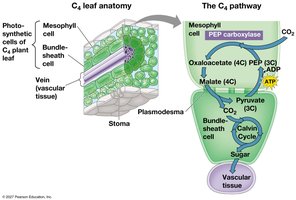
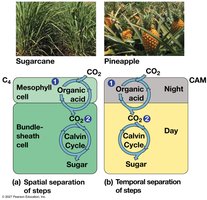
Plants in hot, arid climates have evolved alternative carbon fixation mechanisms to minimize photorespiration and optimize water use. C4 plants spatially separate carbon fixation and the Calvin cycle, while CAM plants temporally separate these processes.
C4 pathway: CO2 fixed into a four-carbon compound in mesophyll cells, then released in bundle-sheath cells for the Calvin cycle.
CAM pathway: CO2 fixed at night into organic acids, released during the day for the Calvin cycle.
Photosynthesis: Essential for Life
Role in Ecosystems and Cellular Function
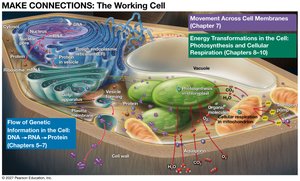
Photosynthesis stores solar energy as chemical energy in organic compounds, providing energy and carbon skeletons for cellular metabolism. Excess sugar is stored as starch in various plant structures.
Summary Table: Comparison of Photosynthetic Pathways
Pathway | Initial CO2 Fixation | Location/Timing | Photorespiration | Examples |
|---|---|---|---|---|
C3 | Rubisco (3C compound) | Mesophyll cells | High | Rice, wheat |
C4 | PEP carboxylase (4C compound) | Mesophyll & bundle-sheath cells | Low | Corn, sugarcane |
CAM | Organic acids (night) | Same cell, night/day separation | Low | Pineapple, succulents |
Key Equations
Photosynthesis:
Calvin Cycle (per G3P):
Additional info: The notes above expand on brief points with academic context, definitions, and examples, ensuring completeness and clarity for exam preparation.
