 Indietro
Chapter 16: The Molecular Basis of Inheritance – DNA Structure, Function, and Replication part 1
Guida di studio - Note intelligenti
 Appunti personalizzati basati sui tuoi materiali, ampliati con definizioni chiave, esempi e contesto.
DNA as the Genetic Material
The Search for Genetic Material
Early 20th-century biologists sought to identify the molecules responsible for inheritance. Chromosomes, composed of DNA and protein, were the primary candidates. The role of DNA in heredity was first discovered through studies of bacteria and viruses.
Evidence That DNA Can Transform Bacteria
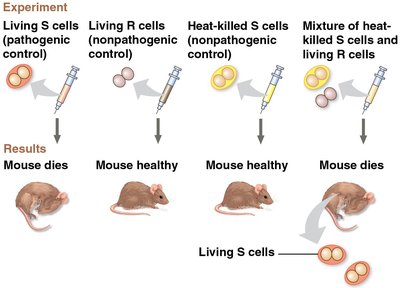
Frederick Griffith's 1928 experiment demonstrated that DNA could transform bacteria, a process now defined as a change in genotype and phenotype due to the assimilation of external DNA by a cell.
Pathogenic (S) strain: Causes disease in mice.
Non-pathogenic (R) strain: Harmless to mice.
Mixing heat-killed S strain with live R strain resulted in the death of the mouse and recovery of live S cells, showing transformation.
Avery, MacLeod, and McCarty's Experiment
Oswald Avery and colleagues identified DNA as the transforming substance by selectively inactivating DNA, RNA, and protein. Only DNA enabled transformation, confirming its role as genetic material.
Structure of DNA
DNA Composition and Nucleotides
DNA is a polymer made of nucleotides, each consisting of a nitrogenous base, a deoxyribose sugar, and a phosphate group. The four bases are adenine (A), thymine (T), guanine (G), and cytosine (C).
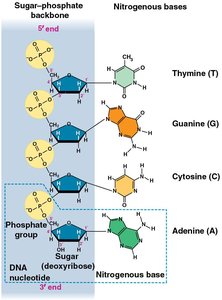
Pyrimidines: Cytosine (C) and Thymine (T)
Purines: Adenine (A) and Guanine (G)
Chargaff’s Rules
Erwin Chargaff discovered that DNA composition varies between species and that the number of A and T bases is equal, as is the number of G and C bases.
Rule 1: Base composition varies between species.
Rule 2: In any species, A = T and G = C.
Building the Structural Model of DNA
X-ray Crystallography and the Double Helix
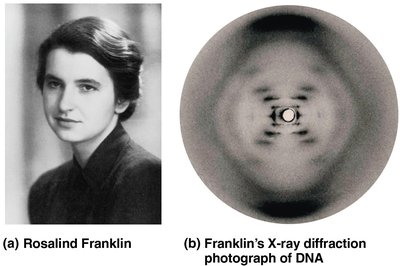
Maurice Wilkins and Rosalind Franklin used X-ray crystallography to study DNA's structure. Franklin's X-ray diffraction photograph provided critical evidence for the helical structure of DNA.
Watson and Crick’s Model
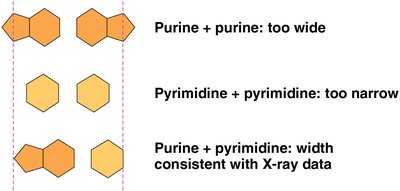
James Watson and Francis Crick deduced that DNA is a double helix with two antiparallel sugar-phosphate backbones and paired nitrogenous bases in the interior. The double helix has a uniform width, explained by pairing a purine with a pyrimidine.
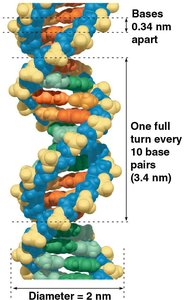
Antiparallel strands: The two DNA strands run in opposite directions (5' to 3' and 3' to 5').
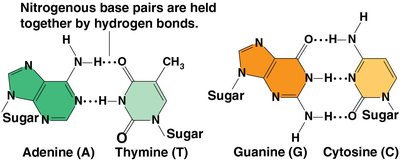
Base pairing: Adenine pairs with thymine, and guanine pairs with cytosine.
Hydrogen bonds: Hold the base pairs together.
DNA Replication
Principle of Base Pairing to a Template Strand
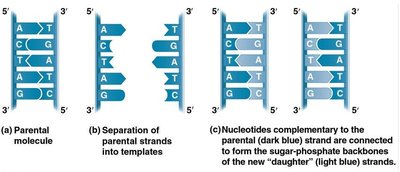
Watson and Crick proposed that each DNA strand serves as a template for the synthesis of a new complementary strand. This mechanism ensures accurate duplication of genetic information.
Models of DNA Replication
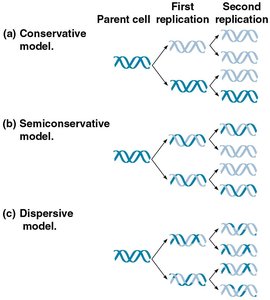
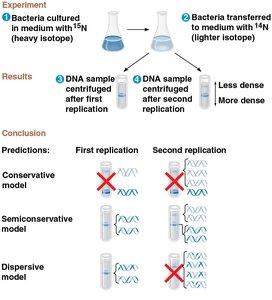
Three models were considered for DNA replication:
Conservative model: Parental strands rejoin; one molecule is all old, one is all new.
Semiconservative model: Each new molecule has one old and one new strand.
Dispersive model: Each strand is a mix of old and new DNA segments.
Meselson-Stahl Experiment
Matthew Meselson and Franklin Stahl used nitrogen isotopes to distinguish old and new DNA strands, confirming the semiconservative model of replication.
Heavy (¹⁵N) DNA: Parental strands labeled with heavy nitrogen.
Light (¹⁴N) DNA: Newly synthesized strands labeled with light nitrogen.
After one replication: Hybrid DNA (one old, one new strand).
After two replications: One hybrid and one light DNA band.
Summary Table: DNA Structure and Replication Models
Feature | Description |
|---|---|
Genetic Material | DNA, not protein, is responsible for inheritance |
Nucleotide Components | Nitrogenous base, deoxyribose sugar, phosphate group |
Base Pairing | A=T, G=C (Chargaff's rules) |
Double Helix | Two antiparallel strands, helical structure |
Replication Model | Semiconservative: each new DNA has one old and one new strand |
Experimental Proof | Meselson-Stahl experiment |
Key Terms and Concepts
Transformation: Change in genotype and phenotype due to assimilation of external DNA.
Antiparallel: DNA strands run in opposite directions.
Semiconservative replication: Each new DNA molecule contains one parental and one new strand.
Hydrogen bonds: Hold base pairs together in the DNA double helix.
Important Equations
Chargaff's rules for base pairing:
Semiconservative replication:
Example Exam Questions
Which result from Griffith’s experiment is an example of transformation?
If a DNA molecule has 22% guanine, what is the expected percentage of cytosine?
Who conducted the X-ray diffraction studies key to the discovery of DNA structure?
What is the backbone of DNA composed of?
What model of DNA replication was confirmed by the Meselson-Stahl experiment?
Additional info:
DNA replication is essential for both mitosis and meiosis, ensuring genetic continuity.
Rosalind Franklin’s X-ray diffraction image was critical in deducing the double helix structure.
