 Indietro
Chapter 16: The Molecular Basis of Inheritance – Study Notes
Guida di studio - Note intelligenti
 Appunti personalizzati basati sui tuoi materiali, ampliati con definizioni chiave, esempi e contesto.
The Molecular Basis of Inheritance
Life’s Operating Instructions
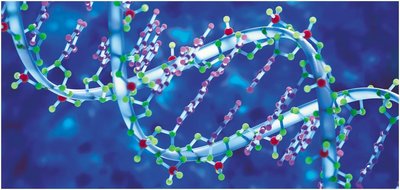
DNA is the hereditary material that encodes information for the development, functioning, and reproduction of all living organisms. The double-helical structure of DNA, discovered by James Watson and Francis Crick in 1953, enables the faithful transmission of genetic information from cell to cell and generation to generation.
DNA directs biochemical, anatomical, physiological, and behavioral traits.
DNA replication ensures genetic continuity.
Cells can repair their DNA to maintain integrity.
DNA Replication and Genetic Information Transmission
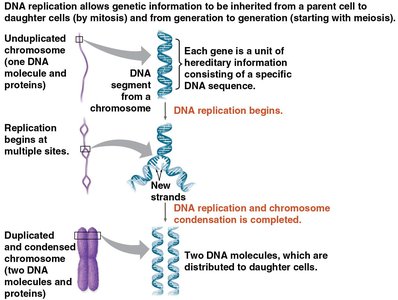
DNA replication allows genetic information to be inherited from parent cells to daughter cells during mitosis and from generation to generation during meiosis.
Replication begins at multiple sites along the chromosome.
Each gene is a unit of hereditary information consisting of a specific DNA sequence.
After replication, duplicated chromosomes are distributed to daughter cells.
DNA as the Genetic Material
The Search for the Genetic Material
Early 20th-century biologists debated whether DNA or protein was the genetic material. The role of DNA was first discovered by studying bacteria and viruses.
Genes are located on chromosomes, which contain both DNA and protein.
Bacterial and viral studies provided key evidence for DNA’s role in heredity.
Evidence That DNA Can Transform Bacteria
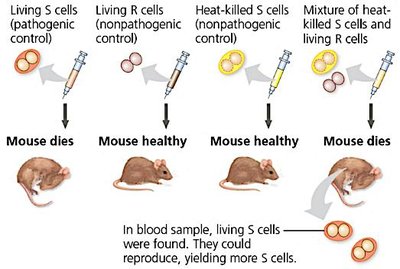
Frederick Griffith’s experiments in 1928 demonstrated that DNA could transform bacteria, a process now known as transformation.
Griffith worked with pathogenic (S) and nonpathogenic (R) strains of Streptococcus pneumoniae.
Mixing heat-killed S cells with living R cells resulted in pathogenic R cells, showing genetic transformation.
Transformation: change in genotype and phenotype due to assimilation of foreign DNA.
Evidence That Viral DNA Can Program Cells
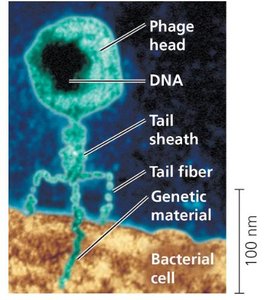
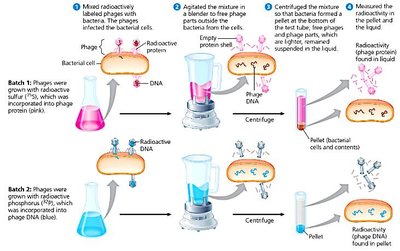
Viruses called bacteriophages (phages) provided further evidence that DNA is the genetic material. A virus consists of DNA (or RNA) enclosed by a protein coat.
Phages infect bacteria by injecting their genetic material.
Alfred Hershey and Martha Chase (1952) showed that only DNA enters the bacterial cell during infection, confirming DNA as the genetic material.
Chargaff’s Rules and DNA Structure
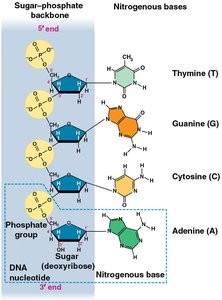
Erwin Chargaff discovered that DNA composition varies between species and that the number of adenine (A) equals thymine (T), and guanine (G) equals cytosine (C).
DNA is a polymer of nucleotides: each contains a nitrogenous base, a sugar (deoxyribose), and a phosphate group.
Chargaff’s rules: A = T, G = C in any species.
Building a Structural Model of DNA
X-ray Crystallography and the Double Helix
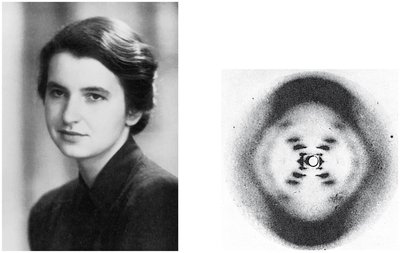
Maurice Wilkins and Rosalind Franklin used X-ray crystallography to study DNA’s molecular structure. Franklin’s images revealed DNA’s helical shape and provided measurements for the width and spacing of the bases.
DNA is composed of two strands forming a double helix.
Strands are antiparallel: their subunits run in opposite directions.
Base Pairing and the Watson-Crick Model
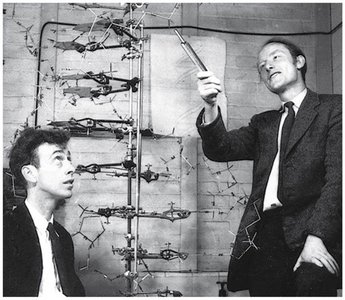
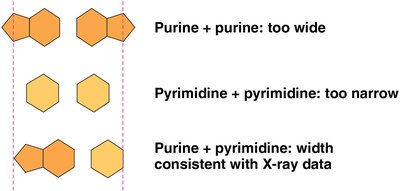
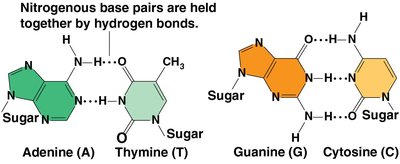
Watson and Crick determined that base pairing is specific: adenine pairs only with thymine, and guanine pairs only with cytosine. Pairing a purine with a pyrimidine results in a uniform width consistent with X-ray data.
Purines: adenine (A), guanine (G); Pyrimidines: cytosine (C), thymine (T).
Hydrogen bonds hold base pairs together.
Explains Chargaff’s rules: A = T, G = C.
DNA Replication and Repair
Base Pairing to a Template Strand
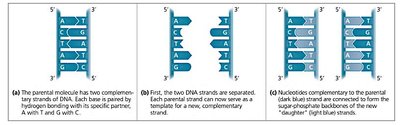
Each DNA strand serves as a template for building a new complementary strand during replication, yielding two exact replicas of the parental molecule.
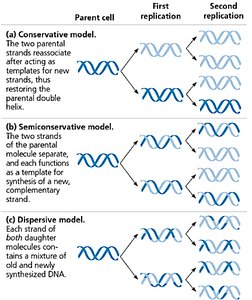
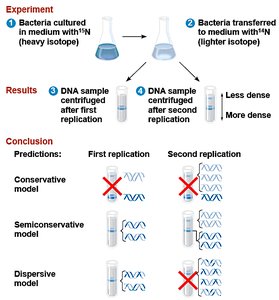
Replication is semiconservative: each daughter molecule has one old strand and one new strand.
Competing models: conservative (parent strands rejoin), dispersive (mix of old and new).
Experimental Evidence for Semiconservative Replication
Matthew Meselson and Franklin Stahl’s experiments supported the semiconservative model of DNA replication.
Bacteria were cultured in heavy and light nitrogen isotopes.
Results matched predictions for semiconservative replication.
DNA Replication: A Closer Look
DNA replication begins at origins of replication, where strands are separated, forming replication bubbles. Replication proceeds in both directions until the entire molecule is copied.
Replication forks are Y-shaped regions where DNA is unwound.
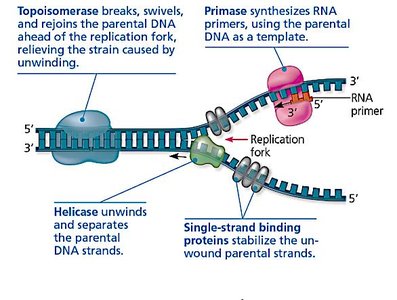
Helicases untwist the double helix; single-strand binding proteins stabilize unwound DNA; topoisomerase relieves strain.
Synthesizing a New DNA Strand
DNA polymerases require a primer to add nucleotides. Primase synthesizes a short RNA primer, and DNA polymerases catalyze the synthesis of new DNA at the replication fork.
Nucleotides are added as nucleoside triphosphates (e.g., dATP).
Each addition releases two phosphate groups as pyrophosphate.
Equation:
Antiparallel Elongation
The antiparallel structure of DNA affects replication. DNA polymerases add nucleotides only to the free 3′ end, so new strands elongate in the 5′ → 3′ direction.
Leading strand: synthesized continuously toward the replication fork.
Lagging strand: synthesized discontinuously as Okazaki fragments, joined by DNA ligase.
Proofreading, Repair, and Chromosome Structure
Proofreading and Repairing DNA
DNA polymerases proofread newly made DNA, replacing incorrect nucleotides. Repair enzymes correct mismatches and excise damaged DNA.
Nucleotide excision repair: nuclease cuts out and replaces damaged DNA.
Mutations are permanent changes that can be passed to the next generation and are a source of genetic variation.
Replicating the Ends of DNA Molecules
Linear DNA molecules face challenges in replicating their ends. Eukaryotic chromosomes have telomeres, special nucleotide sequences that postpone gene erosion. Telomerase catalyzes telomere lengthening in germ cells.
Telomere shortening is linked to aging and may protect against cancer.
Telomerase activity is observed in cancer cells.
Chromosome Structure and DNA Packing
Chromatin and Chromosome Packing
Bacterial chromosomes are circular and supercoiled, while eukaryotic chromosomes are linear and packed with proteins. DNA is combined with proteins in chromatin, which undergoes multilevel packing to fit into the nucleus.
Histones are responsible for DNA packing in interphase chromatin.
Nucleosomes: DNA wound around a core of eight histones.
Chromatin can be loosely packed (euchromatin) or highly condensed (heterochromatin).
Chromatin packing changes during the cell cycle, condensing into metaphase chromosomes for mitosis.
Histone Modifications and Gene Expression
Histones can undergo chemical modifications that affect chromatin condensation and gene expression.
Chromatin structure regulates access to genetic information.
Changes in packing can influence gene expression and cellular function.
DNA Structure Feature | Description |
|---|---|
Double Helix | Two antiparallel strands twisted together |
Base Pairing | A pairs with T; G pairs with C |
Chromatin | DNA + protein complex in eukaryotes |
Nucleosome | DNA wrapped around histone core |
Telomere | Special sequence at chromosome ends |
