 Indietro
Chapter 2: Life’s Chemical Basis – Chemistry for Biology
Guida di studio - Note intelligenti
 Appunti personalizzati basati sui tuoi materiali, ampliati con definizioni chiave, esempi e contesto.
Chemistry in Biology
Why Chemistry is Fundamental to Biology
All living organisms are composed of chemicals, and understanding biology requires a foundational knowledge of chemistry. Atoms combine to form molecules, which in turn make up cells—the basic units of life.
Atoms are the smallest units of matter that retain the properties of an element.
Molecules are combinations of two or more atoms held together by chemical bonds.
Biological processes depend on chemical reactions and interactions.
Properties of Matter
States of Matter
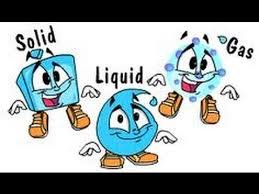
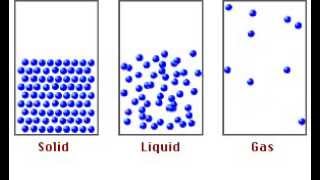
Matter is anything that has mass and occupies space. It exists in three primary states: solid, liquid, and gas.
Solid: Definite shape and volume.
Liquid: Definite volume but takes the shape of its container.
Gas: No definite shape or volume; expands to fill its container.
Mass vs. Weight
Mass is the amount of matter in an object and does not change with location. Weight is the force of gravity on an object and can change depending on the gravitational field (e.g., less on the Moon than on Earth).
Elements and the Periodic Table
Elements
Elements are pure substances that cannot be broken down into simpler substances by chemical means. Each element is made up of atoms with a unique number of protons.
There are over 100 known elements.
Four elements—carbon (C), hydrogen (H), oxygen (O), and nitrogen (N)—make up about 96% of living matter.
Trace elements (e.g., iron, iodine, calcium) are also essential for life.
The Periodic Table
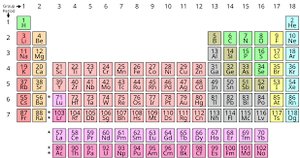
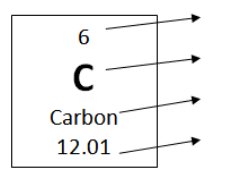
The periodic table organizes elements by their atomic number (number of protons) and properties.
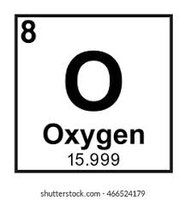
Atomic number: Number of protons in the nucleus (defines the element).
Atomic mass: Approximately the sum of protons and neutrons.
Structure of the Atom
Subatomic Particles
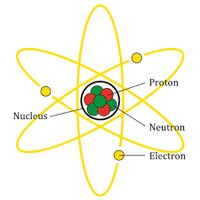
Atoms are composed of three types of subatomic particles:
Protons (p+): Positively charged, found in the nucleus.
Neutrons (n0): Neutral, found in the nucleus.
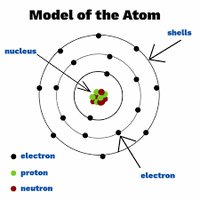
Electrons (e-): Negatively charged, orbit the nucleus in energy shells.
Atomic Number and Mass Number
Atomic number: Number of protons (also equals number of electrons in a neutral atom).
Mass number: Number of protons plus neutrons.
Isotopes are atoms of the same element with different numbers of neutrons.
Isotopes and Radioactivity
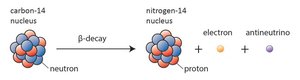
Some isotopes are unstable and undergo radioactive decay, emitting particles and energy.
Radioactive isotopes are used in biological research and medicine (e.g., carbon dating, tracers).
Electron Arrangement and Chemical Bonds
Electron Shells
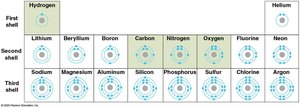
Electrons occupy energy levels or shells around the nucleus. The arrangement of electrons determines how atoms interact and bond.
First shell: up to 2 electrons
Second shell: up to 8 electrons
Third shell: up to 8 electrons (for main group elements)
Chemical Bonds
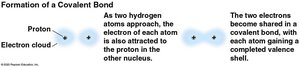
Atoms form chemical bonds to achieve stable electron configurations, usually by filling their outermost shell.
Chemical bond: An attraction between atoms that enables the formation of chemical substances.
Types of Chemical Bonds
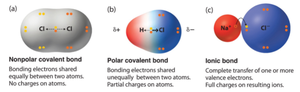
Nonpolar covalent bond: Electrons are shared equally between atoms (e.g., H2, O2).
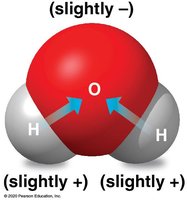
Polar covalent bond: Electrons are shared unequally, resulting in partial charges (e.g., H2O).
Ionic bond: Electrons are transferred from one atom to another, creating ions that attract each other (e.g., NaCl).

Hydrogen Bonds
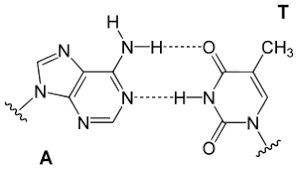
Hydrogen bonds are weak attractions between a hydrogen atom in one polar molecule and an electronegative atom (O, N, or F) in another molecule. They are crucial for the properties of water and the structure of biomolecules like DNA.
Water’s Life-Supporting Properties
Polarity and Hydrogen Bonding
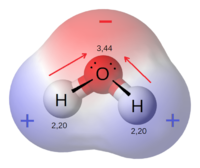
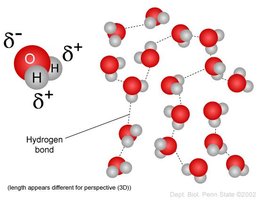
Water is a polar molecule, with oxygen being slightly negative (𝛿-) and hydrogens slightly positive (𝛿+). This allows water molecules to form hydrogen bonds with each other.
Cohesion and Adhesion
Cohesion: Water molecules stick to each other due to hydrogen bonding, resulting in high surface tension.
Adhesion: Water molecules stick to other substances, aiding processes like water transport in plants.
Temperature Moderation
Water has a high specific heat, meaning it can absorb or release large amounts of heat with little temperature change. This property helps organisms maintain homeostasis and stabilizes environmental temperatures.
Density and Insulation
Water is most dense at 4°C. As it freezes, it becomes less dense, causing ice to float. This insulates aquatic life in cold climates.
Water as a Solvent
Water is known as the "universal solvent" because it dissolves many substances, especially polar and ionic compounds. This property is essential for biological reactions and transport of materials in organisms.
Hydrophilic: Substances that dissolve in water (e.g., salts, sugars).
Hydrophobic: Substances that do not dissolve in water (e.g., oils, lipids).
Acids, Bases, and pH
pH Scale
The pH scale measures the concentration of hydrogen ions (H+) in a solution. It ranges from 0 (most acidic) to 14 (most basic), with 7 being neutral (pure water).
Acid: Increases H+ concentration (pH < 7).
Base: Decreases H+ concentration (pH > 7).
Buffer: Substance that minimizes changes in pH by absorbing or releasing H+ ions.
Biological Importance of pH
Enzyme activity, cellular processes, and organismal health depend on maintaining a stable pH. Buffers help organisms maintain homeostasis.
Ocean Acidification
Increased atmospheric CO2 dissolves in oceans, forming carbonic acid and lowering pH. This reduces carbonate ion availability, slowing coral reef calcification and threatening marine ecosystems.
Summary Table: Types of Chemical Bonds
Bond Type | Electron Behavior | Example | Relative Strength |
|---|---|---|---|
Nonpolar Covalent | Electrons shared equally | O2, H2 | Strong |
Polar Covalent | Electrons shared unequally | H2O | Strong |
Ionic | Electrons transferred | NaCl | Moderate |
Hydrogen Bond | Attraction between polar molecules | Between H2O molecules | Weak (individually) |
Key Equations
Atomic mass number:
pH:
Concept Check
Describe the importance of chemical elements to living organisms.
Explain the formation of compounds and the types of chemical bonds.
List and define the life-supporting properties of water.
Explain the pH scale and the biological significance of acids, bases, and buffers.
Discuss the impact of ocean acidification on coral reefs.
