 Indietro
Chapter 20: Phylogeny – Investigating the Evolutionary History of Life
Guida di studio - Note intelligenti
 Appunti personalizzati basati sui tuoi materiali, ampliati con definizioni chiave, esempi e contesto.
Phylogeny: Investigating the Evolutionary History of Life
Overview of Phylogeny
Phylogeny is the study of the evolutionary history and relationships among species or groups of related species. Systematics is the scientific discipline that classifies organisms and determines their evolutionary relationships, while taxonomy is the ordered division and naming of organisms. Understanding phylogeny allows biologists to reconstruct the tree of life and trace the lineage of organisms.
Concept 20.1: Phylogenies Show Evolutionary Relationships
Taxonomy and Classification
Taxonomy organizes living organisms into hierarchical categories based on shared characteristics. The binomial nomenclature system assigns each species a two-part scientific name (genus and species). The main taxonomic ranks are: Domain, Kingdom, Phylum, Class, Order, Family, Genus, and Species. A taxonomic unit at any level is called a taxon.
Binomial nomenclature: Example: Panthera pardus (leopard)
Hierarchical classification: Domains (Archaea, Bacteria, Eukarya) are the broadest categories.
Linking classification and phylogeny: Systematists use branching phylogenetic trees to depict evolutionary relationships.
Phylogenetic Trees
A phylogenetic tree is a diagram that represents a hypothesis about evolutionary relationships. Each branch point (node) represents the divergence of two taxa from a common ancestor. Sister taxa share an immediate common ancestor. A rooted tree includes a branch point representing the most recent common ancestor of all taxa in the tree. A basal taxon diverges early and originates near the common ancestor. A polytomy is a branch from which more than two groups emerge.
Parts of a tree: Root, branches, branch points, basal taxon, sister taxa, polytomy.
Tree diagrams: Can be vertical, diagonal, or rotated around branch points.
Interpretation: Phylogenetic trees show patterns of descent, not phenotypic similarity or the amount of change.
Applying Phylogenies
Phylogenies can be used in practical applications, such as identifying illegal harvests of endangered species or tracing the origins of diseases.
Concept 20.2: Phylogenies Are Inferred from Morphological and Molecular Data
Homology and Analogy
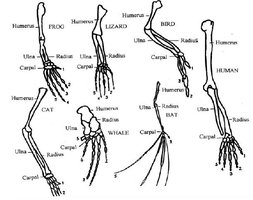
To infer phylogeny, systematists gather information about morphologies, genes, and biochemistry. Similarities used to infer phylogenies must result from shared ancestry (homology). Analogous structures or molecular sequences that evolved independently are called homoplasies.
Homologous structures: Similar due to shared ancestry (e.g., forelimbs of vertebrates).
Analogous structures: Similar due to convergent evolution, not common ancestry (e.g., wings of bats and birds).
Molecular homologies: Determined by comparing nucleotide sequences.
Evaluating Molecular Homologies
Molecular homologies are assessed by the degree of similarity in DNA sequences. Computer programs are used to analyze comparable DNA segments. Shared bases in otherwise dissimilar sequences are called molecular homoplasies.
Concept 20.3: Shared Characters Are Used to Construct Phylogenetic Trees
Cladistics and Clades
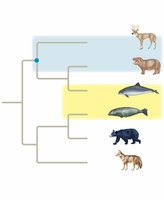
Cladistics classifies organisms by common descent. A clade is a group of species that includes an ancestral species and all its descendants. Clades can be nested within larger clades. Not all groupings qualify as clades.
Monophyletic group: Consists of an ancestor and all its descendants.
Paraphyletic group: Consists of an ancestor and some, but not all, descendants.
Polyphyletic group: Includes taxa with different ancestors.
Shared Ancestral and Shared Derived Characters
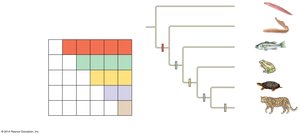
A shared ancestral character originated in an ancestor of the taxon, while a shared derived character is an evolutionary novelty unique to a particular clade. Systematists compare ingroup species with an outgroup to differentiate between shared derived and ancestral characteristics.
Phylogenetic Trees with Proportional Branch Lengths
Branch length in some trees can reflect the number of genetic changes or chronological time, determined from the fossil record.
Maximum Parsimony
The principle of maximum parsimony assumes that the tree requiring the fewest evolutionary events is most likely. Computer programs search for parsimonious trees.
Phylogenetic Trees as Hypotheses
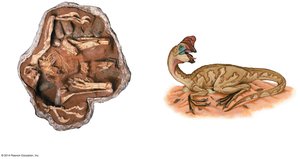
Phylogenetic trees are hypotheses that fit morphological, molecular, and fossil data. They are modified as new evidence arises. Phylogenetic bracketing allows prediction of features in ancestors and extinct descendants based on features of closely related living descendants.
Concept 20.4: Molecular Clocks Help Track Evolutionary Time
Molecular Clocks
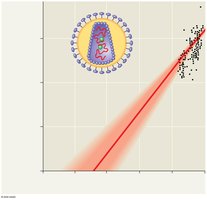
A molecular clock uses constant rates of evolution in some genes to estimate the absolute time of evolutionary change. Individual genes vary in how clocklike they are. Molecular clocks do not always run smoothly due to natural selection and other factors. Using multiple genes may improve estimates.
Application: Dating the origin of HIV using molecular clock analysis.
Concept 20.5: New Information Continues to Revise Our Understanding of Evolutionary History
Three-Domain System and Horizontal Gene Transfer
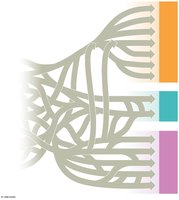
Recent advances in DNA sequence analysis have led to the three-domain system: Bacteria, Archaea, and Eukarya. Horizontal gene transfer is the movement of genes from one genome to another, occurring by exchange of transposable elements, plasmids, viral infection, or fusion of organisms. This process complicates the tree of life.
Summary Table: Types of Phylogenetic Groups
Group Type | Definition | Example |
|---|---|---|
Monophyletic | Ancestor and all descendants | All mammals |
Paraphyletic | Ancestor and some descendants | Reptiles (excluding birds) |
Polyphyletic | Taxa with different ancestors | Marine mammals (whales, seals) |
Key Terms and Concepts
Phylogeny: Evolutionary history of a species or group
Systematics: Classification and determination of evolutionary relationships
Taxonomy: Ordered division and naming of organisms
Homology: Similarity due to shared ancestry
Analogy: Similarity due to convergent evolution
Clade: Group of species including ancestor and all descendants
Molecular clock: Method to estimate evolutionary time using genetic data
Horizontal gene transfer: Movement of genes between genomes
Additional info: The notes above expand on brief points from the original slides, providing definitions, examples, and context for each concept. Images included are directly relevant to the explanation of phylogenetic relationships, homology, character tables, molecular clocks, and horizontal gene transfer.
