 Indietro
Chapter 20: Phylogeny – Investigating the Evolutionary History of Life
Guida di studio - Note intelligenti
 Appunti personalizzati basati sui tuoi materiali, ampliati con definizioni chiave, esempi e contesto.
Overview: Investigating the Evolutionary History of Life
Introduction to Phylogeny
Phylogeny is the study of the evolutionary history and relationships among species or groups of related species. Systematics is the scientific discipline that classifies organisms and determines their evolutionary relationships, while taxonomy is the ordered division and naming of organisms.
Phylogeny: Evolutionary history of a species or group.
Systematics: Classification and determination of evolutionary relationships.
Taxonomy: Naming and organizing organisms into hierarchical groups.
Concept 20.1: Phylogenies Show Evolutionary Relationships
Binomial Nomenclature and Hierarchical Classification
Organisms are classified using binomial nomenclature (Genus species) and hierarchical classification (Domain, Kingdom, Phylum, Class, Order, Family, Genus, Species). Each level is called a taxon.
Binomial nomenclature: Two-part scientific naming system.
Hierarchical classification: Nested levels of organization.
Taxon: Any unit at any level of hierarchy.
Linking Classification and Phylogeny
Systematists use branching phylogenetic trees to depict evolutionary relationships. Linnaean classification may differ from phylogeny, and modern systematists propose classification based on evolutionary relationships.
Phylogenetic tree: Diagram showing evolutionary relationships.
Rooted tree: Includes the most recent common ancestor of all taxa.
Basal taxon: Diverges early and originates near the common ancestor.
Polytomy: Branch from which more than two groups emerge.
Sister taxa: Groups sharing an immediate common ancestor.
Parts of a Phylogenetic Tree
Phylogenetic trees represent hypotheses about evolutionary relationships. Each branch point represents divergence from a common ancestor. The order of taxa does not imply a sequence of evolution leading to the last taxon.
Branch point: Divergence of two taxa.
Rotation: Branches can be rotated around points without changing relationships.
What We Can and Cannot Learn from Phylogenetic Trees
Phylogenetic trees show patterns of descent, not phenotypic similarity. They do not indicate when a species evolved or how much change occurred in a lineage. It should not be assumed that a taxon evolved from the taxon next to it.
Applying Phylogenies
Phylogenies can be used in practical applications, such as identifying illegal whale harvests by comparing DNA sequences to known species.
Concept 20.2: Phylogenies Are Inferred from Morphological and Molecular Data
Inferring Phylogeny
Systematists gather information about morphologies, genes, and biochemistry. Similarities used to infer phylogenies must result from shared ancestry (homology).
Homology: Similarity due to shared ancestry.
Analogy: Similarity due to convergent evolution.
Homoplasies: Analogous structures or sequences that evolved independently.
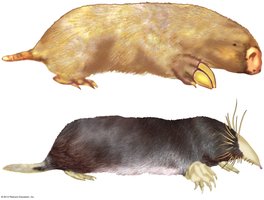
Evaluating Molecular Homologies
Molecular homologies are determined by comparing nucleotide sequences. Shared bases in otherwise dissimilar sequences are called molecular homoplasies. Computer programs are used to analyze DNA segments.
Concept 20.3: Shared Characters Are Used to Construct Phylogenetic Trees
Cladistics and Clades
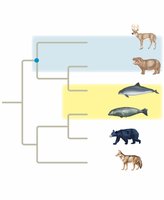
Cladistics classifies organisms by common descent. A clade is a group of species that includes an ancestral species and all its descendants. Clades can be nested, but not all groupings qualify as clades.
Monophyletic group (clade): Ancestor and all descendants.
Paraphyletic group: Ancestor and some descendants.
Polyphyletic group: Members do not share a recent common ancestor.
Shared Ancestral and Shared Derived Characters
Organisms have both shared and different characteristics compared to their ancestors. A shared ancestral character originated in an ancestor, while a shared derived character is unique to a particular clade. Systematists use outgroups to differentiate these characters.
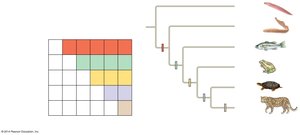
Phylogenetic Trees with Proportional Branch Lengths
Branch length in some trees reflects the number of genetic changes or chronological time, determined from the fossil record.
Maximum Parsimony
The principle of maximum parsimony assumes the tree requiring the fewest evolutionary events is most likely. Computer programs search for parsimonious trees.
Phylogenetic Trees as Hypotheses
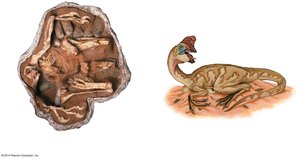
Phylogenetic trees are hypotheses that fit morphological, molecular, and fossil data. They are modified as new evidence arises. Phylogenetic bracketing allows prediction of features in ancestors and extinct descendants based on living relatives.
Concept 20.4: Molecular Clocks Help Track Evolutionary Time
Molecular Clocks
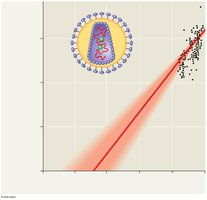
A molecular clock uses constant rates of evolution in some genes to estimate the absolute time of evolutionary change. Individual genes vary in how clocklike they are.
Molecular clock: Estimates divergence times based on mutation rates.
Potential problems: Clocks may not run smoothly due to natural selection or irregular mutation rates.
Applying a Molecular Clock: Dating the Origin of HIV
Phylogenetic analysis shows HIV is descended from viruses infecting primates. Molecular clock analysis suggests HIV spread to humans during the 1930s.
Concept 20.5: New Information Continues to Revise Our Understanding of Evolutionary History
Three-Domain System
Recent DNA sequence analysis has led to a three-domain system: Bacteria, Archaea, and Eukarya. The tree of life is based largely on rRNA genes, which evolve slowly.
Domains: Bacteria, Archaea, Eukarya.
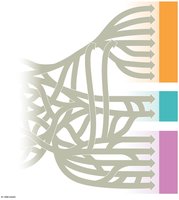
Horizontal gene transfer: Movement of genes between genomes via transposable elements, plasmids, viral infection, or organism fusion.
Summary
Phylogenies show evolutionary relationships.
Phylogenies are inferred from morphological and molecular data.
Shared characters are used to construct phylogenetic trees.
Molecular clocks help keep track of evolutionary time.
New information continues to revise our understanding of evolutionary history.
