 Indietro
Chapter 21: The Evolution of Populations – Mechanisms, Genetic Variation, and Hardy-Weinberg Equilibrium
Guida di studio - Note intelligenti
 Appunti personalizzati basati sui tuoi materiali, ampliati con definizioni chiave, esempi e contesto.
The Evolution of Populations
Mechanisms Causing Evolution in Populations
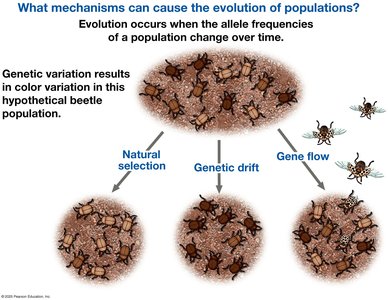
Evolution occurs when the allele frequencies of a population change over time. While natural selection acts on individuals, it is the population that evolves. Genetic variation within a population is essential for evolution, and several mechanisms can drive these changes.
Natural Selection: Individuals with traits better suited to their environment survive and reproduce, passing those traits to the next generation.
Genetic Drift: Random fluctuations in allele frequencies, especially pronounced in small populations, can lead to loss of genetic variation.
Gene Flow: Movement of alleles between populations through migration or transfer of gametes.
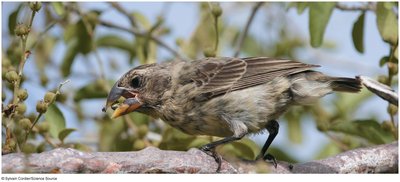
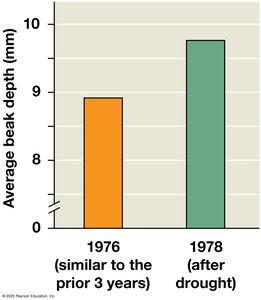
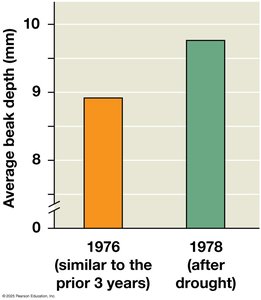
Example: The medium-ground finches of Daphne Major experienced a shift in beak size after a drought, as birds with deeper beaks survived better and passed on their alleles for large beak size.
Microevolution
Microevolution refers to the smallest scale of evolution: changes in allele frequencies within a population over a short period. Environmental forces can alter allele composition in just a few generations.
Example: After a drought, finches with alleles for large beaks survived at higher rates, making those alleles more common.
Genetic Variation Makes Evolution Possible
Genetic Variation and Heritable Traits
Variation in heritable traits is a prerequisite for evolution by natural selection. Darwin recognized the importance of variation, but Mendel's work revealed how traits are passed as discrete units (genes).
Genes: Units of heredity that encode traits.
Phenotypic Variation: Often reflects underlying genetic variation.
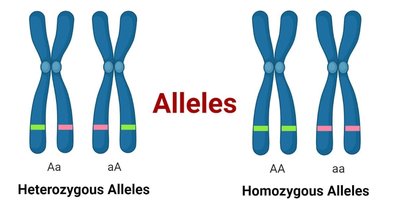
Monogenic vs. Polygenic Inheritance
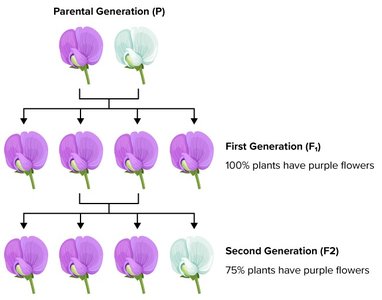
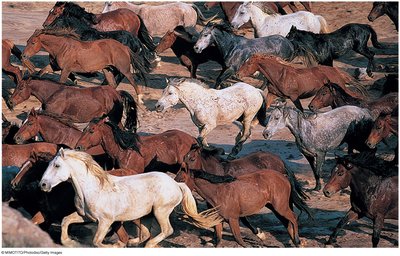
Some phenotypic differences are determined by a single gene (monogenic), while others are influenced by multiple genes (polygenic), resulting in continuous variation.
Monogenic Example: Flower color in Mendel's peas (purple or white).
Polygenic Example: Coat color in horses, seed number in corn, height in humans.
Phenotypic Plasticity
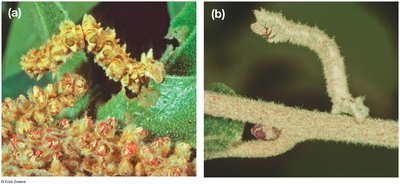
Phenotype is the product of both inherited genotype and environmental influences. Phenotypic plasticity is the ability of a genotype to produce different phenotypes in different environments, but only genetically determined traits are heritable.
Example: Bodybuilding in humans does not pass large muscles to offspring; caterpillars' appearance changes due to diet, not genotype.
Sources of Genetic Variation
Genetic variation arises from several sources:
Mutation: Changes in DNA sequence.
Gene Flow: Migration introduces new alleles.
Sexual Reproduction: Arranges existing genes in new combinations through crossing over, independent assortment, and random fertilization.
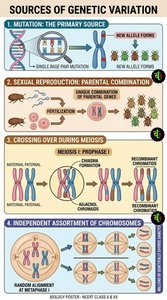
Formation of New Alleles: Mutation
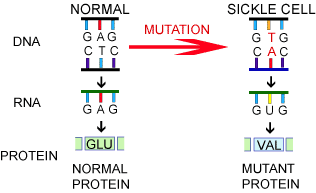
Mutations are changes in the nucleotide sequence of DNA. They can arise from errors in replication or exposure to radiation/chemicals. Point mutations affect single nucleotides and can be harmful, neutral, or rarely beneficial.
Example: Sickle cell disease results from a point mutation.
Neutral Variation: Mutations in noncoding regions with no effect on fitness.
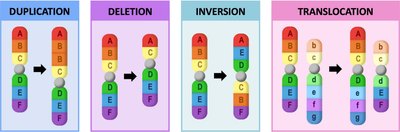
Altering Gene Number or Position
Mutations can delete, disrupt, duplicate, or rearrange chromosome segments. While most are harmful, duplications of small segments can persist and evolve new functions.
Example: Humans and mice have many copies of odor-detecting genes.
Rapid Reproduction and Mutation Rates
Mutation rates are generally low in plants and animals, but accumulate rapidly in prokaryotes and viruses due to short generation times. This leads to faster evolutionary change in these organisms.
The Hardy–Weinberg Equation: A Model of No Evolution
Gene Pools and Allele Frequencies
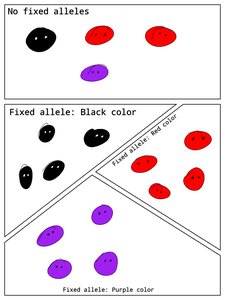
A population is a group of individuals of the same species that interbreed. The gene pool consists of all alleles at every locus in all members. Allele frequency is calculated for diploid populations, and fixed alleles occur when only one variant exists for a gene.
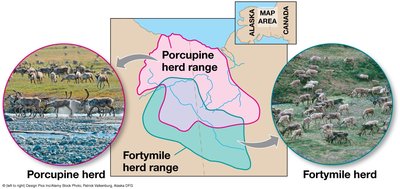
Example: Caribou populations breed mostly within their own group.
Calculating Allele Frequencies
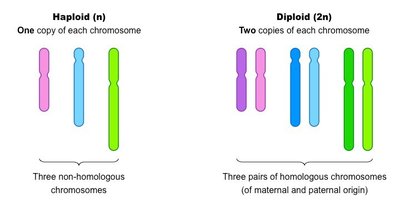
For a diploid population, the number of alleles equals twice the number of individuals. Allele frequencies are calculated based on genotype counts.
Example: In a population of 20 organisms (5 RR, 10 Rr, 5 rr), there are 40 alleles.
Hardy-Weinberg Equilibrium
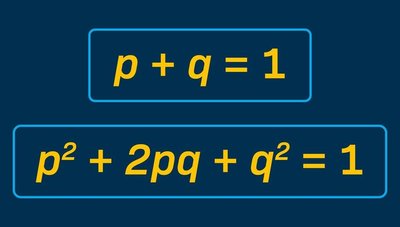
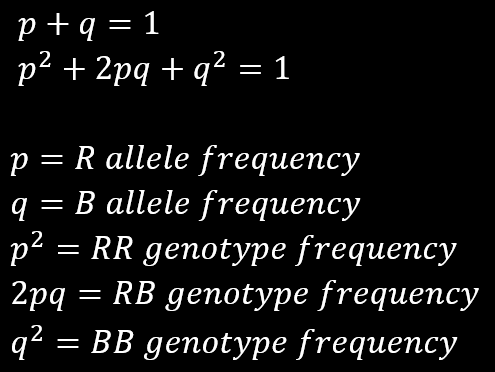
The Hardy-Weinberg model describes a population where allele frequencies remain constant, serving as a null hypothesis for no evolution. The model assumes no mutation, random mating, no selection, infinite population size, and no migration.
Allele Frequency Equation:
Genotype Frequency Equation:
Example: Wildflower Population
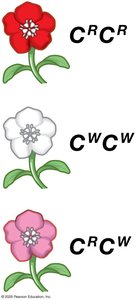
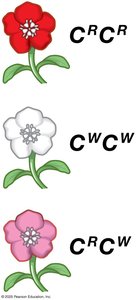
In a population with incomplete dominance for color, allele frequencies can be calculated from counts of red, pink, and white flowers.
Example: 320 red, 160 pink, 20 white flowers.
Allele frequency: ,
Hardy-Weinberg Model: Genotype Frequencies
For two alleles, the expected frequencies are:
Homozygous dominant:
Heterozygous:
Homozygous recessive:
Mechanisms That Change Allele Frequencies
Major and Minor Mechanisms
Five mechanisms can change allele frequencies:
Major: Natural selection, genetic drift, gene flow
Minor: Mutation, non-random mating
Only natural selection consistently improves adaptation to the environment.
Genetic Drift
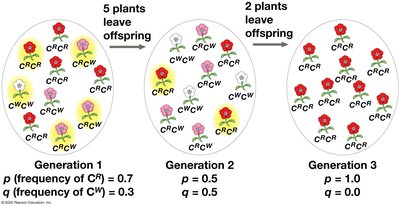
Genetic drift is the random fluctuation of allele frequencies, reducing genetic variation and potentially fixing harmful alleles. It is most significant in small populations.
Example: Squirrel population affected by mudslide; random flower reproduction.
The Founder Effect
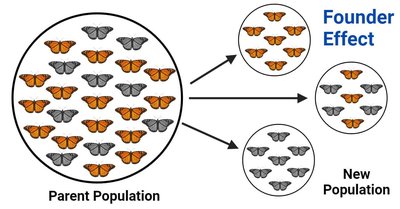
The founder effect occurs when a few individuals become isolated from a larger population, resulting in different allele frequencies due to chance.
Example: Ellis-van Creveld syndrome in Amish populations.
The Bottleneck Effect
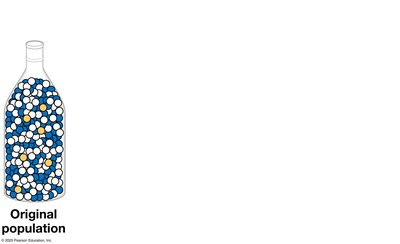
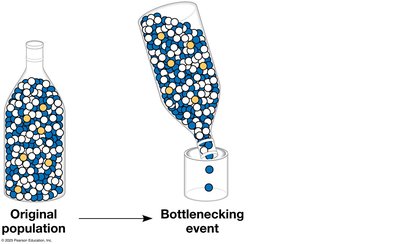
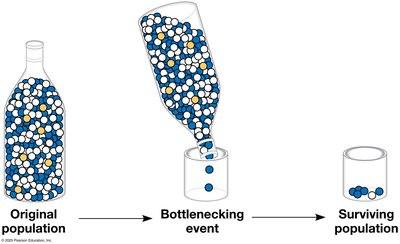
The bottleneck effect results from a drastic reduction in population size, causing the surviving gene pool to differ from the original. Continued small population size increases genetic drift.
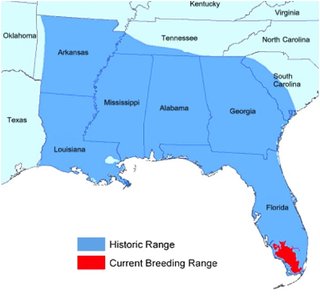
Example: Florida panther population reduced by habitat loss and overharvesting.
Gene Flow
Gene flow is the movement of alleles between populations, often reducing genetic differences and affecting adaptation to local environments.
Example: Lake Erie water snakes: banded coloration alleles transferred from mainland to island populations.
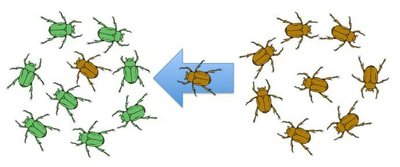
Gene Flow in Modern Humans
Increased global movement and mating between populations leads to more allele exchange and fewer genetic differences.
Natural Selection and Adaptive Evolution
Natural Selection: Chance and Sorting
Evolution by natural selection involves both random genetic variation and non-random sorting of beneficial alleles. Natural selection consistently increases the frequency of alleles that provide reproductive advantage.
Relative Fitness
Relative fitness measures the reproductive success of an individual or genotype compared to others. Selection acts on phenotypes, indirectly favoring certain genotypes.
Modes of Natural Selection
Directional Selection: Favors individuals at one end of the phenotypic range.
Disruptive Selection: Favors individuals at both extremes.
Stabilizing Selection: Favors intermediate variants, acting against extremes.
Key Role of Natural Selection
Natural selection leads to striking adaptations, such as octopuses changing color or snakes swallowing large prey. Adaptive evolution is a continuous process as environments change.
Balancing Selection
Balancing selection maintains stable frequencies of two or more phenotypes. It includes:
Heterozygote Advantage: Heterozygotes have higher fitness than either homozygote (e.g., sickle cell disease and malaria resistance).
Frequency-Dependent Selection: Favors less common phenotypes (e.g., scale-eating fish mouth orientation).
Sexual Selection
Sexual selection occurs when individuals have inherited traits that improve mating success, leading to sexual dimorphism (differences in secondary sexual characteristics).
Intrasexual Selection: Competition among individuals of one sex for mates.
Good Genes Hypothesis: Female preference for traits indicating genetic quality.
Limitations of Natural Selection
Selection can act only on existing variations.
Evolution is limited by historical constraints.
Adaptations are often compromises.
Chance, natural selection, and the environment interact.
