 Indietro
Chapter 25: The History of Life on Earth – Study Notes
Guida di studio - Note intelligenti
 Appunti personalizzati basati sui tuoi materiali, ampliati con definizioni chiave, esempi e contesto.
The History of Life on Earth
Macroevolution and the Changing Nature of Life
Macroevolution refers to the broad patterns of evolutionary change above the species level, as documented by the fossil record. Over Earth's history, groups of organisms have arisen, diversified, and gone extinct, often in response to large-scale processes such as continental drift, mass extinction, and adaptive radiation.
Fossil evidence shows that past organisms were very different from those living today. For example, fossils in the Saharan Desert document the transition of whales from land to sea.
Key macroevolutionary events include the emergence of terrestrial vertebrates, the impact of mass extinctions, and the origin of key adaptations such as flight.
Conditions on Early Earth and the Origin of Life
Stages in the Origin of Simple Cells
Life on Earth likely began through a series of chemical and physical processes that produced simple cells in four main stages:
Abiotic synthesis of small organic molecules
Joining of these molecules into macromolecules
Packaging of molecules into protocells
Origin of self-replicating molecules
Synthesis of Organic Compounds on Early Earth
Earth formed about 4.6 billion years ago. The early atmosphere was reducing, with little oxygen and abundant water vapor, nitrogen, carbon dioxide, methane, ammonia, and hydrogen. As the planet cooled, oceans formed and hydrogen escaped into space.
Oparin and Haldane hypothesized that the early atmosphere favored the formation of organic molecules.
Miller and Urey's 1953 experiment demonstrated that amino acids and other organic molecules could form under simulated early Earth conditions.
Reanalysis of Miller's results in 2008 showed even greater yields of amino acids under volcanic conditions.
Alternative Sources of Organic Molecules
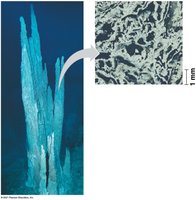
Organic compounds may have formed in deep-sea hydrothermal vents, where hot, mineral-rich water emerges from the Earth's crust.
Alkaline vents, with moderate temperatures and high pH, may have been more suitable for the formation of stable organic molecules.
Meteorites, such as the Murchison meteorite, have also delivered amino acids and other organic molecules to Earth.
Abiotic Synthesis of Macromolecules
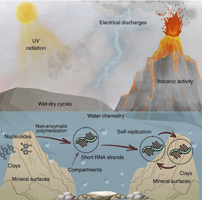
Laboratory experiments have shown that RNA nucleotides can spontaneously polymerize on hot sand, clay, or rock, supporting the "RNA world hypothesis." These polymers could have acted as weak catalysts, facilitating further chemical reactions.
Protocells: The First Life-Like Structures
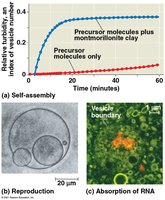
Protocells are membrane-bound droplets that maintain an internal chemistry distinct from their environment. They may have formed from vesicles composed of lipids and other organic molecules, with montmorillonite clay enhancing vesicle formation and the absorption of organic molecules.
Protocells could grow, reproduce, and maintain homeostasis.
Self-Replicating RNA and the Origin of Heredity
The first genetic material was likely RNA, which can act as both a template and a catalyst (ribozyme). Protocells containing self-replicating RNA could undergo natural selection, leading to the evolution of more complex life forms. Eventually, DNA replaced RNA as the primary genetic material due to its greater stability and accuracy in replication.
The Fossil Record and the History of Life
Formation and Types of Fossils
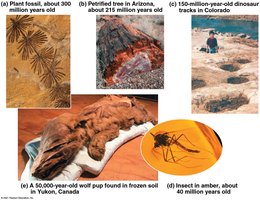
The fossil record is based on the accumulation of fossils in sedimentary rock layers (strata). Fossils can form through mineralization, preservation in amber, freezing, or as trace fossils (e.g., footprints).
The fossil record is incomplete and biased toward species that were abundant, widespread, and had hard parts.
Dating Rocks and Fossils
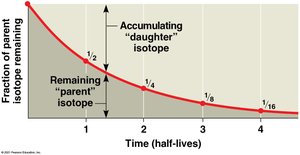
Relative dating uses the order of fossils in strata to determine their sequence, while radiometric dating measures the decay of radioactive isotopes to determine absolute ages. Each isotope has a characteristic half-life, such as 5,730 years for carbon-14 and 4.5 billion years for uranium-238.
Carbon-14 dating is useful for fossils up to 75,000 years old; older fossils are dated using isotopes in surrounding volcanic rock.
The Geologic Record
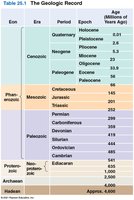
The geologic record divides Earth's history into four eons: Hadean, Archaean, Proterozoic, and Phanerozoic. The Phanerozoic eon is further divided into the Paleozoic, Mesozoic, and Cenozoic eras, each marked by major evolutionary events and mass extinctions.
Eon | Era | Period | Epoch | Age (Millions of Years |
|---|---|---|---|---|
Phanerozoic | Cenozoic | Quaternary | Holocene | 0.01 |
Phanerozoic | Cenozoic | Quaternary | Pleistocene | 2.6 |
Phanerozoic | Cenozoic | Neogene | Pliocene | 5.3 |
Phanerozoic | Cenozoic | Neogene | Miocene | 23 |
Phanerozoic | Cenozoic | Paleogene | Oligocene | 34 |
Phanerozoic | Cenozoic | Paleogene | Eocene | 56 |
Phanerozoic | Cenozoic | Paleogene | Paleocene | 66 |
Phanerozoic | Mesozoic | Cretaceous | 145 | |
Phanerozoic | Mesozoic | Jurassic | 201 | |
Phanerozoic | Mesozoic | Triassic | 252 | |
Phanerozoic | Paleozoic | Permian | 299 | |
Phanerozoic | Paleozoic | Carboniferous | 359 | |
Phanerozoic | Paleozoic | Devonian | 419 | |
Phanerozoic | Paleozoic | Silurian | 444 | |
Phanerozoic | Paleozoic | Ordovician | 485 | |
Phanerozoic | Paleozoic | Cambrian | 541 | |
Proterozoic | Ediacaran | 635 | ||
Archaean | 4,000 | |||
Hadean | 4,600 |
The Origin and Diversification of Major Groups
The Origin of Mammals: A Case Study
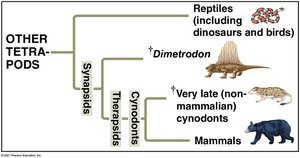
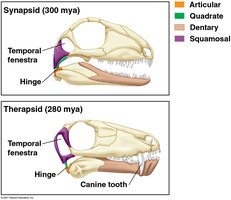
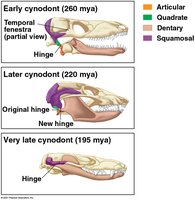
Mammals evolved gradually from synapsid tetrapods, with changes in jaw structure, teeth, and ear bones traceable in the fossil record. Early synapsids had multiple jaw bones and simple teeth, while later forms developed specialized teeth and jaw hinges. In mammals, some jaw bones evolved into the middle ear bones (malleus and incus).
The Origin of Unicellular and Multicellular Life
Major Eons and the Timeline of Life
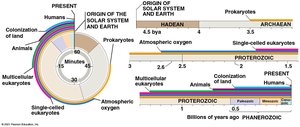
The geologic record is divided into eons, eras, periods, and epochs. The Phanerozoic eon includes the most recent 541 million years, encompassing the diversification of animals, plants, and fungi.
The First Single-Celled Organisms
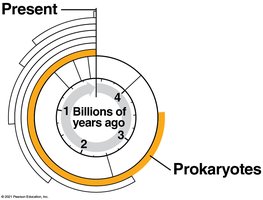
Stromatolites, layered rocks formed by prokaryotes, provide the earliest evidence of life (3.5 billion years ago). Prokaryotes dominated Earth's biosphere for over 1.5 billion years.
Photosynthesis and the Oxygen Revolution
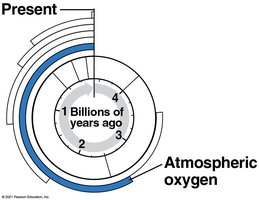
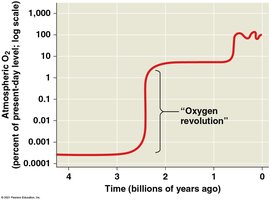
Photosynthetic prokaryotes began producing oxygen, which accumulated in the atmosphere about 2.7–2.4 billion years ago. This "oxygen revolution" caused the extinction of many anaerobic organisms and enabled the evolution of aerobic respiration.
The First Eukaryotes and Endosymbiosis
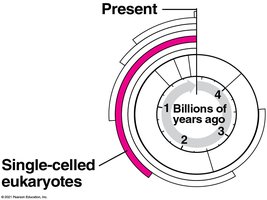
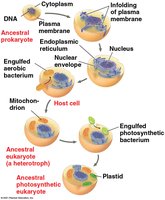
Eukaryotes, with nuclei and organelles, originated about 1.8 billion years ago. The endosymbiotic theory proposes that mitochondria and plastids originated as engulfed prokaryotes, which became permanent residents in host cells.
The Origin of Multicellularity
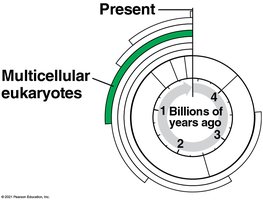
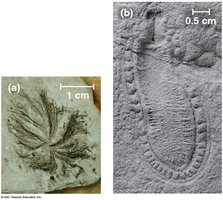
Multicellular eukaryotes evolved from unicellular ancestors, leading to the diversification of algae, plants, fungi, and animals. The oldest multicellular fossils are red algae from 1.2 billion years ago; the Ediacaran biota (600 million years ago) includes early multicellular animals and algae.
The Cambrian Explosion
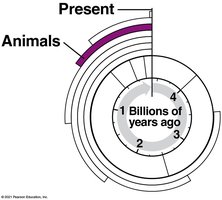
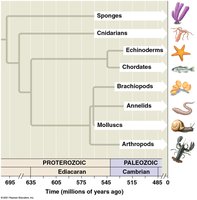
The Cambrian explosion (535–525 million years ago) marks the rapid appearance of most major animal phyla in the fossil record. This period saw the evolution of complex body plans, predation, and defensive adaptations.
The Colonization of Land
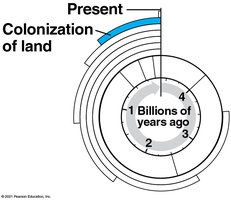
Life colonized land in several stages: prokaryotes (3.2 billion years ago), fungi, plants, and animals (about 500 million years ago). Adaptations such as waxy coatings and vascular systems in plants, and specialized limbs in animals, enabled survival on land.
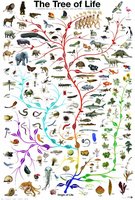
Large-Scale Processes Shaping Life's History
Plate Tectonics and Continental Drift
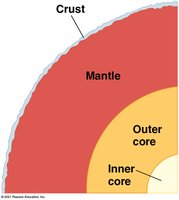
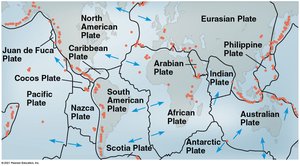
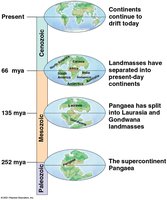
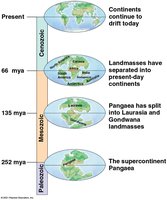
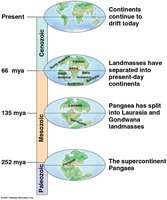
Earth's crust is divided into tectonic plates that move over the mantle, causing continents to drift. This movement has repeatedly formed and broken apart supercontinents, altering habitats and driving speciation and extinction.
Mass Extinctions
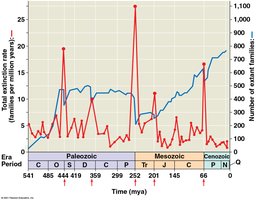
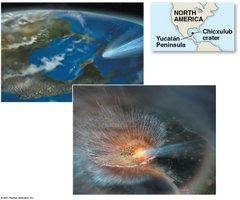
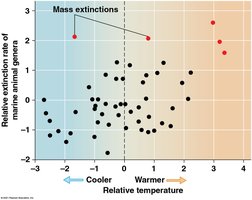
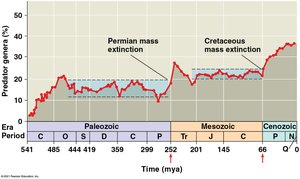
Mass extinctions are periods when large numbers of species become extinct worldwide due to disruptive global changes. Five major mass extinctions have occurred in the past 500 million years, including the Permian and Cretaceous events.
Adaptive Radiations
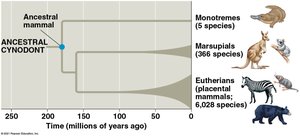
Adaptive radiation is the rapid evolution of many new species from a common ancestor, often following mass extinctions or the evolution of novel traits. Mammals, for example, diversified after the extinction of dinosaurs, filling ecological niches left vacant.
Genetic Mechanisms of Evolutionary Change
Changes in Developmental Genes
Evolutionary changes in the rate, timing, and spatial pattern of gene expression can lead to major changes in body form. Heterochrony refers to changes in the timing of developmental events, while homeotic genes (such as Hox genes) control the placement of body parts.
Mechanism | Description | Example |
|---|---|---|
Heterochrony | Change in rate/timing of development | Human vs. chimpanzee skull shape |
Homeotic genes | Control spatial arrangement of body parts | Hox gene changes in crustaceans/insects |
Evolutionary Trends and the Fossil Record
The fossil record can reveal evolutionary trends, such as the increase in body size and reduction in toe number in horses. However, trends do not imply a goal or direction; evolution is shaped by environmental interactions and can reverse or cease if conditions change.
