 Indietro
Chapter 26: Phylogeny, Systematics, and the Tree of Life
Guida di studio - Note intelligenti
 Appunti personalizzati basati sui tuoi materiali, ampliati con definizioni chiave, esempi e contesto.
Systematics and Phylogeny
Introduction to Systematics
Systematics is the scientific discipline focused on classifying organisms and determining their evolutionary relationships. Phylogeny refers to the evolutionary history of a species or group of species, often represented as a branching diagram called a phylogenetic tree.
Systematics uses data from fossils, morphology, genes, and biochemistry to infer evolutionary relationships.
Phylogenetic trees illustrate hypotheses about evolutionary relationships among groups of organisms.
The Linnaean Classification System
The Linnaean system organizes biological diversity into a hierarchy of taxa, from broad to specific categories.
Domain > Kingdom > Phylum > Class > Order > Family > Genus > Species
Each species is given a two-part scientific name (binomial nomenclature): Genus species.
Phylogenetic Trees and Cladistics
Reading and Building Phylogenetic Trees
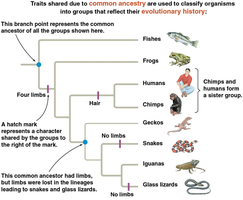
Phylogenetic trees are hypotheses about evolutionary relationships. They are constructed using shared characteristics, primarily homologous traits.
Branch points represent common ancestors.
Sister taxa are groups that share an immediate common ancestor.
Only homologous characters (traits inherited from a common ancestor) are used to infer phylogeny.
Homology vs. Analogy
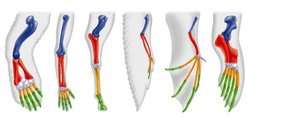
Understanding the difference between homologous and analogous structures is crucial for accurate phylogenetic inference.
Homology: Similarity due to shared ancestry (e.g., vertebrate forelimbs).
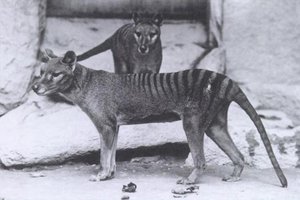
Analogy: Similarity due to convergent evolution, not common ancestry (e.g., wings of birds and bats).
Cladistics and Cladograms
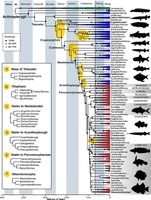
Cladistics is a method of classification based on common ancestry. A cladogram is a diagram that shows patterns of shared derived characteristics among taxa.
Clade: A group consisting of an ancestral species and all its descendants (monophyletic group).
Clades can be nested within larger clades.
Types of Groups in Phylogenetics
Monophyletic group: Includes an ancestor and all its descendants.
Paraphyletic group: Includes an ancestor and some, but not all, descendants.
Polyphyletic group: Includes distantly related species but not their most recent common ancestor.
Shared Ancestral vs. Shared Derived Characters
Characters used in cladistics are classified as either ancestral or derived:
Shared ancestral character: Originated in an ancestor of the group.
Shared derived character: An evolutionary novelty unique to a particular clade.
Outgroup: A species or group closely related to, but not part of, the group being studied (ingroup).
Constructing Phylogenies: Methods and Data
Morphological and Molecular Data
Phylogenies are inferred from both morphological traits and molecular data (DNA, RNA, proteins). Only homologous traits are informative for evolutionary relationships.
Maximum Parsimony and Maximum Likelihood
Maximum parsimony: The simplest explanation (fewest evolutionary changes) is preferred.
Maximum likelihood: Identifies the tree most likely to have produced the observed data, based on specific models of genetic change.
Gene Families and Genome Evolution
Gene Duplications
Gene duplication increases genetic material, allowing for evolutionary innovation. Repeated duplications create gene families—groups of related genes within a genome.
Orthologous vs. Paralogous Genes
Orthologous genes: Homology due to speciation; found in different species.
Paralogous genes: Homology due to gene duplication; found within the same species.
Genome Evolution
Lineages that diverged long ago often share many orthologous genes (e.g., humans and mice share 99% of their genes).
Gene number does not always correlate with organismal complexity.
Molecular Clocks
Concept and Application
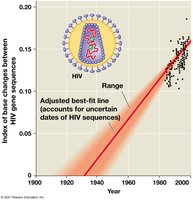
A molecular clock uses the rate of genetic mutations to estimate the timing of evolutionary events. It is calibrated using fossil data and known divergence times.
The number of nucleotide substitutions is proportional to the time since divergence for orthologous genes.
For paralogous genes, it is proportional to the time since gene duplication.
Limitations of Molecular Clocks
Some genes evolve at irregular rates.
Rates can vary among lineages and genes.
Not all evolutionary events are clock-like.
Classification of Life: Domains and Kingdoms
The Three-Domain System
Modern classification recognizes three domains of life:
Bacteria (Eubacteria)
Archaea
Eukarya (includes Protista, Fungi, Plantae, Animalia)
Five-Kingdom System (Historical)
Monera (prokaryotes)
Protista
Fungi
Plantae
Animalia
Summary Table: Key Terms in Phylogenetics
Term | Definition |
|---|---|
Homology | Similarity due to shared ancestry |
Analogy | Similarity due to convergent evolution |
Clade | Group of ancestor and all descendants |
Monophyletic | Clade with ancestor and all descendants |
Paraphyletic | Group with ancestor and some descendants |
Polyphyletic | Group with distantly related species, not common ancestor |
Orthologous genes | Homologous genes in different species |
Paralogous genes | Homologous genes within a species |
Molecular clock | Method to estimate evolutionary time using genetic data |
Additional info: This summary integrates textbook-level explanations and examples to clarify the concepts of phylogeny, systematics, and molecular evolution, as outlined in Chapter 26 of a General Biology course.
